 Add to Chrome
 Add to Firefox
 Add to Edge
PhyEdit: Towards Real-World Object Manipulation via Physically-Grounded Image Editing
Apr 09, 2026
Achieving physically accurate object manipulation in image editing is essential for its potential applications in interactive world models. However, existing visual generative models often fail at precise spatial manipulation, resulting in incorrect scaling and positioning of objects. This limitation primarily stems from the lack of explicit mechanisms to incorporate 3D geometry and perspective projection. To achieve accurate manipulation, we develop PhyEdit, an image editing framework that leverages explicit geometric simulation as contextual 3D-aware visual guidance. By combining this plug-and-play 3D prior with joint 2D--3D supervision, our method effectively improves physical accuracy and manipulation consistency. To support this method and evaluate performance, we present a real-world dataset, RealManip-10K, for 3D-aware object manipulation featuring paired images and depth annotations. We also propose ManipEval, a benchmark with multi-dimensional metrics to evaluate 3D spatial control and geometric consistency. Extensive experiments show that our approach outperforms existing methods, including strong closed-source models, in both 3D geometric accuracy and manipulation consistency.

Fast Density Estimation for Density-based Clustering Methods
Sep 23, 2021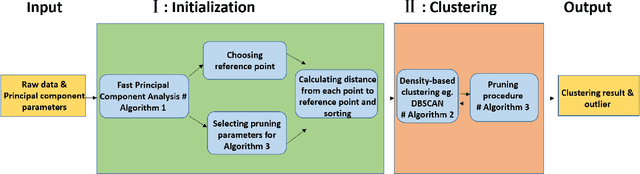
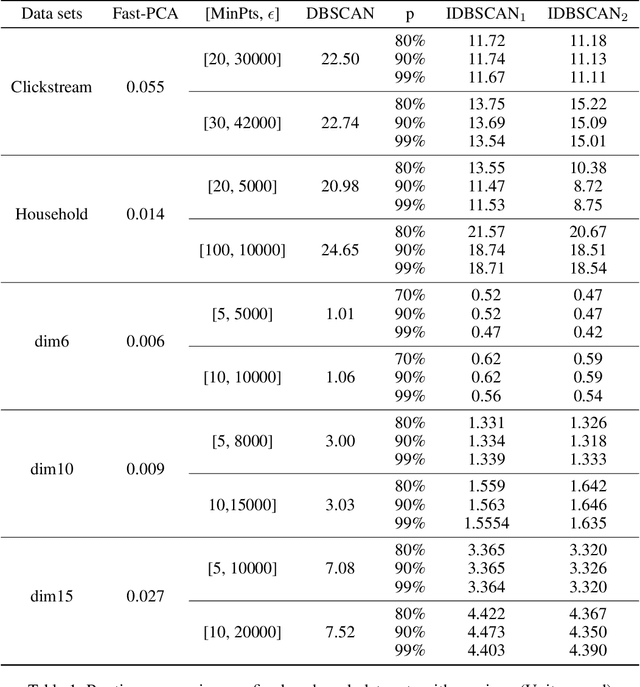

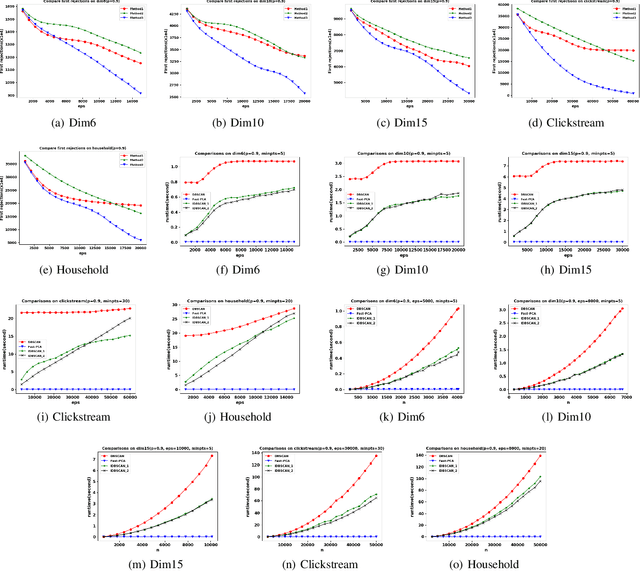
Density-based clustering algorithms are widely used for discovering clusters in pattern recognition and machine learning since they can deal with non-hyperspherical clusters and are robustness to handle outliers. However, the runtime of density-based algorithms is heavily dominated by finding neighbors and calculating the density of each point which is time-consuming. To address this issue, this paper proposes a density-based clustering framework by using the fast principal component analysis, which can be applied to density based methods to prune unnecessary distance calculations when finding neighbors and estimating densities. By applying this clustering framework to the Density Based Spatial Clustering of Applications with Noise (DBSCAN) algorithm, an improved DBSCAN (called IDBSCAN) is obtained, which preserves the advantage of DBSCAN and meanwhile, greatly reduces the computation of redundant distances. Experiments on five benchmark datasets demonstrate that the proposed IDBSCAN algorithm improves the computational efficiency significantly.