 Add to Chrome
 Add to Firefox
 Add to Edge
NumerosityVLM: A Cognitively Inspired Benchmark for Interpreting Numerosity Representations in Vision-Language Models
Aug 15, 2026
Vision-language models (VLMs) achieve strong performance on high-level multimodal tasks, yet numerosity perception, a cognitive ability that emerges in human infants before language acquisition, remains poorly understood in current models, as existing counting benchmarks entangle numerosity with correlated visual factors. We introduce a cognitively inspired diagnostic benchmark, NumerosityVLM, comprising 10,800 synthetic images across six controlled conditions. The benchmark orthogonally manipulates object size, spatial arrangement, and numerosity, while progressively ablating texture, shape, and color. Evaluating seven VLMs in a zero-shot setting, multi-factor analysis reveals that model architecture explains the largest proportion of performance variance (partial $ω^{2}=0.325$), far exceeding visual conditions. Layer-wise probing further shows that linearly separable numerosity signals consistently emerge at early stages of the vision encoder, while performance differences across evaluated models are primarily associated with the language model component. Code and data are publicly available at https://github.com/fuy3/NumerosityVLM-Benchmark, and https://huggingface.co/datasets/fuy3/NumerosityVLM.

Quantize More, Lose Less: Autoregressive Generation from Residually Quantized Speech Representations
Jul 16, 2025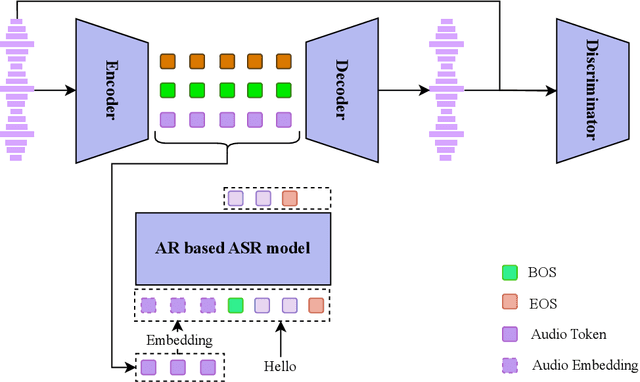
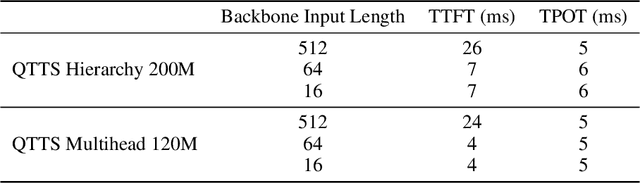
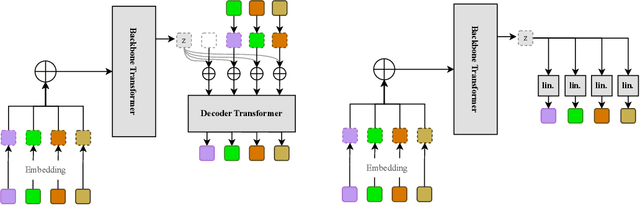
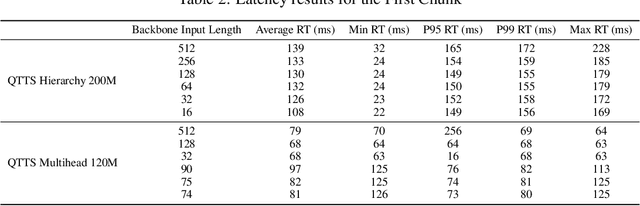
Text-to-speech (TTS) synthesis has seen renewed progress under the discrete modeling paradigm. Existing autoregressive approaches often rely on single-codebook representations, which suffer from significant information loss. Even with post-hoc refinement techniques such as flow matching, these methods fail to recover fine-grained details (e.g., prosodic nuances, speaker-specific timbres), especially in challenging scenarios like singing voice or music synthesis. We propose QTTS, a novel TTS framework built upon our new audio codec, QDAC. The core innovation of QDAC lies in its end-to-end training of an ASR-based auto-regressive network with a GAN, which achieves superior semantic feature disentanglement for scalable, near-lossless compression. QTTS models these discrete codes using two innovative strategies: the Hierarchical Parallel architecture, which uses a dual-AR structure to model inter-codebook dependencies for higher-quality synthesis, and the Delay Multihead approach, which employs parallelized prediction with a fixed delay to accelerate inference speed. Our experiments demonstrate that the proposed framework achieves higher synthesis quality and better preserves expressive content compared to baseline. This suggests that scaling up compression via multi-codebook modeling is a promising direction for high-fidelity, general-purpose speech and audio generation.