 Add to Chrome
 Add to Firefox
 Add to Edge
ProgramTab: Boosting Table Reasoning of LLMs via Programmatic Paradigm
Jul 13, 2026
Table-based reasoning with large language models (LLMs), which requires reasoning based on natural language questions and structured tabular data, has gained widespread attention. However, a series of issues still constrain the application of this task. The previous approaches suffered from significant performance degradation when faced with large tables due to the difficulty of long text modeling and the limitation of input length for LLMs. The text-to-SQL approach is used to efficiently extract key information from tables and generate smaller sub-tables. However, tabular data, especially web tables, often lack the necessary structure and consistency, making them unsuitable for performing mathematical logic operations using SQL queries. We propose the ProgramTab framework, which guides LLMs employing in-context learning to perform tabular data preprocessing with Python code, as well as the momentous contents extraction with row and column extraction and SQL generation. The experiment results on table reasoning datasets demonstrate that the ProgramTab framework effectively deals with table-based reasoning tasks and outperforms all LLM-based baselines.

PSM-SQL: Progressive Schema Learning with Multi-granularity Semantics for Text-to-SQL
Feb 07, 2025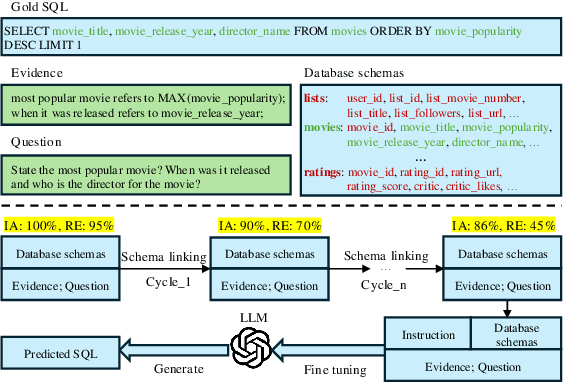
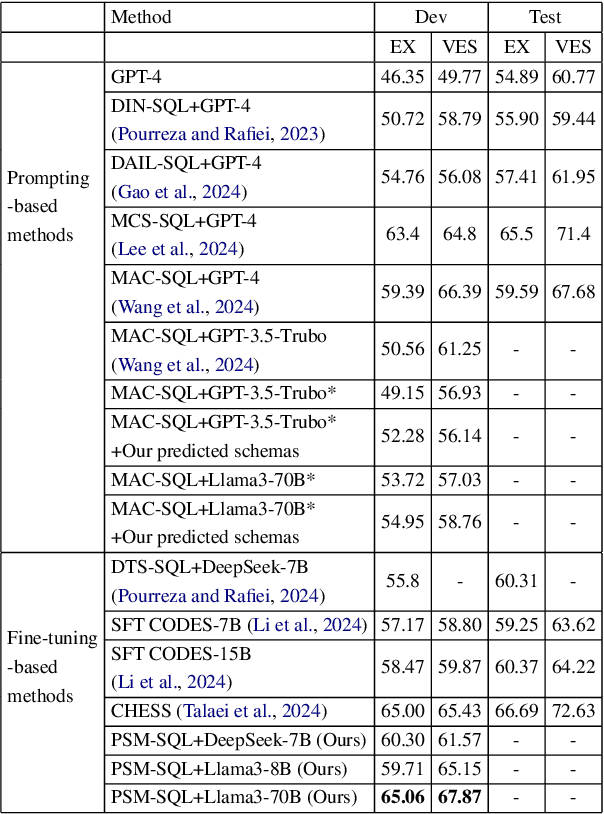
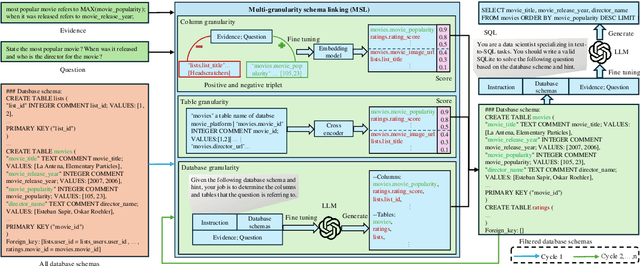
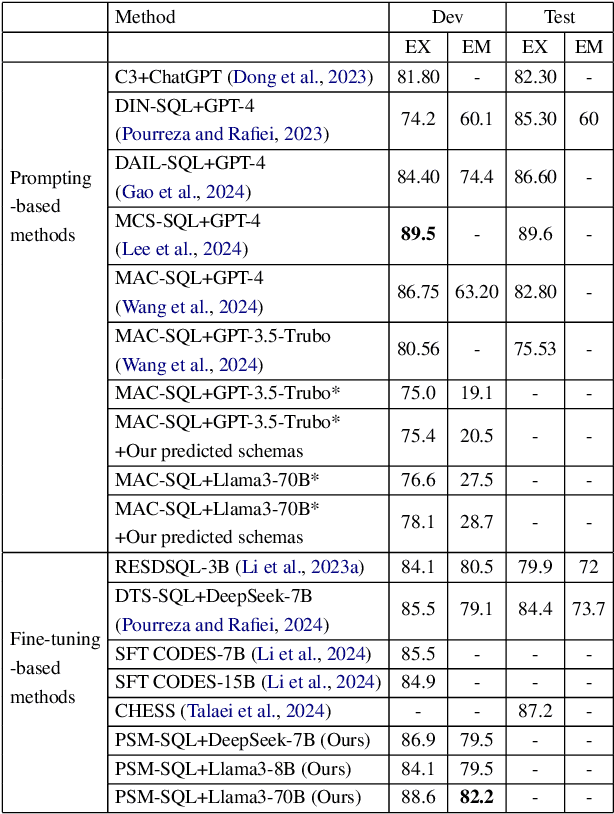
It is challenging to convert natural language (NL) questions into executable structured query language (SQL) queries for text-to-SQL tasks due to the vast number of database schemas with redundancy, which interferes with semantic learning, and the domain shift between NL and SQL. Existing works for schema linking focus on the table level and perform it once, ignoring the multi-granularity semantics and chainable cyclicity of schemas. In this paper, we propose a progressive schema linking with multi-granularity semantics (PSM-SQL) framework to reduce the redundant database schemas for text-to-SQL. Using the multi-granularity schema linking (MSL) module, PSM-SQL learns the schema semantics at the column, table, and database levels. More specifically, a triplet loss is used at the column level to learn embeddings, while fine-tuning LLMs is employed at the database level for schema reasoning. MSL employs classifier and similarity scores to model schema interactions for schema linking at the table level. In particular, PSM-SQL adopts a chain loop strategy to reduce the task difficulty of schema linking by continuously reducing the number of redundant schemas. Experiments conducted on text-to-SQL datasets show that the proposed PSM-SQL is 1-3 percentage points higher than the existing methods.
Solid-SQL: Enhanced Schema-linking based In-context Learning for Robust Text-to-SQL
Dec 17, 2024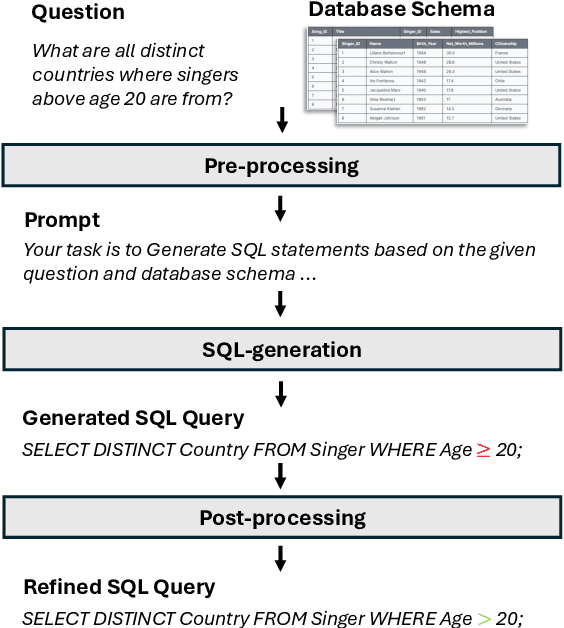
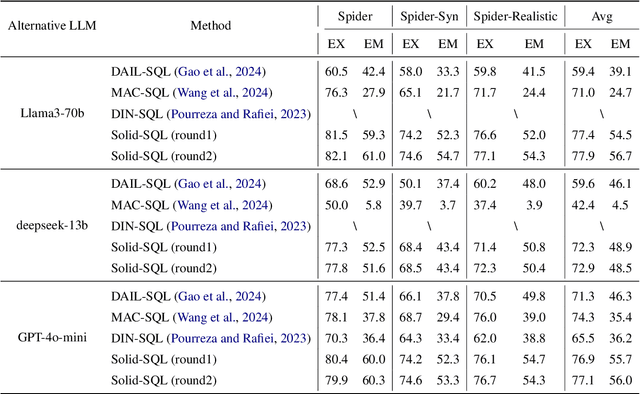
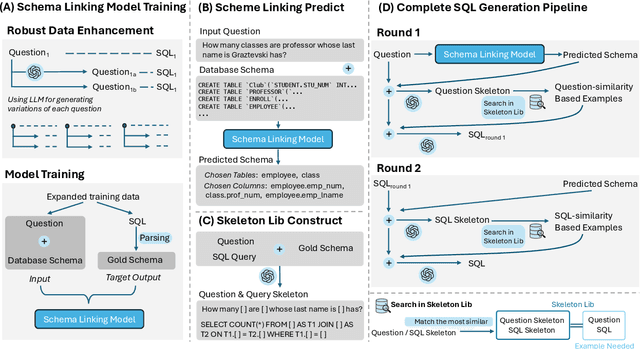
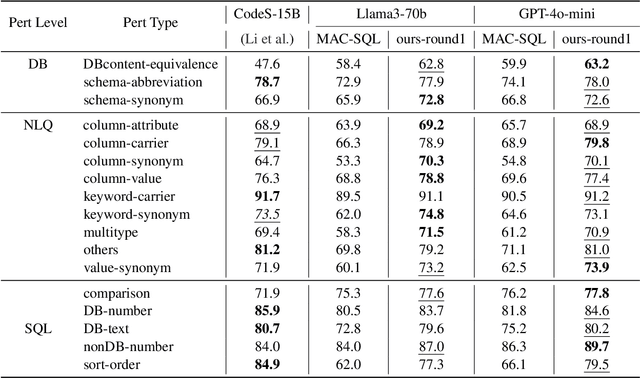
Recently, large language models (LLMs) have significantly improved the performance of text-to-SQL systems. Nevertheless, many state-of-the-art (SOTA) approaches have overlooked the critical aspect of system robustness. Our experiments reveal that while LLM-driven methods excel on standard datasets, their accuracy is notably compromised when faced with adversarial perturbations. To address this challenge, we propose a robust text-to-SQL solution, called Solid-SQL, designed to integrate with various LLMs. We focus on the pre-processing stage, training a robust schema-linking model enhanced by LLM-based data augmentation. Additionally, we design a two-round, structural similarity-based example retrieval strategy for in-context learning. Our method achieves SOTA SQL execution accuracy levels of 82.1% and 58.9% on the general Spider and Bird benchmarks, respectively. Furthermore, experimental results show that Solid-SQL delivers an average improvement of 11.6% compared to baselines on the perturbed Spider-Syn, Spider-Realistic, and Dr. Spider benchmarks.