 Add to Chrome
 Add to Firefox
 Add to Edge
MPC-Injection: Biasing Off-Policy Locomotion RL Toward Controller-Induced Behavior Basins
Jun 24, 2026
Reinforcement learning (RL) for locomotion frequently converges to locally optimal but undeployable behaviors, such as vibrating limbs or scooting on the torso, that maximize return without producing a usable gait. We present MPC-Injection, a low-overhead method that steers RL toward a designer-preferred gait by inserting transitions into the replay buffer from a model predictive controller solving the same Markov decision process. Unlike reward shaping, MPC-Injection does not require redesigning the task reward, and unlike adversarial imitation learning, it adds no discriminator, no kinematic retargeting, and no auxiliary objective. Instead, the controller's preferred behavior is transferred to the policy purely through the replay state distribution. On a 2D walker in simulation and with sim-to-real evaluation on a Go2 quadruped, we show that MPC-Injection drives the policy into the controller's behavior basin using a one to two-term task reward, producing gaits qualitatively comparable to those of reward shaping with twenty-one tuned terms and of adversarial motion priors without their discriminator and retargeting overhead. We further analyze how the injected transitions bias actor-critic updates toward controller-visited states, allowing the policy to learn behaviors that pure RL may fail to reach under simple reward functions.

ASCII Art Turns LLMs into VLA Controllers
Jun 19, 2026Vision--Language--Action (VLA) controllers are often built by extending vision--language models (VLMs) with action supervision, relying on multimodal backbones with large data and compute requirements. We demonstrate that a text-only large language model (LLM) can be adapted into a VLA-style controller when visual observations are rendered into a text input using an ASCII representation. This ASCII-as-vision interface enables existing training and deployment stacks for LLMs to efficiently condition on visual state, follow natural-language instructions, and produce constrained, executable actions. We fine-tune and compare multiple LLMs and VLMs across model families and scales, using both expert demonstrations from a planning-based teacher, as well as DAgger for iterative improvement. In a 2D manipulation benchmark, in both simulation and on a physical manipulator, the resulting controllers can identify task-relevant entities and plan feasible action sequences. Our results suggest that ASCII rendering can serve as a lightweight, interpretable modality bridge from images to text, complementing conventional VLA pipelines, and opening directions for VLA research with text-only backbones.
Sample-Based Output-Feedback Navigation with Bearing Measurements
Mar 08, 2022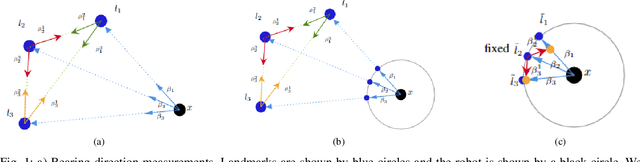
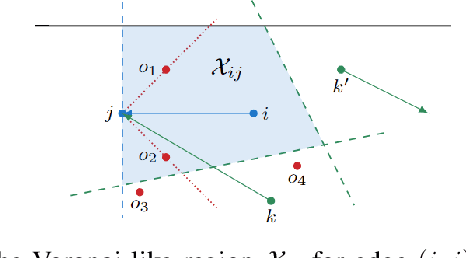
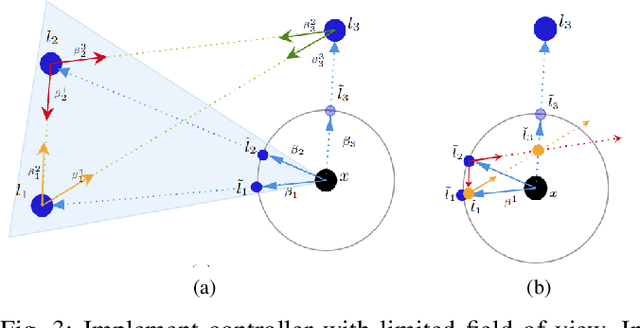
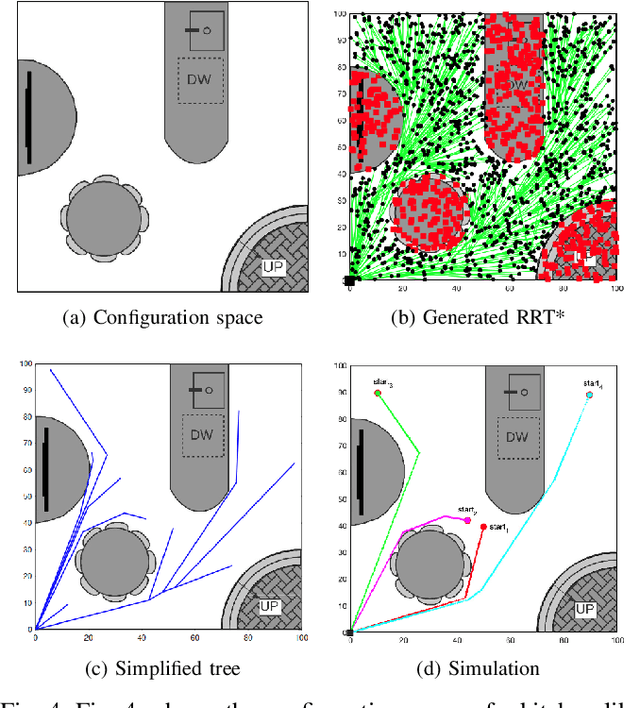
We consider the problem of sample-based feedback-based motion planning from bearing (direction-only) measurements. We build on our previous work that defines a cell decomposition of the environment using RRT*, and finds an output feedback controller to navigate through each cell toward a goal location using duality, Control Lyapunov and Barrier Functions (CLF, CBF), and Linear Programming. In this paper, we propose a novel strategy that uses relative bearing measurements with respect to a set of landmarks in the environment, as opposed to full relative displacements. The main advantage is then that the measurements can be obtained using a simple monocular camera. We test the proposed algorithm in the simulation, and then in an experimental environment to evaluate the performance of our approach with respect to practical issues such as mismatches in the dynamical model of the robot, and measurements acquired with a camera with a limited field of view.