 Add to Chrome
 Add to Firefox
 Add to Edge
Do You See What I Am Pointing At? Gesture-Based Egocentric Video Question Answering
Mar 13, 2026
Understanding and answering questions based on a user's pointing gesture is essential for next-generation egocentric AI assistants. However, current Multimodal Large Language Models (MLLMs) struggle with such tasks due to the lack of gesture-rich data and their limited ability to infer fine-grained pointing intent from egocentric video. To address this, we introduce EgoPointVQA, a dataset and benchmark for gesture-grounded egocentric question answering, comprising 4000 synthetic and 400 real-world videos across multiple deictic reasoning tasks. Built upon it, we further propose Hand Intent Tokens (HINT), which encodes tokens derived from 3D hand keypoints using an off-the-shelf reconstruction model and interleaves them with the model input to provide explicit spatial and temporal context for interpreting pointing intent. We show that our model outperforms others in different backbones and model sizes. In particular, HINT-14B achieves 68.1% accuracy, on average over 6 tasks, surpassing the state-of-the-art, InternVL3-14B, by 6.6%. To further facilitate the open research, we will release the code, model, and dataset. Project page: https://yuuraa.github.io/papers/choi2026egovqa

Test-Time Scaling with Diffusion Language Models via Reward-Guided Stitching
Feb 26, 2026Reasoning with large language models often benefits from generating multiple chains-of-thought, but existing aggregation strategies are typically trajectory-level (e.g., selecting the best trace or voting on the final answer), discarding useful intermediate work from partial or "nearly correct" attempts. We propose Stitching Noisy Diffusion Thoughts, a self-consistency framework that turns cheap diffusion-sampled reasoning into a reusable pool of step-level candidates. Given a problem, we (i) sample many diverse, low-cost reasoning trajectories using a masked diffusion language model, (ii) score every intermediate step with an off-the-shelf process reward model (PRM), and (iii) stitch these highest-quality steps across trajectories into a composite rationale. This rationale then conditions an autoregressive (AR) model (solver) to recompute only the final answer. This modular pipeline separates exploration (diffusion) from evaluation and solution synthesis, avoiding monolithic unified hybrids while preserving broad search. Across math reasoning benchmarks, we find that step-level recombination is most beneficial on harder problems, and ablations highlight the importance of the final AR solver in converting stitched but imperfect rationales into accurate answers. Using low-confidence diffusion sampling with parallel, independent rollouts, our training-free framework improves average accuracy by up to 23.8% across six math and coding tasks. At the same time, it achieves up to a 1.8x latency reduction relative to both traditional diffusion models (e.g., Dream, LLaDA) and unified architectures (e.g., TiDAR). Code is available at https://github.com/roymiles/diffusion-stitching.
A Benchmark for Deep Information Synthesis
Feb 24, 2026Large language model (LLM)-based agents are increasingly used to solve complex tasks involving tool use, such as web browsing, code execution, and data analysis. However, current evaluation benchmarks do not adequately assess their ability to solve real-world tasks that require synthesizing information from multiple sources and inferring insights beyond simple fact retrieval. To address this, we introduce DEEPSYNTH, a novel benchmark designed to evaluate agents on realistic, time-consuming problems that combine information gathering, synthesis, and structured reasoning to produce insights. DEEPSYNTH contains 120 tasks collected across 7 domains and data sources covering 67 countries. DEEPSYNTH is constructed using a multi-stage data collection pipeline that requires annotators to collect official data sources, create hypotheses, perform manual analysis, and design tasks with verifiable answers. When evaluated on DEEPSYNTH, 11 state-of-the-art LLMs and deep research agents achieve a maximum F1 score of 8.97 and 17.5 on the LLM-judge metric, underscoring the difficulty of the benchmark. Our analysis reveals that current agents struggle with hallucinations and reasoning over large information spaces, highlighting DEEPSYNTH as a crucial benchmark for guiding future research.
SATGround: A Spatially-Aware Approach for Visual Grounding in Remote Sensing
Dec 09, 2025Vision-language models (VLMs) are emerging as powerful generalist tools for remote sensing, capable of integrating information across diverse tasks and enabling flexible, instruction-based interactions via a chat interface. In this work, we enhance VLM-based visual grounding in satellite imagery by proposing a novel structured localization mechanism. Our approach involves finetuning a pretrained VLM on a diverse set of instruction-following tasks, while interfacing a dedicated grounding module through specialized control tokens for localization. This method facilitates joint reasoning over both language and spatial information, significantly enhancing the model's ability to precisely localize objects in complex satellite scenes. We evaluate our framework on several remote sensing benchmarks, consistently improving the state-of-the-art, including a 24.8% relative improvement over previous methods on visual grounding. Our results highlight the benefits of integrating structured spatial reasoning into VLMs, paving the way for more reliable real-world satellite data analysis.
RetouchLLM: Training-free White-box Image Retouching
Oct 09, 2025Image retouching not only enhances visual quality but also serves as a means of expressing personal preferences and emotions. However, existing learning-based approaches require large-scale paired data and operate as black boxes, making the retouching process opaque and limiting their adaptability to handle diverse, user- or image-specific adjustments. In this work, we propose RetouchLLM, a training-free white-box image retouching system, which requires no training data and performs interpretable, code-based retouching directly on high-resolution images. Our framework progressively enhances the image in a manner similar to how humans perform multi-step retouching, allowing exploration of diverse adjustment paths. It comprises of two main modules: a visual critic that identifies differences between the input and reference images, and a code generator that produces executable codes. Experiments demonstrate that our approach generalizes well across diverse retouching styles, while natural language-based user interaction enables interpretable and controllable adjustments tailored to user intent.
Region-based Cluster Discrimination for Visual Representation Learning
Jul 26, 2025Learning visual representations is foundational for a broad spectrum of downstream tasks. Although recent vision-language contrastive models, such as CLIP and SigLIP, have achieved impressive zero-shot performance via large-scale vision-language alignment, their reliance on global representations constrains their effectiveness for dense prediction tasks, such as grounding, OCR, and segmentation. To address this gap, we introduce Region-Aware Cluster Discrimination (RICE), a novel method that enhances region-level visual and OCR capabilities. We first construct a billion-scale candidate region dataset and propose a Region Transformer layer to extract rich regional semantics. We further design a unified region cluster discrimination loss that jointly supports object and OCR learning within a single classification framework, enabling efficient and scalable distributed training on large-scale data. Extensive experiments show that RICE consistently outperforms previous methods on tasks, including segmentation, dense detection, and visual perception for Multimodal Large Language Models (MLLMs). The pre-trained models have been released at https://github.com/deepglint/MVT.
VeLoRA: Memory Efficient Training using Rank-1 Sub-Token Projections
May 28, 2024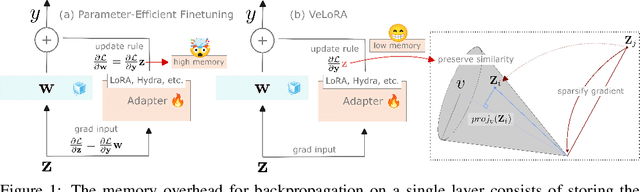
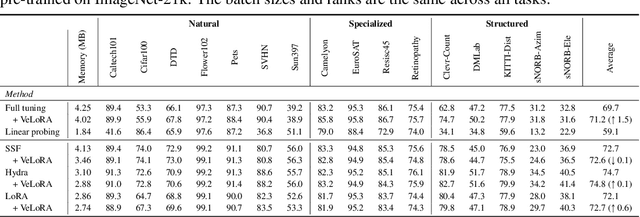
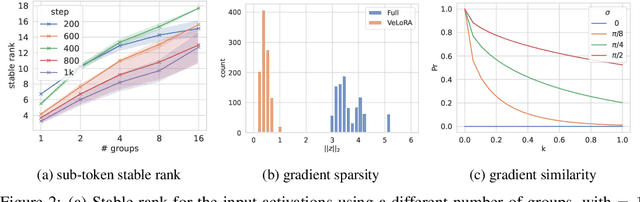

Large language models (LLMs) have recently emerged as powerful tools for tackling many language-processing tasks. Despite their success, training and fine-tuning these models is still far too computationally and memory intensive. In this paper, we identify and characterise the important components needed for effective model convergence using gradient descent. In doing so we find that the intermediate activations used to implement backpropagation can be excessively compressed without incurring any degradation in performance. This result leads us to a cheap and memory-efficient algorithm for both fine-tuning and pre-training LLMs. The proposed algorithm simply divides the tokens up into smaller sub-tokens before projecting them onto a fixed 1-dimensional subspace during the forward pass. These features are then coarsely reconstructed during the backward pass to implement the update rules. We confirm the effectiveness of our algorithm as being complimentary to many state-of-the-art PEFT methods on the VTAB-1k fine-tuning benchmark. Furthermore, we outperform QLoRA for fine-tuning LLaMA and show competitive performance against other memory-efficient pre-training methods on the large-scale C4 dataset.
Learning to Project for Cross-Task Knowledge Distillation
Mar 21, 2024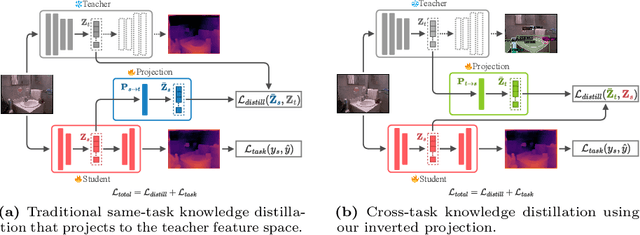
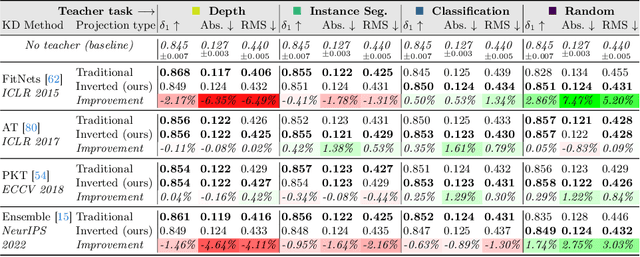
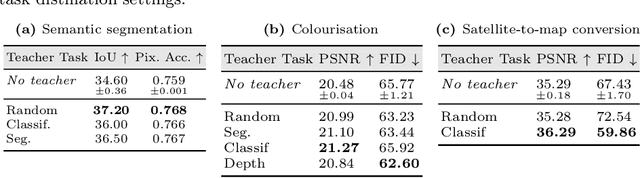
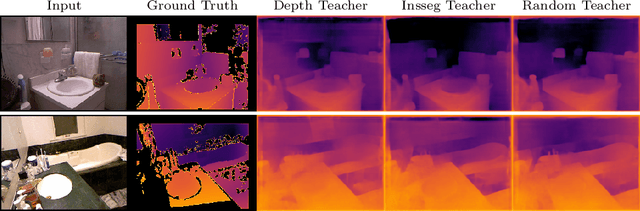
Traditional knowledge distillation (KD) relies on a proficient teacher trained on the target task, which is not always available. In this setting, cross-task distillation can be used, enabling the use of any teacher model trained on a different task. However, many KD methods prove ineffective when applied to this cross-task setting. To address this limitation, we propose a simple modification: the use of an inverted projection. We show that this drop-in replacement for a standard projector is effective by learning to disregard any task-specific features which might degrade the student's performance. We find that this simple modification is sufficient for extending many KD methods to the cross-task setting, where the teacher and student tasks can be very different. In doing so, we obtain up to a 1.9% improvement in the cross-task setting compared to the traditional projection, at no additional cost. Our method can obtain significant performance improvements (up to 7%) when using even a randomly-initialised teacher on various tasks such as depth estimation, image translation, and semantic segmentation, despite the lack of any learned knowledge to transfer. To provide conceptual and analytical insights into this result, we show that using an inverted projection allows the distillation loss to be decomposed into a knowledge transfer and a spectral regularisation component. Through this analysis we are additionally able to propose a novel regularisation loss that allows teacher-free distillation, enabling performance improvements of up to 8.57% on ImageNet with no additional training costs.
$V_kD:$ Improving Knowledge Distillation using Orthogonal Projections
Mar 10, 2024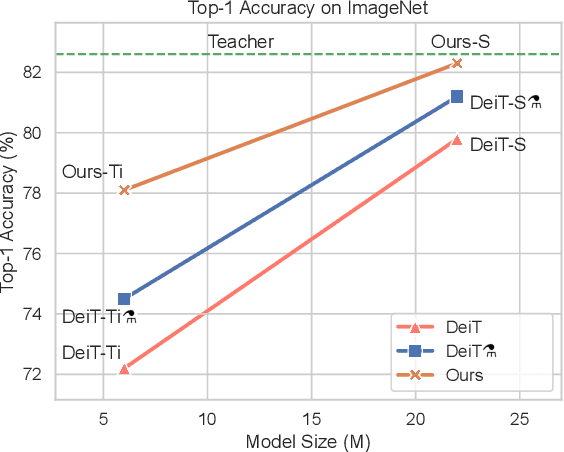
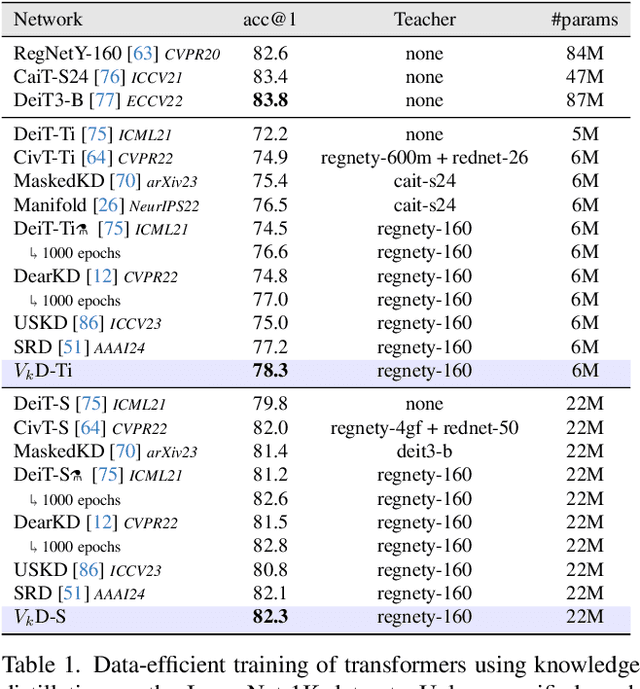
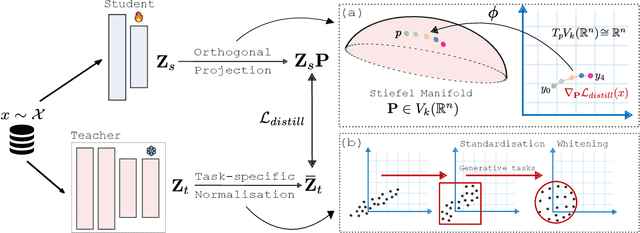
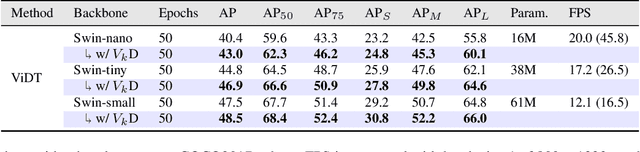
Knowledge distillation is an effective method for training small and efficient deep learning models. However, the efficacy of a single method can degenerate when transferring to other tasks, modalities, or even other architectures. To address this limitation, we propose a novel constrained feature distillation method. This method is derived from a small set of core principles, which results in two emerging components: an orthogonal projection and a task-specific normalisation. Equipped with both of these components, our transformer models can outperform all previous methods on ImageNet and reach up to a 4.4% relative improvement over the previous state-of-the-art methods. To further demonstrate the generality of our method, we apply it to object detection and image generation, whereby we obtain consistent and substantial performance improvements over state-of-the-art. Code and models are publicly available: https://github.com/roymiles/vkd
A closer look at the training dynamics of knowledge distillation
Mar 20, 2023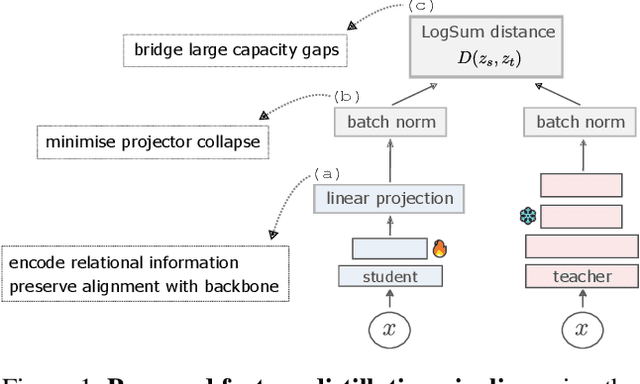
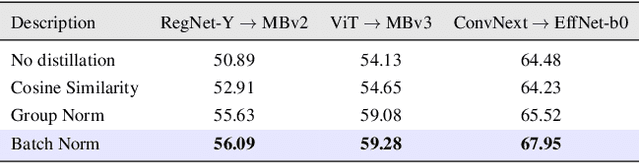
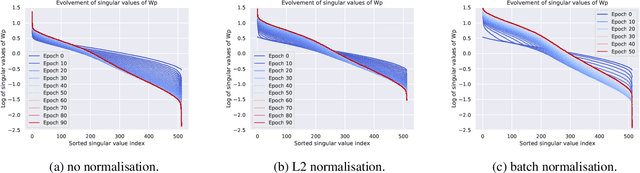

In this paper we revisit the efficacy of knowledge distillation as a function matching and metric learning problem. In doing so we verify three important design decisions, namely the normalisation, soft maximum function, and projection layers as key ingredients. We theoretically show that the projector implicitly encodes information on past examples, enabling relational gradients for the student. We then show that the normalisation of representations is tightly coupled with the training dynamics of this projector, which can have a large impact on the students performance. Finally, we show that a simple soft maximum function can be used to address any significant capacity gap problems. Experimental results on various benchmark datasets demonstrate that using these insights can lead to superior or comparable performance to state-of-the-art knowledge distillation techniques, despite being much more computationally efficient. In particular, we obtain these results across image classification (CIFAR100 and ImageNet), object detection (COCO2017), and on more difficult distillation objectives, such as training data efficient transformers, whereby we attain a 77.2% top-1 accuracy with DeiT-Ti on ImageNet.