 Add to Chrome
 Add to Firefox
 Add to Edge
Policies Permitting LLM Use for Polishing Peer Reviews Are Currently Not Enforceable
Mar 20, 2026
A number of scientific conferences and journals have recently enacted policies that prohibit LLM usage by peer reviewers, except for polishing, paraphrasing, and grammar correction of otherwise human-written reviews. But, are these policies enforceable? To answer this question, we assemble a dataset of peer reviews simulating multiple levels of human-AI collaboration, and evaluate five state-of-the-art detectors, including two commercial systems. Our analysis shows that all detectors misclassify a non-trivial fraction of LLM-polished reviews as AI-generated, thereby risking false accusations of academic misconduct. We further investigate whether peer-review-specific signals, including access to the paper manuscript and the constrained domain of scientific writing, can be leveraged to improve detection. While incorporating such signals yields measurable gains in some settings, we identify limitations in each approach and find that none meets the accuracy standards required for identifying AI use in peer reviews. Importantly, our results suggest that recent public estimates of AI use in peer reviews through the use of AI-text detectors should be interpreted with caution, as current detectors misclassify mixed reviews (collaborative human-AI outputs) as fully AI generated, potentially overstating the extent of policy violations.

Leveraging the Power of LLMs: A Fine-Tuning Approach for High-Quality Aspect-Based Summarization
Aug 05, 2024


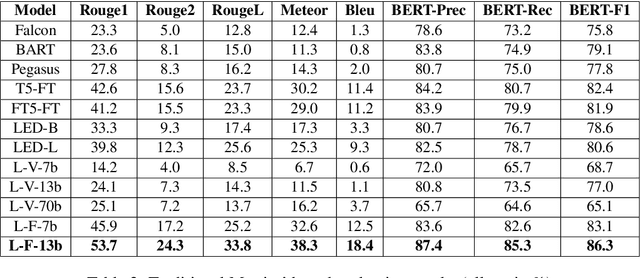
The ever-increasing volume of digital information necessitates efficient methods for users to extract key insights from lengthy documents. Aspect-based summarization offers a targeted approach, generating summaries focused on specific aspects within a document. Despite advancements in aspect-based summarization research, there is a continuous quest for improved model performance. Given that large language models (LLMs) have demonstrated the potential to revolutionize diverse tasks within natural language processing, particularly in the problem of summarization, this paper explores the potential of fine-tuning LLMs for the aspect-based summarization task. We evaluate the impact of fine-tuning open-source foundation LLMs, including Llama2, Mistral, Gemma and Aya, on a publicly available domain-specific aspect based summary dataset. We hypothesize that this approach will enable these models to effectively identify and extract aspect-related information, leading to superior quality aspect-based summaries compared to the state-of-the-art. We establish a comprehensive evaluation framework to compare the performance of fine-tuned LLMs against competing aspect-based summarization methods and vanilla counterparts of the fine-tuned LLMs. Our work contributes to the field of aspect-based summarization by demonstrating the efficacy of fine-tuning LLMs for generating high-quality aspect-based summaries. Furthermore, it opens doors for further exploration of using LLMs for targeted information extraction tasks across various NLP domains.
On The Persona-based Summarization of Domain-Specific Documents
Jun 06, 2024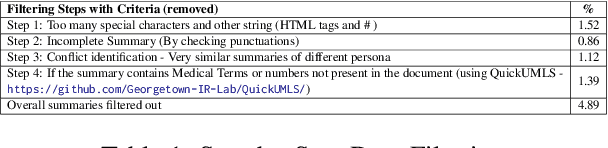
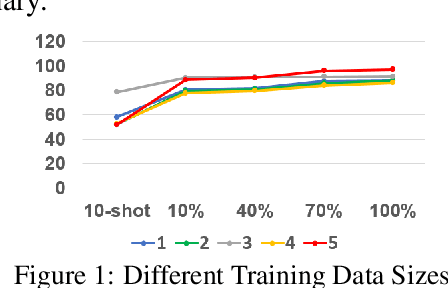
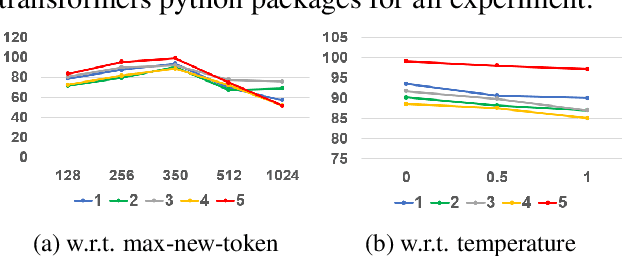
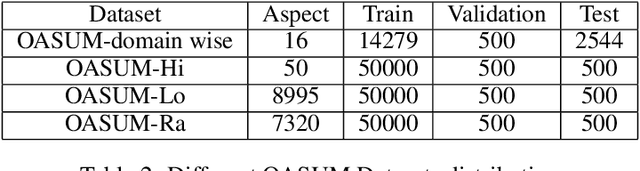
In an ever-expanding world of domain-specific knowledge, the increasing complexity of consuming, and storing information necessitates the generation of summaries from large information repositories. However, every persona of a domain has different requirements of information and hence their summarization. For example, in the healthcare domain, a persona-based (such as Doctor, Nurse, Patient etc.) approach is imperative to deliver targeted medical information efficiently. Persona-based summarization of domain-specific information by humans is a high cognitive load task and is generally not preferred. The summaries generated by two different humans have high variability and do not scale in cost and subject matter expertise as domains and personas grow. Further, AI-generated summaries using generic Large Language Models (LLMs) may not necessarily offer satisfactory accuracy for different domains unless they have been specifically trained on domain-specific data and can also be very expensive to use in day-to-day operations. Our contribution in this paper is two-fold: 1) We present an approach to efficiently fine-tune a domain-specific small foundation LLM using a healthcare corpus and also show that we can effectively evaluate the summarization quality using AI-based critiquing. 2) We further show that AI-based critiquing has good concordance with Human-based critiquing of the summaries. Hence, such AI-based pipelines to generate domain-specific persona-based summaries can be easily scaled to other domains such as legal, enterprise documents, education etc. in a very efficient and cost-effective manner.