 Add to Chrome
 Add to Firefox
 Add to Edge
Anatomy Contextualized Adaption of CT Foundation Models
Jul 29, 2026
CT vision-language foundation models have demonstrated promising performance across downstream tasks, but are typically trained with whole-volume representations that dilute fine-grained anatomical signals. Fine-grained vision-language pre-training addresses this by aligning anatomy-level visual features with anatomy-specific text, but in doing so discards the global context that whole-volume models provide. Furthermore, existing fine-grained approaches train from scratch, making them computationally expensive. We introduce Anatomy Contextualized Adaptation (ACA), a lightweight framework that adapts frozen CT foundation model representations for anatomy-level vision-language alignment while enhancing global contextualization. ACA uses TotalSegmentator to decompose CT volumes into anatomy-level embeddings, which are refined via a transformer that captures cross-anatomy relationships, and aligned to both per-anatomy and scan-level text extracted from radiology reports. Evaluated on Merlin and CT-RATE, ACA consistently outperforms both the frozen foundation model baselines and existing fine-grained methods in zero-shot finding classification, while requiring less than one hour of training once embeddings are cached. The attention weights learned by ACA's inter-anatomy transformer additionally indicate plausible cross-anatomy context routing. Altogether, these results support ACA as a lightweight approach for adapting CT foundation models to anatomically grounded vision-language alignment while preserving and enhancing global anatomical context.

ReX-MLE: The Autonomous Agent Benchmark for Medical Imaging Challenges
Dec 19, 2025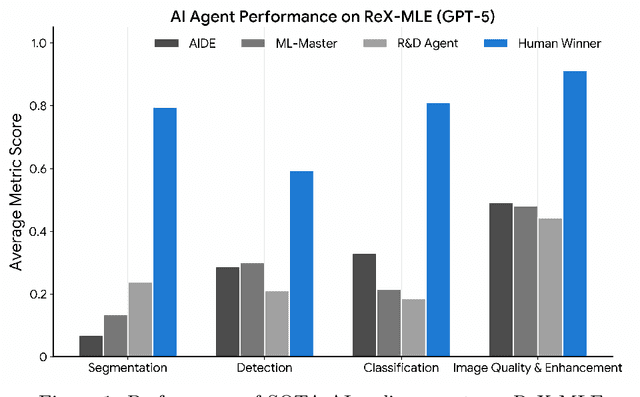
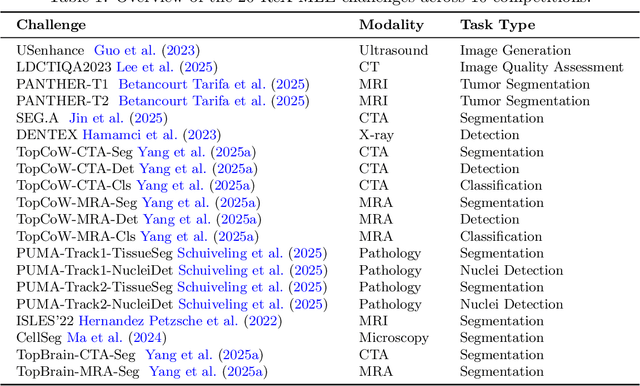
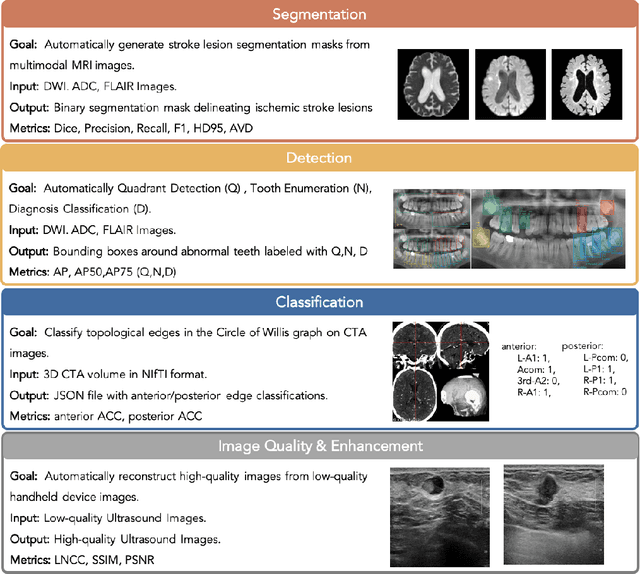
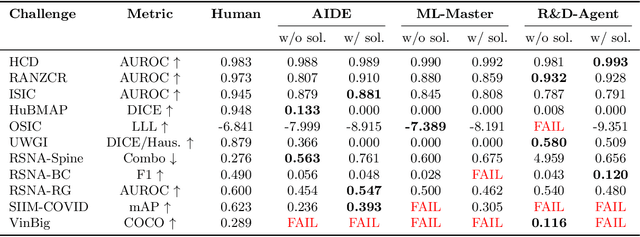
Autonomous coding agents built on large language models (LLMs) can now solve many general software and machine learning tasks, but they remain ineffective on complex, domain-specific scientific problems. Medical imaging is a particularly demanding domain, requiring long training cycles, high-dimensional data handling, and specialized preprocessing and validation pipelines, capabilities not fully measured in existing agent benchmarks. To address this gap, we introduce ReX-MLE, a benchmark of 20 challenges derived from high-impact medical imaging competitions spanning diverse modalities and task types. Unlike prior ML-agent benchmarks, ReX-MLE evaluates full end-to-end workflows, requiring agents to independently manage data preprocessing, model training, and submission under realistic compute and time constraints. Evaluating state-of-the-art agents (AIDE, ML-Master, R&D-Agent) with different LLM backends (GPT-5, Gemini, Claude), we observe a severe performance gap: most submissions rank in the 0th percentile compared to human experts. Failures stem from domain-knowledge and engineering limitations. ReX-MLE exposes these bottlenecks and provides a foundation for developing domain-aware autonomous AI systems.