 Add to Chrome
 Add to Firefox
 Add to Edge
Engineering Regression Without Real-Data Training: Domain Adaptation for Tabular Foundation Models Using Multi-Dataset Embeddings
Mar 05, 2026
Predictive modeling in engineering applications has long been dominated by bespoke models and small, siloed tabular datasets, limiting the applicability of large-scale learning approaches. Despite recent progress in tabular foundation models, the resulting synthetic training distributions used for pre-training may not reflect the statistical structure of engineering data, limiting transfer to engineering regression. We introduce TREDBench, a curated collection of 83 real-world tabular regression datasets with expert engineering/non-engineering labels, and use TabPFN 2.5's dataset-level embedding to study domain structure in a common representation space. We find that engineering datasets are partially distinguishable from non-engineering datasets, while standard procedurally generated datasets are highly distinguishable from engineering datasets, revealing a substantial synthetic-real domain gap. To bridge this gap without training on real engineering samples, we propose an embedding-guided synthetic data curation method: we generate and identify "engineering-like" synthetic datasets, and perform continued pre-training of TabPFN 2.5 using only the selected synthetic tasks. Across 35 engineering regression datasets, this synthetic-only adaptation improves predictive accuracy and data efficiency, outperforming TabPFN 2.5 on 29/35 datasets and AutoGluon on 27/35, with mean multiplicative data-efficiency gains of 1.75x and 4.44x, respectively. More broadly, our results indicate that principled synthetic data curation can convert procedural generators into domain-relevant "data engines," enabling foundation models to improve in data-sparse scientific and industrial domains where real data collection is the primary bottleneck.

TabPFN-2.5: Advancing the State of the Art in Tabular Foundation Models
Nov 11, 2025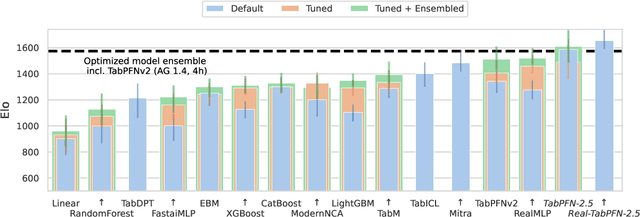
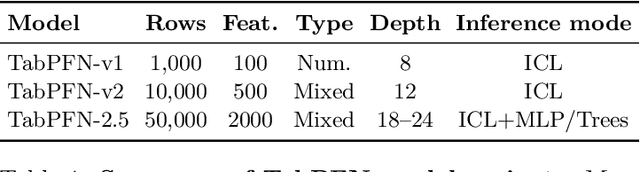
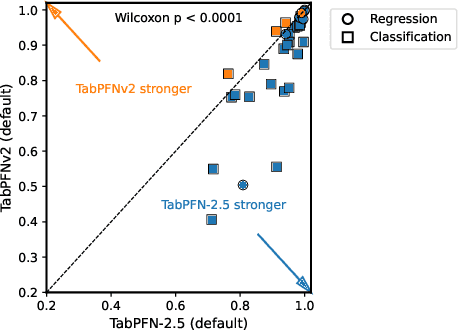
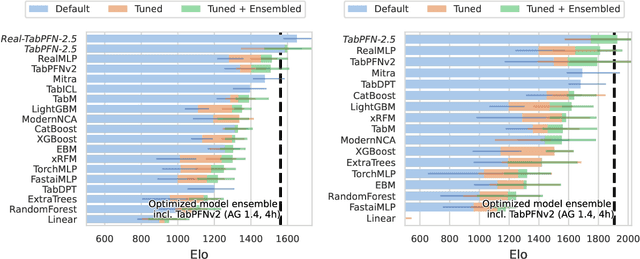
The first tabular foundation model, TabPFN, and its successor TabPFNv2 have impacted tabular AI substantially, with dozens of methods building on it and hundreds of applications across different use cases. This report introduces TabPFN-2.5, the next generation of our tabular foundation model, built for datasets with up to 50,000 data points and 2,000 features, a 20x increase in data cells compared to TabPFNv2. TabPFN-2.5 is now the leading method for the industry standard benchmark TabArena (which contains datasets with up to 100,000 training data points), substantially outperforming tuned tree-based models and matching the accuracy of AutoGluon 1.4, a complex four-hour tuned ensemble that even includes the previous TabPFNv2. Remarkably, default TabPFN-2.5 has a 100% win rate against default XGBoost on small to medium-sized classification datasets (<=10,000 data points, 500 features) and a 87% win rate on larger datasets up to 100K samples and 2K features (85% for regression). For production use cases, we introduce a new distillation engine that converts TabPFN-2.5 into a compact MLP or tree ensemble, preserving most of its accuracy while delivering orders-of-magnitude lower latency and plug-and-play deployment. This new release will immediately strengthen the performance of the many applications and methods already built on the TabPFN ecosystem.