 Add to Chrome
 Add to Firefox
 Add to Edge
Navigating the Conceptual Multiverse
Apr 21, 2026
When language models answer open-ended problems, they implicitly make hidden decisions that shape their outputs, leaving users with uncontextualized answers rather than a working map of the problem; drawing on multiverse analysis from statistics, we build and evaluate the conceptual multiverse, an interactive system that represents conceptual decisions such as how to frame a question or what to value as a space users can transparently inspect, intervenably change, and check against principled domain reasoning; for this structure to be worth navigating rather than misleading, it must be rigorous and checkable against domain reasoning norms, so we develop a general verification framework that enforces properties of good decision structures like unambiguity and completeness calibrated by expert-level reasoning; across three domains, the conceptual multiverse helped participants develop a working map of the problem, with philosophy students rewriting essays with sharper framings and reversed theses, alignment annotators moving from surface preferences to reasoning about user intent and harm, and poets identifying compositional patterns that clarified their taste.

Language Models as Critical Thinking Tools: A Case Study of Philosophers
Apr 06, 2024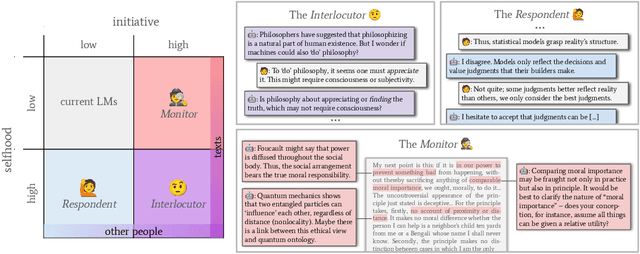
Current work in language models (LMs) helps us speed up or even skip thinking by accelerating and automating cognitive work. But can LMs help us with critical thinking -- thinking in deeper, more reflective ways which challenge assumptions, clarify ideas, and engineer new concepts? We treat philosophy as a case study in critical thinking, and interview 21 professional philosophers about how they engage in critical thinking and on their experiences with LMs. We find that philosophers do not find LMs to be useful because they lack a sense of selfhood (memory, beliefs, consistency) and initiative (curiosity, proactivity). We propose the selfhood-initiative model for critical thinking tools to characterize this gap. Using the model, we formulate three roles LMs could play as critical thinking tools: the Interlocutor, the Monitor, and the Respondent. We hope that our work inspires LM researchers to further develop LMs as critical thinking tools and philosophers and other 'critical thinkers' to imagine intellectually substantive uses of LMs.