 Add to Chrome
 Add to Firefox
 Add to Edge
Linguistic Firewall: Geometry as Defense in Multi-Agent Systems Routing
Jun 29, 2026
The rapid integration of Large Language Models (LLMs) has driven the evolution of Multi-Agent Systems (MAS), where specialized agents collaborate to execute complex workflows. Effective orchestration in these environments requires robust routing mechanisms to efficiently allocate tasks to the most suitable agent. However, existing routers fundamentally rely on unverified proxies, ranging from textual self-descriptions to static surrogate representations, to gauge an agent's competence. This reliance on non-empirical data creates a critical gap between an agent's projected profile and its actual operational capabilities, introducing severe security vulnerabilities. Malicious agents can easily misrepresent their proficiencies or harbor covert backdoors that evade both standard external analysis and static representation-learning techniques. In this work, we introduce ANTAP (Automatic Non-Textual Agent Picker), an evaluation-driven routing architecture that discards indirect proxies in favor of active capability testing. By dynamically querying agents to ascertain their true competencies empirically, ANTAP distills performance into fixed behavioral operators within a shared semantic space. At inference time, routing is performed via a purely non-textual algebraic projection, establishing a "linguistic firewall" that renders metadata-based attacks inexpressible. In our experiments, ANTAP achieves near-zero ASR against description-based injection attacks, compared to 67.3\% and above for the description-based router baseline. Against adaptive embedding attacks, ANTAP achieves substantially lower ASR than the embedding-based baseline, with a 20\% reduction, while remaining resilient to description manipulation by design.

Step-Wise Refusal Dynamics in Autoregressive and Diffusion Language Models
Feb 01, 2026Diffusion language models (DLMs) have recently emerged as a promising alternative to autoregressive (AR) models, offering parallel decoding and controllable sampling dynamics while achieving competitive generation quality at scale. Despite this progress, the role of sampling mechanisms in shaping refusal behavior and jailbreak robustness remains poorly understood. In this work, we present a fundamental analytical framework for step-wise refusal dynamics, enabling comparison between AR and diffusion sampling. Our analysis reveals that the sampling strategy itself plays a central role in safety behavior, as a factor distinct from the underlying learned representations. Motivated by this analysis, we introduce the Step-Wise Refusal Internal Dynamics (SRI) signal, which supports interpretability and improved safety for both AR and DLMs. We demonstrate that the geometric structure of SRI captures internal recovery dynamics, and identifies anomalous behavior in harmful generations as cases of \emph{incomplete internal recovery} that are not observable at the text level. This structure enables lightweight inference-time detectors that generalize to unseen attacks while matching or outperforming existing defenses with over $100\times$ lower inference overhead.
You Had One Job: Per-Task Quantization Using LLMs' Hidden Representations
Nov 09, 2025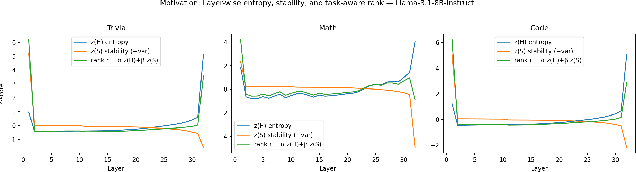
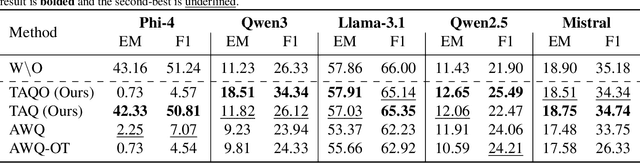
Large Language Models (LLMs) excel across diverse tasks, yet many applications require only limited capabilities, making large variants inefficient in memory and latency. Existing approaches often combine distillation and quantization, but most post-training quantization (PTQ) methods are task-agnostic, ignoring how task-specific signals are distributed across layers. In this work, we propose to use hidden representations that encode task-salient signals as a guideline for quantization. In order to fully utilize our innovative idea, this paper compares two new task-aware PTQ methods: Task-Aware Quantization (TAQ), which allocates bitwidths using task-conditioned statistics from hidden activations, and TAQO, which allocates precision based on direct layer sensitivity tests. From a small calibration set, these approaches identify task-relevant layers, preserving their precision while aggressively quantizing the rest. This yields stable task sensitivity profiles and efficient task-specialized models. Across models, TAQ and TAQO outperform the baselines; TAQ leads on Phi-4, while TAQO leads on Llama-3.1, Qwen3, and Qwen2.5. For instances, on Phi-4 it achieves 42.33 EM / 50.81 F1, far surpassing Activation-aware Weight Quantization (AWQ) (2.25 / 7.07), while remaining within < 1.0% of the original accuracy at lower average precision.
Silenced Biases: The Dark Side LLMs Learned to Refuse
Nov 05, 2025Safety-aligned large language models (LLMs) are becoming increasingly widespread, especially in sensitive applications where fairness is essential and biased outputs can cause significant harm. However, evaluating the fairness of models is a complex challenge, and approaches that do so typically utilize standard question-answer (QA) styled schemes. Such methods often overlook deeper issues by interpreting the model's refusal responses as positive fairness measurements, which creates a false sense of fairness. In this work, we introduce the concept of silenced biases, which are unfair preferences encoded within models' latent space and are effectively concealed by safety-alignment. Previous approaches that considered similar indirect biases often relied on prompt manipulation or handcrafted implicit queries, which present limited scalability and risk contaminating the evaluation process with additional biases. We propose the Silenced Bias Benchmark (SBB), which aims to uncover these biases by employing activation steering to reduce model refusals during QA. SBB supports easy expansion to new demographic groups and subjects, presenting a fairness evaluation framework that encourages the future development of fair models and tools beyond the masking effects of alignment training. We demonstrate our approach over multiple LLMs, where our findings expose an alarming distinction between models' direct responses and their underlying fairness issues.