 Add to Chrome
 Add to Firefox
 Add to Edge
AI Must Embrace Specialization via Superhuman Adaptable Intelligence
Feb 27, 2026
Everyone from AI executives and researchers to doomsayers, politicians, and activists is talking about Artificial General Intelligence (AGI). Yet, they often don't seem to agree on its exact definition. One common definition of AGI is an AI that can do everything a human can do, but are humans truly general? In this paper, we address what's wrong with our conception of AGI, and why, even in its most coherent formulation, it is a flawed concept to describe the future of AI. We explore whether the most widely accepted definitions are plausible, useful, and truly general. We argue that AI must embrace specialization, rather than strive for generality, and in its specialization strive for superhuman performance, and introduce Superhuman Adaptable Intelligence (SAI). SAI is defined as intelligence that can learn to exceed humans at anything important that we can do, and that can fill in the skill gaps where humans are incapable. We then lay out how SAI can help hone a discussion around AI that was blurred by an overloaded definition of AGI, and extrapolate the implications of using it as a guide for the future.

You Had One Job: Per-Task Quantization Using LLMs' Hidden Representations
Nov 09, 2025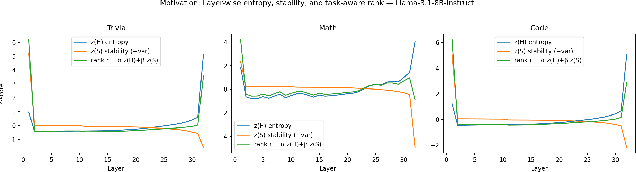
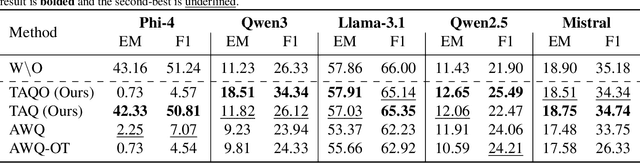
Large Language Models (LLMs) excel across diverse tasks, yet many applications require only limited capabilities, making large variants inefficient in memory and latency. Existing approaches often combine distillation and quantization, but most post-training quantization (PTQ) methods are task-agnostic, ignoring how task-specific signals are distributed across layers. In this work, we propose to use hidden representations that encode task-salient signals as a guideline for quantization. In order to fully utilize our innovative idea, this paper compares two new task-aware PTQ methods: Task-Aware Quantization (TAQ), which allocates bitwidths using task-conditioned statistics from hidden activations, and TAQO, which allocates precision based on direct layer sensitivity tests. From a small calibration set, these approaches identify task-relevant layers, preserving their precision while aggressively quantizing the rest. This yields stable task sensitivity profiles and efficient task-specialized models. Across models, TAQ and TAQO outperform the baselines; TAQ leads on Phi-4, while TAQO leads on Llama-3.1, Qwen3, and Qwen2.5. For instances, on Phi-4 it achieves 42.33 EM / 50.81 F1, far surpassing Activation-aware Weight Quantization (AWQ) (2.25 / 7.07), while remaining within < 1.0% of the original accuracy at lower average precision.
Exploring Human-AI Conceptual Alignment through the Prism of Chess
Oct 29, 2025Do AI systems truly understand human concepts or merely mimic surface patterns? We investigate this through chess, where human creativity meets precise strategic concepts. Analyzing a 270M-parameter transformer that achieves grandmaster-level play, we uncover a striking paradox: while early layers encode human concepts like center control and knight outposts with up to 85\% accuracy, deeper layers, despite driving superior performance, drift toward alien representations, dropping to 50-65\% accuracy. To test conceptual robustness beyond memorization, we introduce the first Chess960 dataset: 240 expert-annotated positions across 6 strategic concepts. When opening theory is eliminated through randomized starting positions, concept recognition drops 10-20\% across all methods, revealing the model's reliance on memorized patterns rather than abstract understanding. Our layer-wise analysis exposes a fundamental tension in current architectures: the representations that win games diverge from those that align with human thinking. These findings suggest that as AI systems optimize for performance, they develop increasingly alien intelligence, a critical challenge for creative AI applications requiring genuine human-AI collaboration. Dataset and code are available at: https://github.com/slomasov/ChessConceptsLLM.