 Add to Chrome
 Add to Firefox
 Add to Edge
Unsupervised Features Mining via Activation Geometry
Jul 05, 2026
Interpretability methods aim to reveal the features represented inside large language models (LLMs). Many existing methods begin with labeled examples of a human-defined concept that may reflect human biases, and then identify how that concept is represented within the model, for example in its activation space or through other decomposition methods. We introduce \emph{Mining via Activation Geometry} (MAG), a simple unsupervised framework for extracting reasoning features from model activations by prepending the same natural-language instruction $Q$ to every input $p$, where $Q$ defines the reasoning feature of interest, such as ``Can this object be found in the desert?'' or ``Is this prompt malicious?'' We measure how the instruction changes the model's internal representation using $m(Q \mid p) - m(p)$ at a single readout point. We explore eight different MAGs. The extracted reasoning features predict the models' own world understanding and judgment, can be approximated into a single activation direction, we found that some features are more linearly represented and some less, this linear representation, which is vector steering, can change the LLMs' decisions through activation steering by injecting reasoning features. Finally, we use the same method to select the best training datasets for prompt-injection classifier probes: while similarity between ordinary activations is almost unrelated to downstream performance, RFD-based similarity achieves $94.7\%$ Top-1 and $100\%$ Top-2 accuracy.

Internal-State Probes Read the Situation, Not the Action: Three Negative Results for Pre-Action Misalignment Monitoring
Jun 29, 2026Probes on model internals could help monitor agentic systems if they identify harmful text or tool actions before those actions are generated. We ask when an internal readout supports this stronger pre-action claim, rather than merely describing the prompt, construction contrast, or current trajectory. We test three methods across three model families: a Qwen2.5-Coder-32B-Instruct fine-tune/base direction, Llama-3.1-8B-Instruct probes at the last token of unsafe prefills, and Gemma-3-27B-IT emotion-concept vectors used for projection and steering in a blackmail tool-action scenario. Across these cases, construction validity, semantic legibility, and steering effects do not become robust pre-action monitors: each is undercut by a generalization or specificity check. The Qwen direction separates fine-tune from base at AUC 1.000, yet crosses its threshold on 0/143 audited pre-assistant turn contexts and on 0/342 Qwen prefill rows where the model continues the unsafe trajectory. The Llama features decode prompt domain almost perfectly (AUC 0.999), while the best future-behavior probe reaches AUC 0.801 and only +5.1 pp accuracy lift over majority; single-source cross-domain transfer is non-positive on five of six ordered pairs. Gemma emotion projections are semantically meaningful, but a shared-prefix minimal pair has indistinguishable states before the first differing input, and steering specificity weakens against unrelated learned directions such as cats}, weather, sports, and geography. We contribute a methodology for converting internal-readout claims into pre-action tests, and report scoped negative results: monitor claims must survive both scenario/action generalization and concept-specificity controls. Code is released at https://github.com/maxf-zn/misalignment_monitoring
Mirage Probes: How Vision Models Fake Visual Understanding
Jun 11, 2026Vision-language models (VLMs) can answer image-based questions confidently, and often correctly, even when no image is provided. This mirage behavior inflates benchmark scores without reflecting visual grounding. Prior work treats this as a single failure mode. We argue it is two. Using Mirage Probes, a contrastive probing framework that pairs paraphrased question variants with matched mirage and non-mirage labels on the same image, we show that mirage behavior is linearly decodable from internal activations across residual stream, MLP, post-attention, and attention-head sites in two open-source VLMs. We demonstrate that a Naive Bayes text baseline cannot recover this signal, ruling out surface lexical confounds. Cross-benchmark separability patterns, together with a novel Prior Harnessing Index (PHI) measuring how much a model can answer from text alone, expose two distinct regimes: textual biases, where the model answers from language priors without engaging visual representations, and spurious images, where it constructs false visual content in latent space and answers as if grounded. The distinction has direct mitigation consequences: text-distribution cleaning can address the first regime but cannot reach the second, since spurious-image mirages live in the model's visual representations rather than its text. Faithful visual grounding will require interventions at the representational level.
Extracting Recurring Vulnerabilities from Black-Box LLM-Generated Software
Feb 02, 2026LLMs are increasingly used for code generation, but their outputs often follow recurring templates that can induce predictable vulnerabilities. We study \emph{vulnerability persistence} in LLM-generated software and introduce \emph{Feature--Security Table (FSTab)} with two components. First, FSTab enables a black-box attack that predicts likely backend vulnerabilities from observable frontend features and knowledge of the source LLM, without access to backend code or source code. Second, FSTab provides a model-centric evaluation that quantifies how consistently a given model reproduces the same vulnerabilities across programs, semantics-preserving rephrasings, and application domains. We evaluate FSTab on state-of-the-art code LLMs, including GPT-5.2, Claude-4.5 Opus, and Gemini-3 Pro, across diverse application domains. Our results show strong cross-domain transfer: even when the target domain is excluded from training, FSTab achieves up to 94\% attack success and 93\% vulnerability coverage on Internal Tools (Claude-4.5 Opus). These findings expose an underexplored attack surface in LLM-generated software and highlight the security risks of code generation. Our code is available at: https://anonymous.4open.science/r/FSTab-024E.
Step-Wise Refusal Dynamics in Autoregressive and Diffusion Language Models
Feb 01, 2026Diffusion language models (DLMs) have recently emerged as a promising alternative to autoregressive (AR) models, offering parallel decoding and controllable sampling dynamics while achieving competitive generation quality at scale. Despite this progress, the role of sampling mechanisms in shaping refusal behavior and jailbreak robustness remains poorly understood. In this work, we present a fundamental analytical framework for step-wise refusal dynamics, enabling comparison between AR and diffusion sampling. Our analysis reveals that the sampling strategy itself plays a central role in safety behavior, as a factor distinct from the underlying learned representations. Motivated by this analysis, we introduce the Step-Wise Refusal Internal Dynamics (SRI) signal, which supports interpretability and improved safety for both AR and DLMs. We demonstrate that the geometric structure of SRI captures internal recovery dynamics, and identifies anomalous behavior in harmful generations as cases of \emph{incomplete internal recovery} that are not observable at the text level. This structure enables lightweight inference-time detectors that generalize to unseen attacks while matching or outperforming existing defenses with over $100\times$ lower inference overhead.
You Had One Job: Per-Task Quantization Using LLMs' Hidden Representations
Nov 09, 2025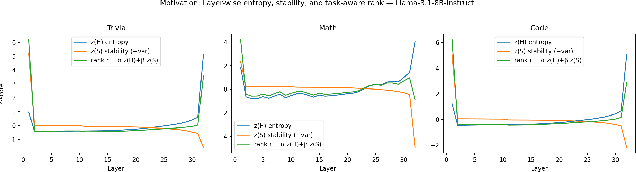
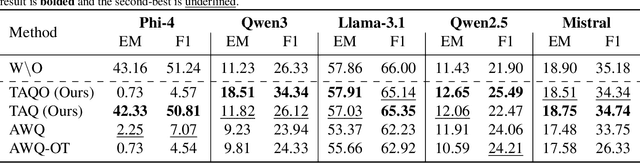
Large Language Models (LLMs) excel across diverse tasks, yet many applications require only limited capabilities, making large variants inefficient in memory and latency. Existing approaches often combine distillation and quantization, but most post-training quantization (PTQ) methods are task-agnostic, ignoring how task-specific signals are distributed across layers. In this work, we propose to use hidden representations that encode task-salient signals as a guideline for quantization. In order to fully utilize our innovative idea, this paper compares two new task-aware PTQ methods: Task-Aware Quantization (TAQ), which allocates bitwidths using task-conditioned statistics from hidden activations, and TAQO, which allocates precision based on direct layer sensitivity tests. From a small calibration set, these approaches identify task-relevant layers, preserving their precision while aggressively quantizing the rest. This yields stable task sensitivity profiles and efficient task-specialized models. Across models, TAQ and TAQO outperform the baselines; TAQ leads on Phi-4, while TAQO leads on Llama-3.1, Qwen3, and Qwen2.5. For instances, on Phi-4 it achieves 42.33 EM / 50.81 F1, far surpassing Activation-aware Weight Quantization (AWQ) (2.25 / 7.07), while remaining within < 1.0% of the original accuracy at lower average precision.
Silenced Biases: The Dark Side LLMs Learned to Refuse
Nov 05, 2025Safety-aligned large language models (LLMs) are becoming increasingly widespread, especially in sensitive applications where fairness is essential and biased outputs can cause significant harm. However, evaluating the fairness of models is a complex challenge, and approaches that do so typically utilize standard question-answer (QA) styled schemes. Such methods often overlook deeper issues by interpreting the model's refusal responses as positive fairness measurements, which creates a false sense of fairness. In this work, we introduce the concept of silenced biases, which are unfair preferences encoded within models' latent space and are effectively concealed by safety-alignment. Previous approaches that considered similar indirect biases often relied on prompt manipulation or handcrafted implicit queries, which present limited scalability and risk contaminating the evaluation process with additional biases. We propose the Silenced Bias Benchmark (SBB), which aims to uncover these biases by employing activation steering to reduce model refusals during QA. SBB supports easy expansion to new demographic groups and subjects, presenting a fairness evaluation framework that encourages the future development of fair models and tools beyond the masking effects of alignment training. We demonstrate our approach over multiple LLMs, where our findings expose an alarming distinction between models' direct responses and their underlying fairness issues.