 Add to Chrome
 Add to Firefox
 Add to Edge
ReplicatorBench: Benchmarking LLM Agents for Replicability in Social and Behavioral Sciences
Feb 11, 2026
The literature has witnessed an emerging interest in AI agents for automated assessment of scientific papers. Existing benchmarks focus primarily on the computational aspect of this task, testing agents' ability to reproduce or replicate research outcomes when having access to the code and data. This setting, while foundational, (1) fails to capture the inconsistent availability of new data for replication as opposed to reproduction, and (2) lacks ground-truth diversity by focusing only on reproducible papers, thereby failing to evaluate an agent's ability to identify non-replicable research. Furthermore, most benchmarks only evaluate outcomes rather than the replication process. In response, we introduce ReplicatorBench, an end-to-end benchmark, including human-verified replicable and non-replicable research claims in social and behavioral sciences for evaluating AI agents in research replication across three stages: (1) extraction and retrieval of replication data; (2) design and execution of computational experiments; and (3) interpretation of results, allowing a test of AI agents' capability to mimic the activities of human replicators in real world. To set a baseline of AI agents' capability, we develop ReplicatorAgent, an agentic framework equipped with necessary tools, like web search and iterative interaction with sandboxed environments, to accomplish tasks in ReplicatorBench. We evaluate ReplicatorAgent across four underlying large language models (LLMs), as well as different design choices of programming language and levels of code access. Our findings reveal that while current LLM agents are capable of effectively designing and executing computational experiments, they struggle with retrieving resources, such as new data, necessary to replicate a claim. All code and data are publicly available at https://github.com/CenterForOpenScience/llm-benchmarking.

CC30k: A Citation Contexts Dataset for Reproducibility-Oriented Sentiment Analysis
Nov 11, 2025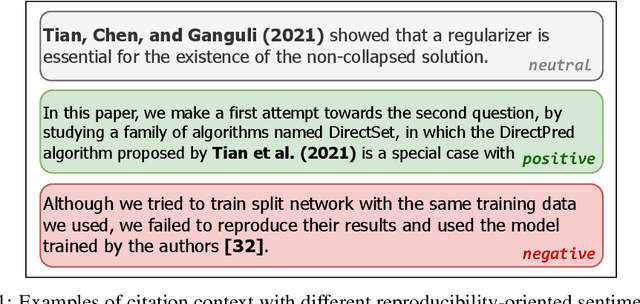
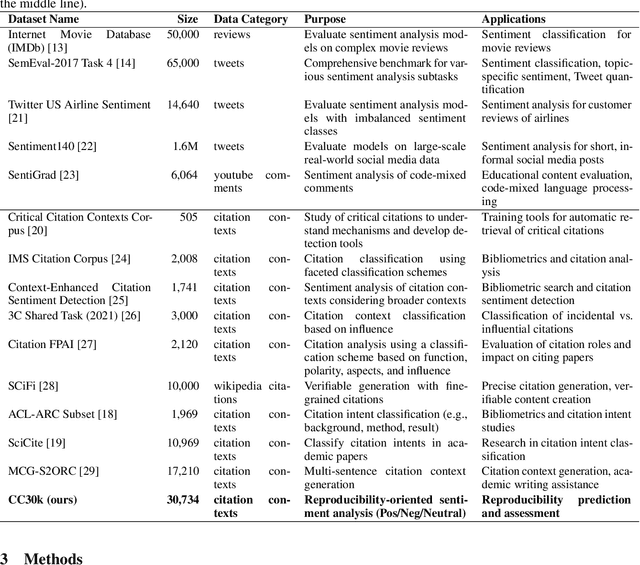
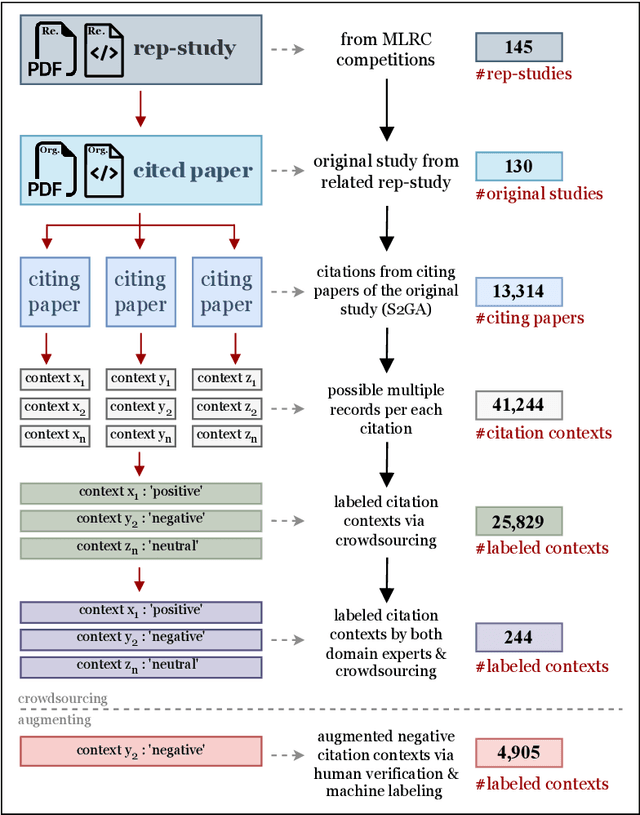
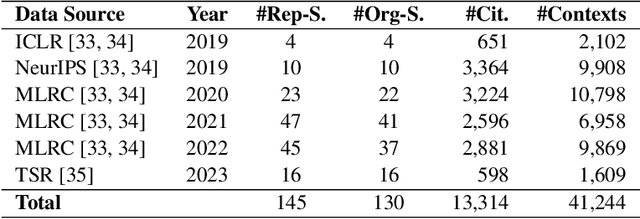
Sentiments about the reproducibility of cited papers in downstream literature offer community perspectives and have shown as a promising signal of the actual reproducibility of published findings. To train effective models to effectively predict reproducibility-oriented sentiments and further systematically study their correlation with reproducibility, we introduce the CC30k dataset, comprising a total of 30,734 citation contexts in machine learning papers. Each citation context is labeled with one of three reproducibility-oriented sentiment labels: Positive, Negative, or Neutral, reflecting the cited paper's perceived reproducibility or replicability. Of these, 25,829 are labeled through crowdsourcing, supplemented with negatives generated through a controlled pipeline to counter the scarcity of negative labels. Unlike traditional sentiment analysis datasets, CC30k focuses on reproducibility-oriented sentiments, addressing a research gap in resources for computational reproducibility studies. The dataset was created through a pipeline that includes robust data cleansing, careful crowd selection, and thorough validation. The resulting dataset achieves a labeling accuracy of 94%. We then demonstrated that the performance of three large language models significantly improves on the reproducibility-oriented sentiment classification after fine-tuning using our dataset. The dataset lays the foundation for large-scale assessments of the reproducibility of machine learning papers. The CC30k dataset and the Jupyter notebooks used to produce and analyze the dataset are publicly available at https://github.com/lamps-lab/CC30k .
Can citations tell us about a paper's reproducibility? A case study of machine learning papers
May 07, 2024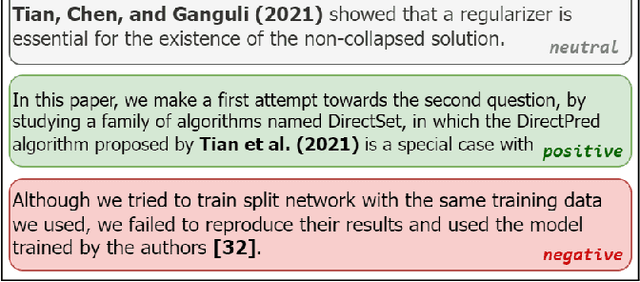
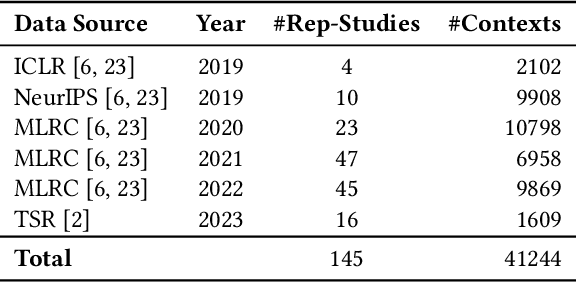
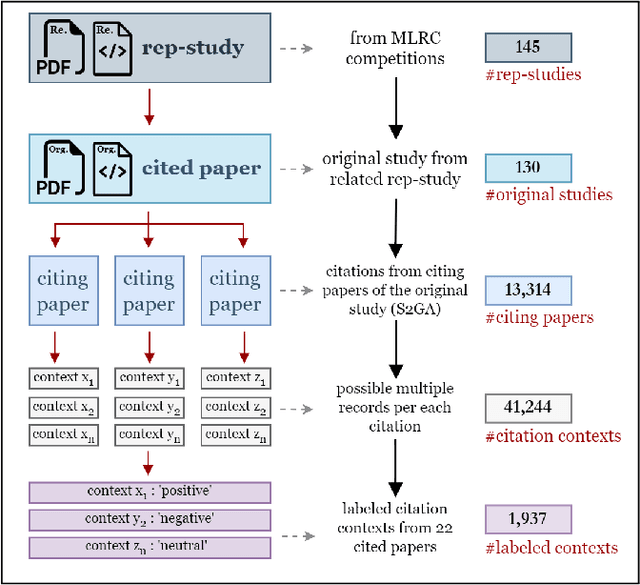
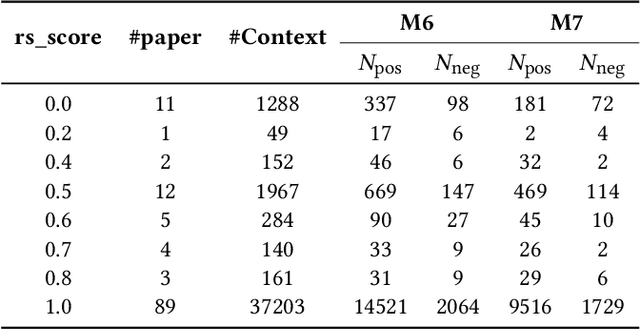
The iterative character of work in machine learning (ML) and artificial intelligence (AI) and reliance on comparisons against benchmark datasets emphasize the importance of reproducibility in that literature. Yet, resource constraints and inadequate documentation can make running replications particularly challenging. Our work explores the potential of using downstream citation contexts as a signal of reproducibility. We introduce a sentiment analysis framework applied to citation contexts from papers involved in Machine Learning Reproducibility Challenges in order to interpret the positive or negative outcomes of reproduction attempts. Our contributions include training classifiers for reproducibility-related contexts and sentiment analysis, and exploring correlations between citation context sentiment and reproducibility scores. Study data, software, and an artifact appendix are publicly available at https://github.com/lamps-lab/ccair-ai-reproducibility .