 Add to Chrome
 Add to Firefox
 Add to Edge
Sapling-NeRF: Geo-Localised Sapling Reconstruction in Forests for Ecological Monitoring
Feb 26, 2026
Saplings are key indicators of forest regeneration and overall forest health. However, their fine-scale architectural traits are difficult to capture with existing 3D sensing methods, which make quantitative evaluation difficult. Terrestrial Laser Scanners (TLS), Mobile Laser Scanners (MLS), or traditional photogrammetry approaches poorly reconstruct thin branches, dense foliage, and lack the scale consistency needed for long-term monitoring. Implicit 3D reconstruction methods such as Neural Radiance Fields (NeRF) and 3D Gaussian Splatting (3DGS) are promising alternatives, but cannot recover the true scale of a scene and lack any means to be accurately geo-localised. In this paper, we present a pipeline which fuses NeRF, LiDAR SLAM, and GNSS to enable repeatable, geo-localised ecological monitoring of saplings. Our system proposes a three-level representation: (i) coarse Earth-frame localisation using GNSS, (ii) LiDAR-based SLAM for centimetre-accurate localisation and reconstruction, and (iii) NeRF-derived object-centric dense reconstruction of individual saplings. This approach enables repeatable quantitative evaluation and long-term monitoring of sapling traits. Our experiments in forest plots in Wytham Woods (Oxford, UK) and Evo (Finland) show that stem height, branching patterns, and leaf-to-wood ratios can be captured with increased accuracy as compared to TLS. We demonstrate that accurate stem skeletons and leaf distributions can be measured for saplings with heights between 0.5m and 2m in situ, giving ecologists access to richer structural and quantitative data for analysing forest dynamics.

Watching Grass Grow: Long-term Visual Navigation and Mission Planning for Autonomous Biodiversity Monitoring
Apr 16, 2024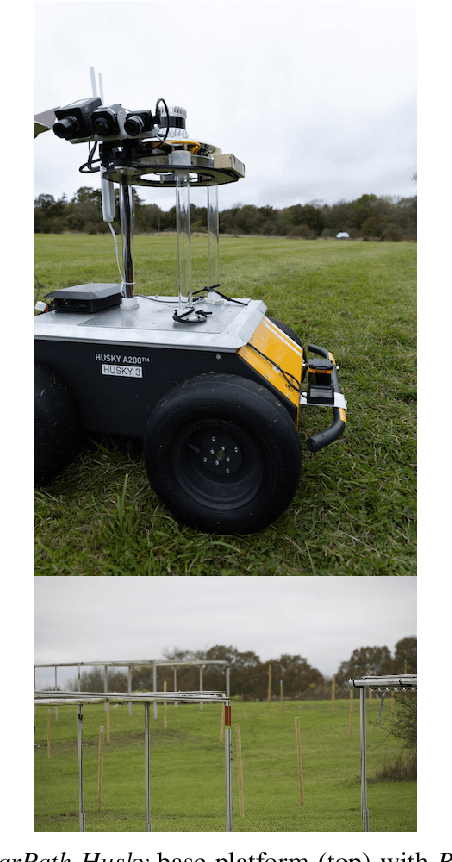
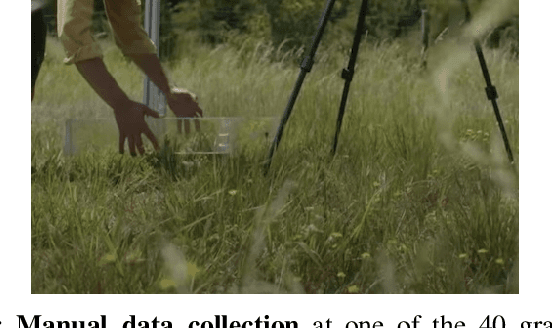
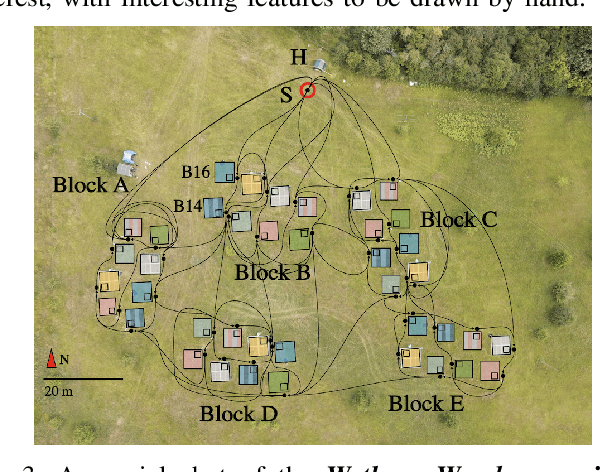
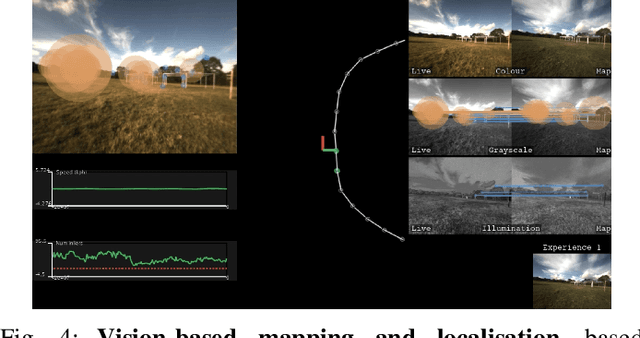
We describe a challenging robotics deployment in a complex ecosystem to monitor a rich plant community. The study site is dominated by dynamic grassland vegetation and is thus visually ambiguous and liable to drastic appearance change over the course of a day and especially through the growing season. This dynamism and complexity in appearance seriously impact the stability of the robotics platform, as localisation is a foundational part of that control loop, and so routes must be carefully taught and retaught until autonomy is robust and repeatable. Our system is demonstrated over a 6-week period monitoring the response of grass species to experimental climate change manipulations. We also discuss the applicability of our pipeline to monitor biodiversity in other complex natural settings.