 Add to Chrome
 Add to Firefox
 Add to Edge
OnCoCo 1.0: A Public Dataset for Fine-Grained Message Classification in Online Counseling Conversations
Dec 10, 2025

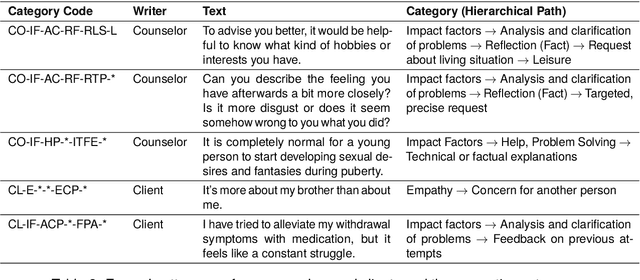

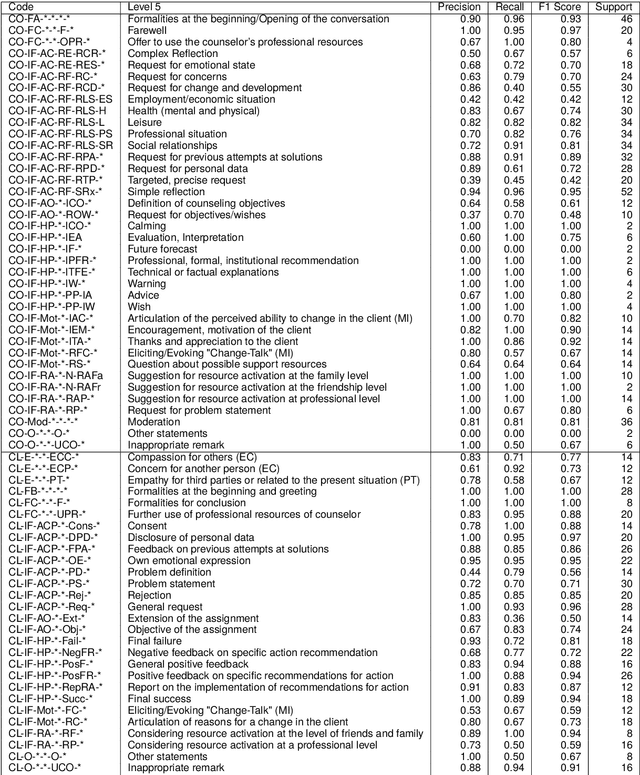
This paper presents OnCoCo 1.0, a new public dataset for fine-grained message classification in online counseling. It is based on a new, integrative system of categories, designed to improve the automated analysis of psychosocial online counseling conversations. Existing category systems, predominantly based on Motivational Interviewing (MI), are limited by their narrow focus and dependence on datasets derived mainly from face-to-face counseling. This limits the detailed examination of textual counseling conversations. In response, we developed a comprehensive new coding scheme that differentiates between 38 types of counselor and 28 types of client utterances, and created a labeled dataset consisting of about 2.800 messages from counseling conversations. We fine-tuned several models on our dataset to demonstrate its applicability. The data and models are publicly available to researchers and practitioners. Thus, our work contributes a new type of fine-grained conversational resource to the language resources community, extending existing datasets for social and mental-health dialogue analysis.

Interpretable Causal Representation Learning for Biological Data in the Pathway Space
Jun 14, 2025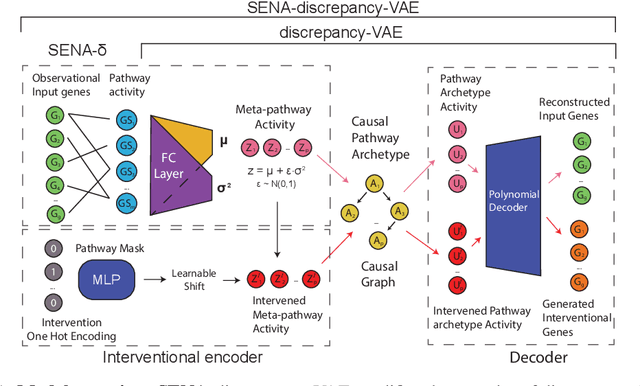
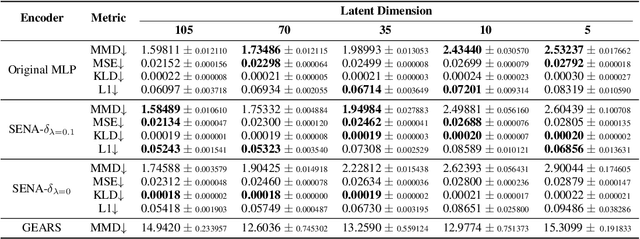
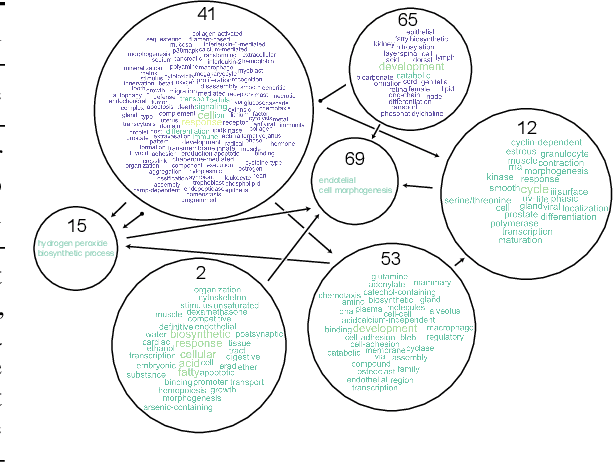
Predicting the impact of genomic and drug perturbations in cellular function is crucial for understanding gene functions and drug effects, ultimately leading to improved therapies. To this end, Causal Representation Learning (CRL) constitutes one of the most promising approaches, as it aims to identify the latent factors that causally govern biological systems, thus facilitating the prediction of the effect of unseen perturbations. Yet, current CRL methods fail in reconciling their principled latent representations with known biological processes, leading to models that are not interpretable. To address this major issue, we present SENA-discrepancy-VAE, a model based on the recently proposed CRL method discrepancy-VAE, that produces representations where each latent factor can be interpreted as the (linear) combination of the activity of a (learned) set of biological processes. To this extent, we present an encoder, SENA-{\delta}, that efficiently compute and map biological processes' activity levels to the latent causal factors. We show that SENA-discrepancy-VAE achieves predictive performances on unseen combinations of interventions that are comparable with its original, non-interpretable counterpart, while inferring causal latent factors that are biologically meaningful.