 Add to Chrome
 Add to Firefox
 Add to Edge
GEMCo: A Validated, Ethically Releasable Proxy for Inaccessible Counselling Data
Jul 26, 2026
This paper presents GEMCo, a releasable, human-written proxy for inaccessible counselling data: 86 complete German e-mail counselling conversations (728 messages), expert-authored cases and counsellor sessions with trained role-players. It is validated against a held-out reference of 124 real counselling conversations. The proxy and the real conversations are measured against each other in counsellor strategies and client emotions. The gap is detectable but small. A generative validation supports the analysis. The validation method itself generalises to any domain where real data cannot be shared but a human-made proxy can. Privacy and ethics keep real counselling data closed. GEMCo carries none by design and can be released -- a first step toward language research in this domain.

LLARS: Enabling Domain Expert & Developer Collaboration for LLM Prompting, Generation and Evaluation
May 11, 2026We demonstrate LLARS (LLM Assisted Research System), an open-source platform that bridges the gap between domain experts and developers for building LLM-based systems. It integrates three tightly connected modules into an end-to-end pipeline: Collaborative Prompt Engineering for real-time co-authoring with version control and instant LLM testing, Batch Generation for configurable output production across user-selected prompts $\times$ models $\times$ data with cost control, and Hybrid Evaluation where human and LLM evaluators jointly assess outputs through diverse assessment methods, with live agreement metrics and provenance analysis to identify the best model-prompt combination for a given use case. New prompts and models are automatically available for batch generation and completed batches can be turned into evaluation scenarios with a single click. Interviews with six domain experts and three developers in online counselling confirmed that LLARS feels intuitive, saves considerable time by keeping everything in one place and makes interdisciplinary collaboration seamless.
Transition-Matrix Regularization for Next Dialogue Act Prediction in Counselling Conversations
Apr 20, 2026This paper studies how empirical dialogue-flow statistics can be incorporated into Next Dialogue Act Prediction (NDAP). A KL regularization term is proposed that aligns predicted act distributions with corpus-derived transition patterns. Evaluated on a 60-class German counselling taxonomy using 5-fold cross-validation, this improves macro-F1 by 9--42% relative depending on encoder and substantially improves dialogue-flow alignment. Cross-dataset validation on HOPE suggests that improvements transfer across languages and counselling domains. In systematic ablations across pretrained encoders and architectures, the findings indicate that transition regularization provides consistent gains and disproportionately benefits weaker baseline models. The results suggest that lightweight discourse-flow priors complement pretrained encoders, especially in fine-grained, data-sparse dialogue tasks.
OnCoCo 1.0: A Public Dataset for Fine-Grained Message Classification in Online Counseling Conversations
Dec 10, 2025
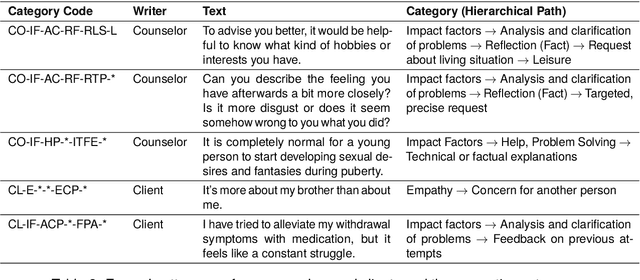

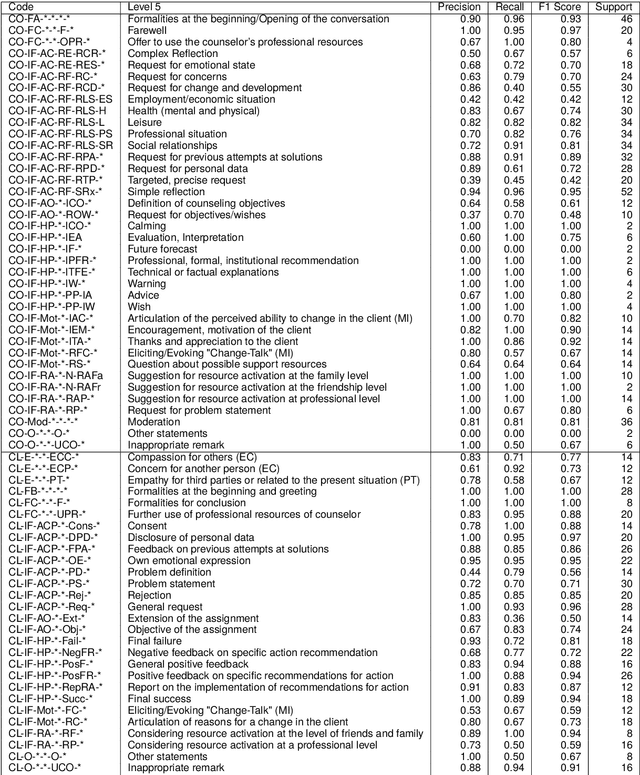
This paper presents OnCoCo 1.0, a new public dataset for fine-grained message classification in online counseling. It is based on a new, integrative system of categories, designed to improve the automated analysis of psychosocial online counseling conversations. Existing category systems, predominantly based on Motivational Interviewing (MI), are limited by their narrow focus and dependence on datasets derived mainly from face-to-face counseling. This limits the detailed examination of textual counseling conversations. In response, we developed a comprehensive new coding scheme that differentiates between 38 types of counselor and 28 types of client utterances, and created a labeled dataset consisting of about 2.800 messages from counseling conversations. We fine-tuned several models on our dataset to demonstrate its applicability. The data and models are publicly available to researchers and practitioners. Thus, our work contributes a new type of fine-grained conversational resource to the language resources community, extending existing datasets for social and mental-health dialogue analysis.