 Add to Chrome
 Add to Firefox
 Add to Edge
High Volatility and Action Bias Distinguish LLMs from Humans in Group Coordination
Apr 02, 2026
Humans exhibit remarkable abilities to coordinate in groups. As large language models (LLMs) become more capable, it remains an open question whether they can demonstrate comparable adaptive coordination and whether they use the same strategies as humans. To investigate this, we compare LLM and human performance on a common-interest game with imperfect monitoring: Group Binary Search. In this n-player game, participants need to coordinate their actions to achieve a common objective. Players independently submit numerical values in an effort to collectively sum to a randomly assigned target number. Without direct communication, they rely on group feedback to iteratively adjust their submissions until they reach the target number. Our findings show that, unlike humans who adapt and stabilize their behavior over time, LLMs often fail to improve across games and exhibit excessive switching, which impairs group convergence. Moreover, richer feedback (e.g., numerical error magnitude) benefits humans substantially but has small effects on LLMs. Taken together, by grounding the analysis in human baselines and mechanism-level metrics, including reactivity scaling, switching dynamics, and learning across games, we point to differences in human and LLM groups and provide a behaviorally grounded diagnostic for closing the coordination gap.

Reconstructing Maps from Text
May 18, 2020
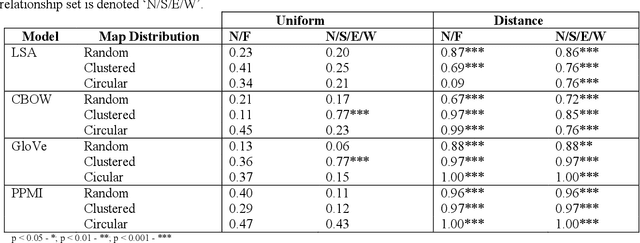

Previous research has demonstrated that Distributional Semantic Models (DSMs) are capable of reconstructing maps from news corpora (Louwerse & Zwaan, 2009) and novels (Louwerse & Benesh, 2012). The capacity for reproducing maps is surprising since DSMs notoriously lack perceptual grounding (De Vega et al., 2012). In this paper we investigate the statistical sources required in language to infer maps, and resulting constraints placed on mechanisms of semantic representation. Study 1 brings word co-occurrence under experimental control to demonstrate that direct co-occurrence in language is necessary for traditional DSMs to successfully reproduce maps. Study 2 presents an instance-based DSM that is capable of reconstructing maps independent of the frequency of co-occurrence of city names.