 Add to Chrome
 Add to Firefox
 Add to Edge
High Volatility and Action Bias Distinguish LLMs from Humans in Group Coordination
Apr 02, 2026
Humans exhibit remarkable abilities to coordinate in groups. As large language models (LLMs) become more capable, it remains an open question whether they can demonstrate comparable adaptive coordination and whether they use the same strategies as humans. To investigate this, we compare LLM and human performance on a common-interest game with imperfect monitoring: Group Binary Search. In this n-player game, participants need to coordinate their actions to achieve a common objective. Players independently submit numerical values in an effort to collectively sum to a randomly assigned target number. Without direct communication, they rely on group feedback to iteratively adjust their submissions until they reach the target number. Our findings show that, unlike humans who adapt and stabilize their behavior over time, LLMs often fail to improve across games and exhibit excessive switching, which impairs group convergence. Moreover, richer feedback (e.g., numerical error magnitude) benefits humans substantially but has small effects on LLMs. Taken together, by grounding the analysis in human baselines and mechanism-level metrics, including reactivity scaling, switching dynamics, and learning across games, we point to differences in human and LLM groups and provide a behaviorally grounded diagnostic for closing the coordination gap.

Temporal Dependencies in In-Context Learning: The Role of Induction Heads
Apr 01, 2026Large language models (LLMs) exhibit strong in-context learning capabilities, but how they track and retrieve information from context remains underexplored. Drawing on the free recall paradigm in cognitive science (where participants recall list items in any order), we show that several open-source LLMs consistently display a serial-recall-like pattern, assigning peak probability to tokens that immediately follow a repeated token in the input sequence. Through systematic ablation experiments, we show that induction heads, specialized attention heads that attend to the token following a previous occurrence of the current token, play an important role in this phenomenon. Removing heads with a high induction score substantially reduces the +1 lag bias, whereas ablating random heads does not reproduce the same reduction. We also show that removing heads with high induction scores impairs the performance of models prompted to do serial recall using few-shot learning to a larger extent than removing random heads. Our findings highlight a mechanistically specific connection between induction heads and temporal context processing in transformers, suggesting that these heads are especially important for ordered retrieval and serial-recall-like behavior during in-context learning.
Beyond Semantics: How Temporal Biases Shape Retrieval in Transformer and State-Space Models
Oct 26, 2025In-context learning is governed by both temporal and semantic relationships, shaping how Large Language Models (LLMs) retrieve contextual information. Analogous to human episodic memory, where the retrieval of specific events is enabled by separating events that happened at different times, this work probes the ability of various pretrained LLMs, including transformer and state-space models, to differentiate and retrieve temporally separated events. Specifically, we prompted models with sequences containing multiple presentations of the same token, which reappears at the sequence end. By fixing the positions of these repeated tokens and permuting all others, we removed semantic confounds and isolated temporal effects on next-token prediction. Across diverse sequences, models consistently placed the highest probabilities on tokens following a repeated token, but with a notable bias for those nearest the beginning or end of the input. An ablation experiment linked this phenomenon in transformers to induction heads. Extending the analysis to unique semantic contexts with partial overlap further demonstrated that memories embedded in the middle of a prompt are retrieved less reliably. Despite architectural differences, state-space and transformer models showed comparable temporal biases. Our findings deepen the understanding of temporal biases in in-context learning and offer an illustration of how these biases can enable temporal separation and episodic retrieval.
Emergence of Episodic Memory in Transformers: Characterizing Changes in Temporal Structure of Attention Scores During Training
Feb 09, 2025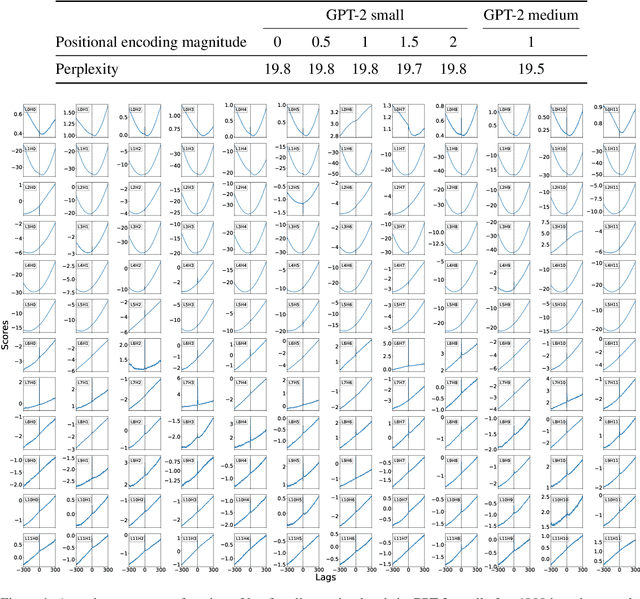
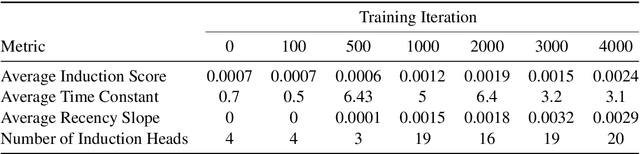
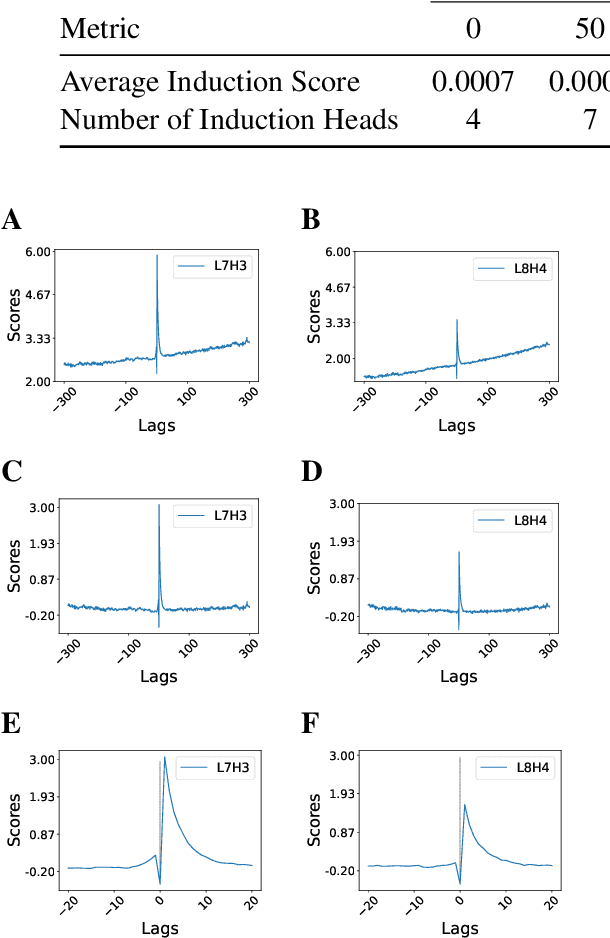
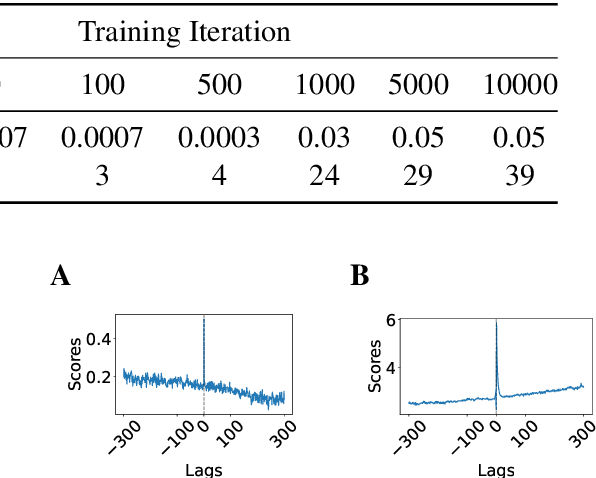
We investigate in-context temporal biases in attention heads and transformer outputs. Using cognitive science methodologies, we analyze attention scores and outputs of the GPT-2 models of varying sizes. Across attention heads, we observe effects characteristic of human episodic memory, including temporal contiguity, primacy and recency. Transformer outputs demonstrate a tendency toward in-context serial recall. Importantly, this effect is eliminated after the ablation of the induction heads, which are the driving force behind the contiguity effect. Our findings offer insights into how transformers organize information temporally during in-context learning, shedding light on their similarities and differences with human memory and learning.