 Add to Chrome
 Add to Firefox
 Add to Edge
Inference-Time Reasoning Selectively Reduces Implicit Social Bias in Large Language Models
Feb 04, 2026
Drawing on constructs from psychology, prior work has identified a distinction between explicit and implicit bias in large language models (LLMs). While many LLMs undergo post-training alignment and safety procedures to avoid expressions of explicit social bias, they still exhibit significant implicit biases on indirect tasks resembling the Implicit Association Test (IAT). Recent work has further shown that inference-time reasoning can impair LLM performance on tasks that rely on implicit statistical learning. Motivated by a theoretical link between implicit associations and statistical learning in human cognition, we examine how reasoning-enabled inference affects implicit bias in LLMs. We find that enabling reasoning significantly reduces measured implicit bias on an IAT-style evaluation for some model classes across fifteen stereotype topics. This effect appears specific to social bias domains, as we observe no corresponding reduction for non-social implicit associations. As reasoning is increasingly enabled by default in deployed LLMs, these findings suggest that it can meaningfully alter fairness evaluation outcomes in some systems, while also raising questions about how alignment procedures interact with inference-time reasoning to drive variation in bias reduction across model types. More broadly, this work highlights how theory from cognitive science and psychology can complement AI evaluation research by providing methodological and interpretive frameworks that reveal new insights into model behavior.

Reconstructing Maps from Text
May 18, 2020
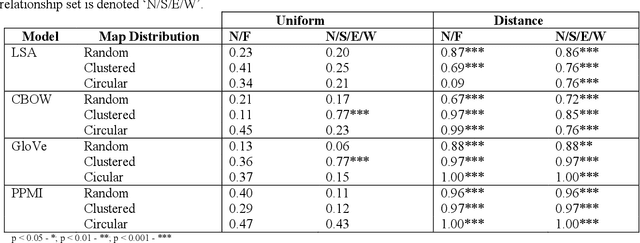

Previous research has demonstrated that Distributional Semantic Models (DSMs) are capable of reconstructing maps from news corpora (Louwerse & Zwaan, 2009) and novels (Louwerse & Benesh, 2012). The capacity for reproducing maps is surprising since DSMs notoriously lack perceptual grounding (De Vega et al., 2012). In this paper we investigate the statistical sources required in language to infer maps, and resulting constraints placed on mechanisms of semantic representation. Study 1 brings word co-occurrence under experimental control to demonstrate that direct co-occurrence in language is necessary for traditional DSMs to successfully reproduce maps. Study 2 presents an instance-based DSM that is capable of reconstructing maps independent of the frequency of co-occurrence of city names.