 Add to Chrome
 Add to Firefox
 Add to Edge
A Hierarchical Approach to Imitation Learning for Manipulation Tasks Requiring Time Varying Forces
Aug 04, 2026
Diffusion policies have shown strong performance in learning complex, multi-modal behaviors for robotic manipulation. However, their application to contact-rich disassembly tasks remains limited by a key trade-off: the iterative denoising process introduces inference latencies that makes high frequency control difficult, which is essential for realizing dynamic interactions such as chiseling and prying. Recent action-chunking techniques mitigate latency but use an open-loop execution window, rendering the system blind to rapid force transients caused by fracture events. To bridge this gap, we introduce the Diffusion Policy Augmented by Fast Trajectory Generation (DPA-FTG). Compared to recent visual-tactile approaches that focus on positional correction, DPA-FTG decouples low-frequency planning from high-frequency force regulation. At the high level ($5$ Hz), a conditional diffusion model predicts a sequence of latent parameters for selecting a strategy from a learned vocabulary of task primitives. At the low level ($60$ Hz), a lightweight, force-conditioned policy acts as a neural impedance controller, modulating execution in real-time to maintain contact stability. We validate our approach on a bimanual battery disassembly task involving the separation of a compliant sheet. Experimental evaluation demonstrates that DPA-FTG outperforms state-of-the-art baselines, including Reactive Diffusion Policy (RDP).

IJCB-AFMFR 2026: Competition on Adapting Foundation Models for Face Recognition Using Synthetic Training Data
Jul 27, 2026This paper presents a summary of the Competition on Adapting Foundation Models for Face Recognition Using Synthetic Training Data (AFMFR), held at the 2026 International Joint Conference on Biometrics (IJCB 2026). The competition received a total of eight valid submissions from four distinct teams across two complementary tracks: a Full Data Track, in which participants adapt the CLIP ViT-L/14 foundation model using large-scale synthetic identity data, and a Limited Data Track, designed to reflect more resource-constrained adaptation regimes. All training data was generated exclusively using IDPERTURB. Submitted solutions are ranked based on verification and identification performance across a diverse suite of benchmarks, including LFW, CFP-FP, AgeDB-30, CALFW, CPLFW, IJB-B, IJB-C, and TinyFace, using the Borda count method. Fairness evaluation is additionally conducted on the RFW dataset across four demographic groups. The results demonstrate that adaptation of the CLIP foundation model with synthetic training data substantially improves over the off-the-shelf model and, in several cases, surpasses the baseline. Notably, full fine-tuning with Sub-Center ArcFace (DMSTI-Neurotechnology) leads the Full Data Track, while rank-stabilized LoRA adaptation (Idiap-BSP) proves most effective under limited-data conditions.
Infrastructure-Guided Connectivity-Enhanced Road Crack Detection and Estimation
Apr 27, 2026In this paper, we report the world's first infrastructure-guided communication-enhanced road crack detection pipeline that is effective and implementable on passenger vehicles. We first design a customized communication protocol to transmit the region of interest from the infrastructure to the vehicle. With proper camera image processing (e.g., dynamic cropping and frame selection), the focused images are provided to the crack detection model. Leveraging state-of-the-art crack detection model backbones and a carefully prepared dataset comprising a forward-facing view with a crack, we train the model to improve crack-detection performance. We demonstrate the full detection pipeline on an experimental vehicle platform, showcase the detection effectiveness, and project future research directions.
Secure and Privacy Preserving Proxy Biometrics Identities
Dec 21, 2022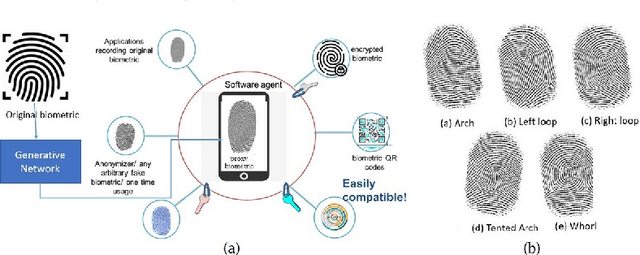
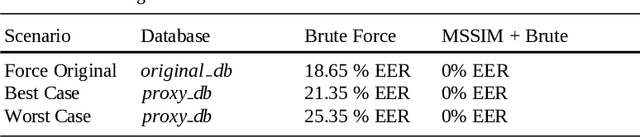
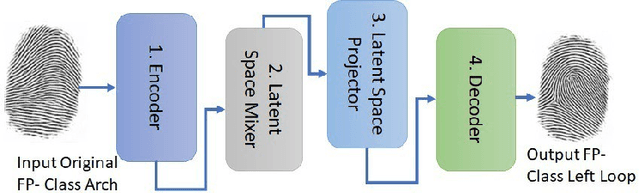
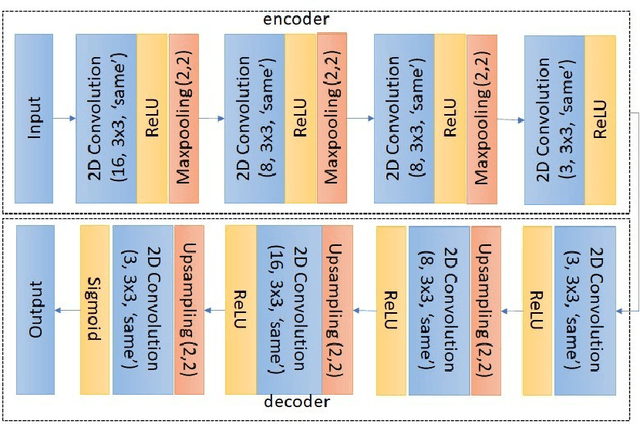
With large-scale adaption to biometric based applications, security and privacy of biometrics is utmost important especially when operating in unsupervised online mode. This work proposes a novel approach for generating new artificial fingerprints also called proxy fingerprints that are natural looking, non-invertible, revocable and privacy preserving. These proxy biometrics can be generated from original ones only with the help of a user-specific key. Instead of using the original fingerprint, these proxy templates can be used anywhere with same convenience. The manuscripts walks through an interesting way in which proxy fingerprints of different types can be generated and how they can be combined with use-specific keys to provide revocability and cancelability in case of compromise. Using the proposed approach a proxy dataset is generated from samples belonging to Anguli fingerprint database. Matching experiments were performed on the new set which is 5 times larger than the original, and it was found that their performance is at par with 0 FAR and 0 FRR in the stolen key, safe key scenarios. Other parameters on revocability and diversity are also analyzed for protection performance.