 Add to Chrome
 Add to Firefox
 Add to Edge
IJCB-AFMFR 2026: Competition on Adapting Foundation Models for Face Recognition Using Synthetic Training Data
Jul 27, 2026
This paper presents a summary of the Competition on Adapting Foundation Models for Face Recognition Using Synthetic Training Data (AFMFR), held at the 2026 International Joint Conference on Biometrics (IJCB 2026). The competition received a total of eight valid submissions from four distinct teams across two complementary tracks: a Full Data Track, in which participants adapt the CLIP ViT-L/14 foundation model using large-scale synthetic identity data, and a Limited Data Track, designed to reflect more resource-constrained adaptation regimes. All training data was generated exclusively using IDPERTURB. Submitted solutions are ranked based on verification and identification performance across a diverse suite of benchmarks, including LFW, CFP-FP, AgeDB-30, CALFW, CPLFW, IJB-B, IJB-C, and TinyFace, using the Borda count method. Fairness evaluation is additionally conducted on the RFW dataset across four demographic groups. The results demonstrate that adaptation of the CLIP foundation model with synthetic training data substantially improves over the off-the-shelf model and, in several cases, surpasses the baseline. Notably, full fine-tuning with Sub-Center ArcFace (DMSTI-Neurotechnology) leads the Full Data Track, while rank-stabilized LoRA adaptation (Idiap-BSP) proves most effective under limited-data conditions.

ViT-FREE: Efficient Face Recognition via Early Exiting and Synthetic Adaptation
Jun 10, 2026Vision Transformers (ViTs) have gained significant attention in computer vision and shown strong potential for face recognition (FR). However, their high computational cost makes deployment on resource-constrained devices challenging, motivating the need for methods that balance efficiency and accuracy. In this work, we investigate early exiting in pretrained ViTs as a simple yet effective training-free strategy for efficient FR inference. Leveraging the uniform feature dimensionality across transformer encoder blocks, we introduce ViT-FREE, a multi-exit framework that enables face verification directly from intermediate representations without modifying or retraining the backbone model, and thus, reducing inference cost. Empirically, we show that patch embeddings and attention maps evolve progressively across depth, exhibiting high similarity between consecutive ViT blocks and increasing alignment with the final representation. This indicates gradual feature refinement and attention convergence, suggesting that intermediate layers already provide stable and discriminative representations suitable for early exiting. Through extensive experiments on multiple FR benchmarks, we systematically analyze the accuracy-efficiency trade-off across exit depths. Our results demonstrate that later exits achieve a highly favorable balance, with exiting at layer 10 yielding up to a 20% speedup while incurring only a 1.5 drop in verification performance on benchmarks such as IJB-C. Also, we propose ViT-FREE_FT, a lightweight exit-specific fine-tuning strategy that adapts only the projection layers using a small synthetic dataset while keeping the transformer backbone frozen. This approach improves the performance of shallow exits while preserving the efficiency benefits and leaving deeper exits largely unaffected.
Vision Transformers for Face Recognition Need More Registers
Jun 10, 2026Recent advances in Vision Transformers (ViTs) for face recognition (FR) have moved beyond the standard CLS-token paradigm. In this paradigm, a special classification token (CLS) is prepended to the patch embeddings and used as a representation of the input for downstream tasks. An alternative approach, Concatenated Patch Embeddings (CPE), instead leverages all patch tokens by concatenating them into a single vector, which is then projected into a compact face representation. CPE has been shown to improve recognition performance in comparison to CLS-based ones, but our qualitative analysis of attention maps showed the presence of artifacts that limit their interpretability. To address this issue, we incorporate register tokens, learnable tokens concatenated to the initial patch embeddings, and processed jointly through the ViT encoder blocks. This mechanism has been shown to produce more structured and interpretable attention maps compared to baseline ViT. We empirically demonstrate that these artifacts consistently appear across various ViT backbones, including small and large models, and that introducing register tokens effectively mitigates them. Adding four or eight registers significantly enhances interpretability, with eight registers providing the highest verification accuracies and smoothest attention structures. Our resulting model, ViT-8R, corresponds to a CPE-based ViT-B architecture augmented with eight register tokens achieves state-of-the-art performance among ViT-based FR models on large-scale IJB-B and IJB-C benchmarks. Also, ViT-8R produces substantially clearer attention maps compared with the baseline model, which offer deeper insight into the model's attention behavior (https://github.com/TaharChettaoui/ViT-FR-Registers)
PreFIQs: Face Image Quality Is What Survives Pruning
May 13, 2026Face Image Quality Assessment (FIQA) evaluates the utility of a face image for automated face recognition (FR) systems. In this work, we propose PreFIQs, an unsupervised and training-free FIQA framework grounded in the Pruning Identified Exemplar (PIE) hypothesis. We hypothesize that low-utility face images rely disproportionately on fragile network parameters, resulting in larger geometric displacement of their embeddings under model sparsification. Accordingly, PreFIQs quantifies image utility as the Euclidean distance between L2-normalized embeddings extracted from a pre-trained FR model and its pruned counterpart. We provide a first-order theoretical justification via a Jacobian-vector product analysis, demonstrating that this empirical drift serves as a computationally efficient approximation of the exact geometric sensitivity of the latent embedding manifold. Extensive experiments across eight benchmarks and four FR models demonstrate that PreFIQs achieves competitive or superior performance compared to state-of-the-art FIQA methods, including establishing new state-of-the-art results on several benchmarks, without any training or supervision. These results validate parameter sparsification as a principled and practically efficient signal for face image utility, and demonstrate that quality is, in essence, what survives pruning.
DCMorph: Face Morphing via Dual-Stream Cross-Attention Diffusion
Apr 23, 2026Advancing face morphing attack techniques is crucial to anticipate evolving threats and develop robust defensive mechanisms for identity verification systems. This work introduces DCMorph, a dual-stream diffusion-based morphing framework that simultaneously operates at both identity conditioning and latent space levels. Unlike image-level methods suffering from blending artifacts or GAN-based approaches with limited reconstruction fidelity, DCMorph leverages identity-conditioned latent diffusion models through two mechanisms: (1) decoupled cross-attention interpolation that injects identity-specific features from both source faces into the denoising process, enabling explicit dual-identity conditioning absent in existing diffusion-based methods, and (2) DDIM inversion with spherical interpolation between inverted latent representations from both source faces, providing geometrically consistent initial latent representation that preserves structural attributes. Vulnerability analyses across four state-of-the-art face recognition systems demonstrate that DCMorph achieves the highest attack success rates compared to existing methods at both operational thresholds, while remaining challenging to detect by current morphing attack detection solutions.
On the Impact of Face Segmentation-Based Background Removal on Recognition and Morphing Attack Detection
Apr 22, 2026This study investigates the impact of face image background correction through segmentation on face recognition and morphing attack detection performance in realistic, unconstrained image capture scenarios. The motivation is driven by operational biometric systems such as the European Entry/Exit System (EES), which require facial enrolment at airports and other border crossing points where controlled backgrounds usually required for such captures cannot always be guaranteed, as well as by accessibility needs that may necessitate image capture outside traditional office environments. By analyzing how such preprocessing steps influence both recognition accuracy and security mechanisms, this work addresses a critical gap between usability-driven image normalization and the reliability requirements of large-scale biometric identification systems. Our study evaluates a comprehensive range of segmentation techniques, three families of morphing attack detection methods, and four distinct face recognition models, using databases that include both controlled and in-the-wild image captures. The results reveal consistent patterns linking segmentation to both recognition performance and face image quality. Additionally, segmentation is shown to systematically influence morphing attack detection performance. These findings highlight the need for careful consideration when deploying such preprocessing techniques in operational biometric systems.
ViTNT-FIQA: Training-Free Face Image Quality Assessment with Vision Transformers
Jan 09, 2026Face Image Quality Assessment (FIQA) is essential for reliable face recognition systems. Current approaches primarily exploit only final-layer representations, while training-free methods require multiple forward passes or backpropagation. We propose ViTNT-FIQA, a training-free approach that measures the stability of patch embedding evolution across intermediate Vision Transformer (ViT) blocks. We demonstrate that high-quality face images exhibit stable feature refinement trajectories across blocks, while degraded images show erratic transformations. Our method computes Euclidean distances between L2-normalized patch embeddings from consecutive transformer blocks and aggregates them into image-level quality scores. We empirically validate this correlation on a quality-labeled synthetic dataset with controlled degradation levels. Unlike existing training-free approaches, ViTNT-FIQA requires only a single forward pass without backpropagation or architectural modifications. Through extensive evaluation on eight benchmarks (LFW, AgeDB-30, CFP-FP, CALFW, Adience, CPLFW, XQLFW, IJB-C), we show that ViTNT-FIQA achieves competitive performance with state-of-the-art methods while maintaining computational efficiency and immediate applicability to any pre-trained ViT-based face recognition model.
MADation: Face Morphing Attack Detection with Foundation Models
Jan 08, 2025Despite the considerable performance improvements of face recognition algorithms in recent years, the same scientific advances responsible for this progress can also be used to create efficient ways to attack them, posing a threat to their secure deployment. Morphing attack detection (MAD) systems aim to detect a specific type of threat, morphing attacks, at an early stage, preventing them from being considered for verification in critical processes. Foundation models (FM) learn from extensive amounts of unlabeled data, achieving remarkable zero-shot generalization to unseen domains. Although this generalization capacity might be weak when dealing with domain-specific downstream tasks such as MAD, FMs can easily adapt to these settings while retaining the built-in knowledge acquired during pre-training. In this work, we recognize the potential of FMs to perform well in the MAD task when properly adapted to its specificities. To this end, we adapt FM CLIP architectures with LoRA weights while simultaneously training a classification header. The proposed framework, MADation surpasses our alternative FM and transformer-based frameworks and constitutes the first adaption of FMs to the MAD task. MADation presents competitive results with current MAD solutions in the literature and even surpasses them in several evaluation scenarios. To encourage reproducibility and facilitate further research in MAD, we publicly release the implementation of MADation at https: //github.com/gurayozgur/MADation
FoundPAD: Foundation Models Reloaded for Face Presentation Attack Detection
Jan 06, 2025
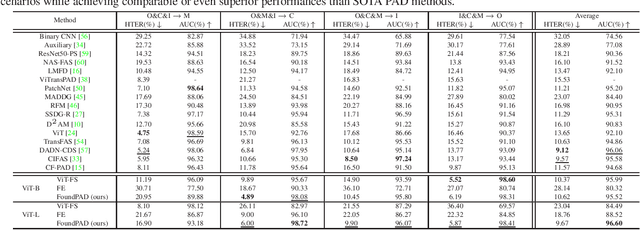
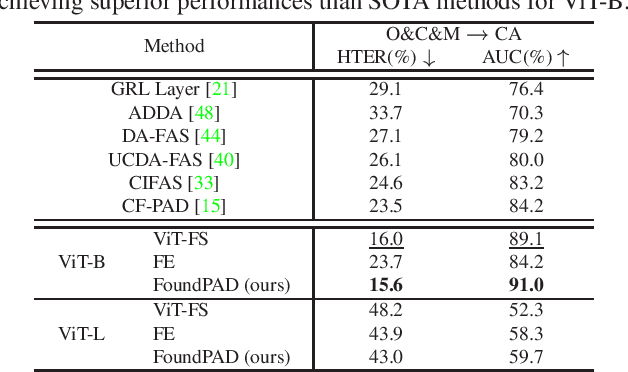
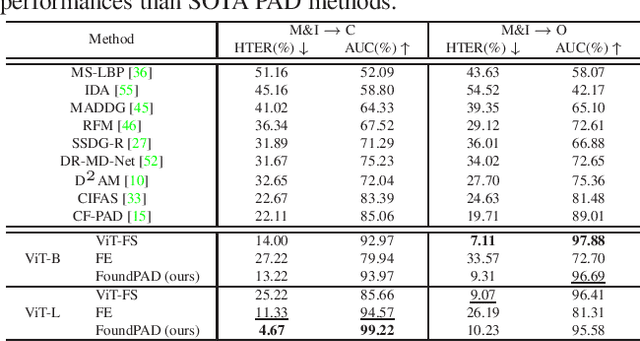
Although face recognition systems have seen a massive performance enhancement in recent years, they are still targeted by threats such as presentation attacks, leading to the need for generalizable presentation attack detection (PAD) algorithms. Current PAD solutions suffer from two main problems: low generalization to unknown cenarios and large training data requirements. Foundation models (FM) are pre-trained on extensive datasets, achieving remarkable results when generalizing to unseen domains and allowing for efficient task-specific adaption even when little training data are available. In this work, we recognize the potential of FMs to address common PAD problems and tackle the PAD task with an adapted FM for the first time. The FM under consideration is adapted with LoRA weights while simultaneously training a classification header. The resultant architecture, FoundPAD, is highly generalizable to unseen domains, achieving competitive results in several settings under different data availability scenarios and even when using synthetic training data. To encourage reproducibility and facilitate further research in PAD, we publicly release the implementation of FoundPAD at https://github.com/gurayozgur/FoundPAD .