 Add to Chrome
 Add to Firefox
 Add to Edge
Modeling Non-Ergodic Path Effects Using Conditional Generative Model for Fourier Amplitude Spectra
Dec 22, 2025
Recent developments in non-ergodic ground-motion models (GMMs) explicitly model systematic spatial variations in source, site, and path effects, reducing standard deviation to 30-40% of ergodic models and enabling more accurate site-specific seismic hazard analysis. Current non-ergodic GMMs rely on Gaussian Process (GP) methods with prescribed correlation functions and thus have computational limitations for large-scale predictions. This study proposes a deep-learning approach called Conditional Generative Modeling for Fourier Amplitude Spectra (CGM-FAS) as an alternative to GP-based methods for modeling non-ergodic path effects in Fourier Amplitude Spectra (FAS). CGM-FAS uses a Conditional Variational Autoencoder architecture to learn spatial patterns and interfrequency correlation directly from data by using geographical coordinates of earthquakes and stations as conditional variables. Using San Francisco Bay Area earthquake data, we compare CGM-FAS against a recent GP-based GMM for the region and demonstrate consistent predictions of non-ergodic path effects. Additionally, CGM-FAS offers advantages compared to GP-based approaches in learning spatial patterns without prescribed correlation functions, capturing interfrequency correlations, and enabling rapid predictions, generating maps for 10,000 sites across 1,000 frequencies within 10 seconds using a few GB of memory. CGM-FAS hyperparameters can be tuned to ensure generated path effects exhibit variability consistent with the GP-based empirical GMM. This work demonstrates a promising direction for efficient non-ergodic ground-motion prediction across multiple frequencies and large spatial domains.

Learning Physics for Unveiling Hidden Earthquake Ground Motions via Conditional Generative Modeling
Jul 21, 2024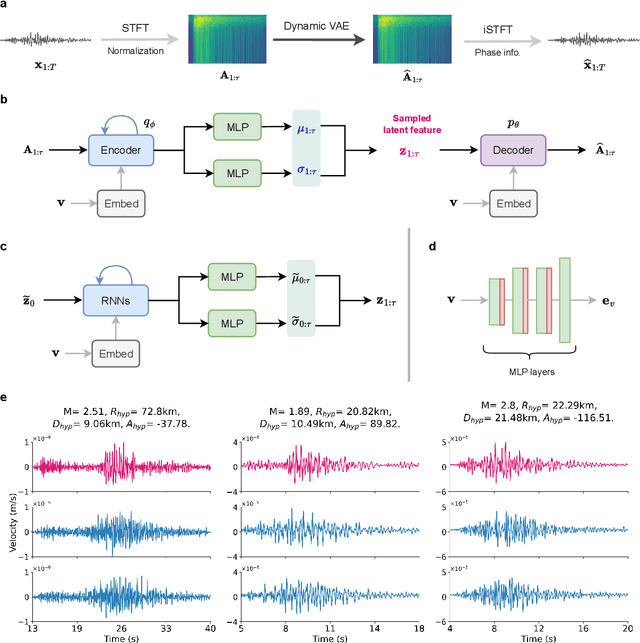
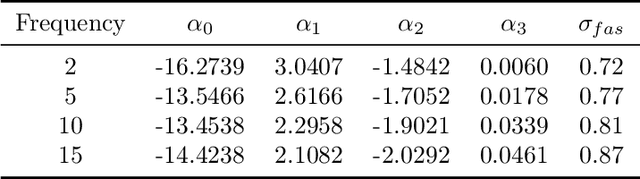
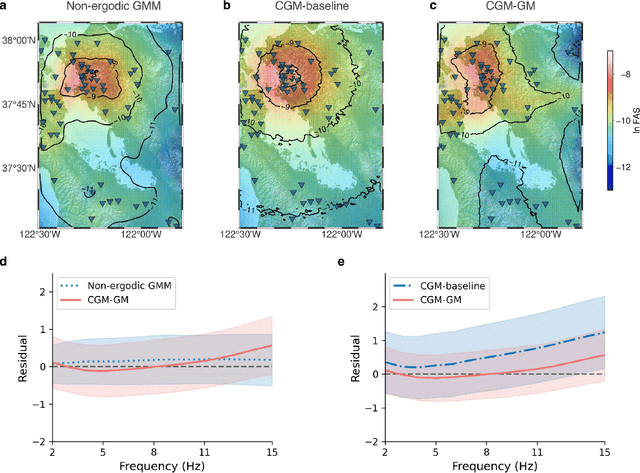
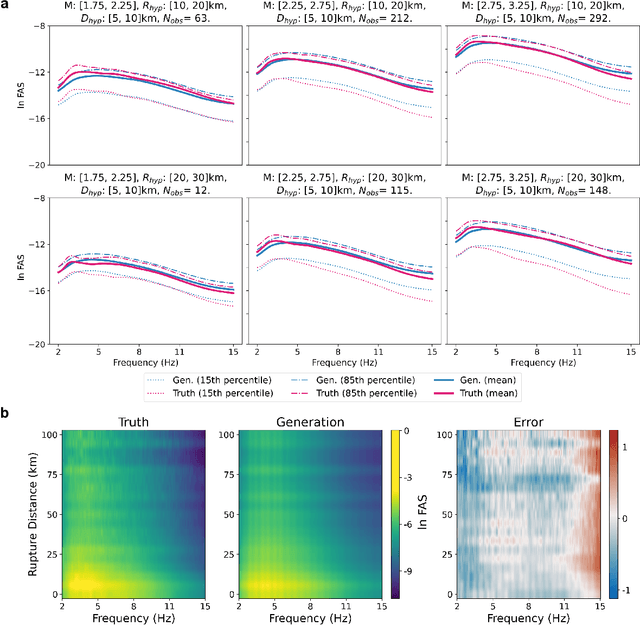
Predicting high-fidelity ground motions for future earthquakes is crucial for seismic hazard assessment and infrastructure resilience. Conventional empirical simulations suffer from sparse sensor distribution and geographically localized earthquake locations, while physics-based methods are computationally intensive and require accurate representations of Earth structures and earthquake sources. We propose a novel artificial intelligence (AI) simulator, Conditional Generative Modeling for Ground Motion (CGM-GM), to synthesize high-frequency and spatially continuous earthquake ground motion waveforms. CGM-GM leverages earthquake magnitudes and geographic coordinates of earthquakes and sensors as inputs, learning complex wave physics and Earth heterogeneities, without explicit physics constraints. This is achieved through a probabilistic autoencoder that captures latent distributions in the time-frequency domain and variational sequential models for prior and posterior distributions. We evaluate the performance of CGM-GM using small-magnitude earthquake records from the San Francisco Bay Area, a region with high seismic risks. CGM-GM demonstrates a strong potential for outperforming a state-of-the-art non-ergodic empirical ground motion model and shows great promise in seismology and beyond.
WaveCastNet: An AI-enabled Wavefield Forecasting Framework for Earthquake Early Warning
May 30, 2024


Large earthquakes can be destructive and quickly wreak havoc on a landscape. To mitigate immediate threats, early warning systems have been developed to alert residents, emergency responders, and critical infrastructure operators seconds to a minute before seismic waves arrive. These warnings provide time to take precautions and prevent damage. The success of these systems relies on fast, accurate predictions of ground motion intensities, which is challenging due to the complex physics of earthquakes, wave propagation, and their intricate spatial and temporal interactions. To improve early warning, we propose a novel AI-enabled framework, WaveCastNet, for forecasting ground motions from large earthquakes. WaveCastNet integrates a novel convolutional Long Expressive Memory (ConvLEM) model into a sequence to sequence (seq2seq) forecasting framework to model long-term dependencies and multi-scale patterns in both space and time. WaveCastNet, which shares weights across spatial and temporal dimensions, requires fewer parameters compared to more resource-intensive models like transformers and thus, in turn, reduces inference times. Importantly, WaveCastNet also generalizes better than transformer-based models to different seismic scenarios, including to more rare and critical situations with higher magnitude earthquakes. Our results using simulated data from the San Francisco Bay Area demonstrate the capability to rapidly predict the intensity and timing of destructive ground motions. Importantly, our proposed approach does not require estimating earthquake magnitudes and epicenters, which are prone to errors using conventional approaches; nor does it require empirical ground motion models, which fail to capture strongly heterogeneous wave propagation effects.