 Add to Chrome
 Add to Firefox
 Add to Edge
Evaluating Risks in Weak-to-Strong Alignment: A Bias-Variance Perspective
Apr 28, 2026
Weak-to-strong alignment offers a promising route to scalable supervision, but it can fail when a strong model becomes confidently wrong on examples that lie in the weak teacher's blind spots. Understanding such failures requires going beyond aggregate accuracy, since weak-to-strong errors depend not only on whether the strong model disagrees with its teacher, but also on how confidence and uncertainty are distributed across examples. In this work, we analyze weak-to-strong alignment through a bias-variance-covariance lens that connects misfit theory to practical post-training pipelines. We derive a misfit-based upper bound on weak-to-strong population risk and study its empirical components using continuous confidence scores. We evaluate four weak-to-strong pipelines spanning supervised fine-tuning (SFT), reinforcement learning from human feedback (RLHF), and reinforcement learning from AI feedback (RLAIF) on the PKU-SafeRLHF and HH-RLHF datasets. Using a blind-spot deception metric that isolates cases where the strong model is confidently wrong while the weak model is uncertain, we find that strong-model variance is the strongest empirical predictor of deception across our settings. Covariance provides additional but weaker information, indicating that weak-strong dependence matters, but does not by itself explain the observed failures. These results suggest that strong-model variance can serve as an early-warning signal for weak-to-strong deception, while blind-spot evaluation helps distinguish whether failures are inherited from weak supervision or arise in regions of weak-model uncertainty.

Leveraging State Space Models in Long Range Genomics
Apr 07, 2025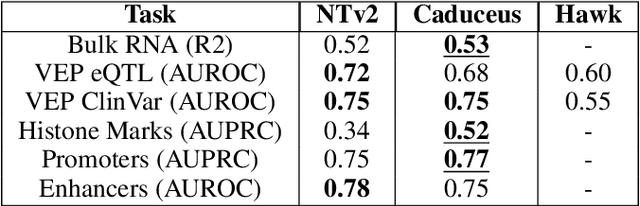
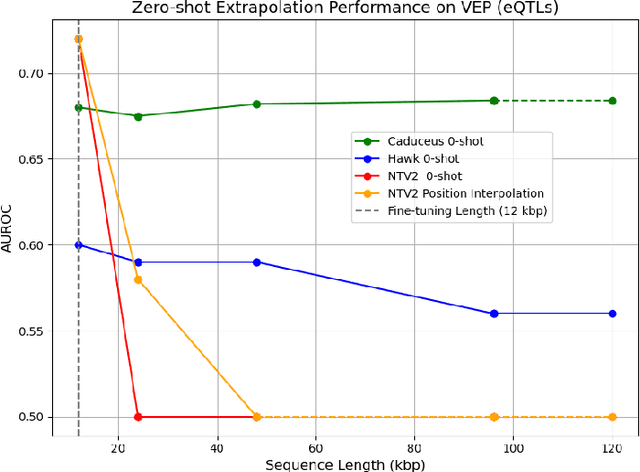
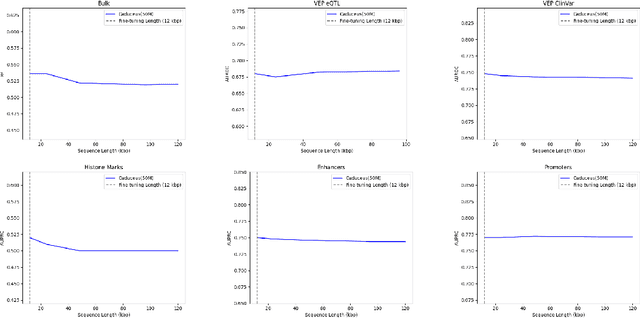
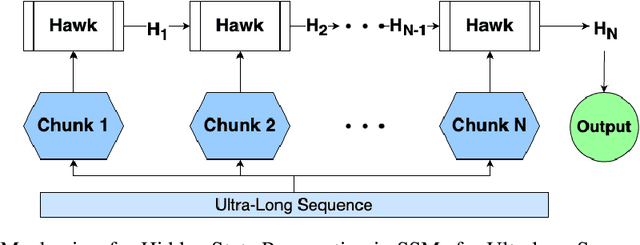
Long-range dependencies are critical for understanding genomic structure and function, yet most conventional methods struggle with them. Widely adopted transformer-based models, while excelling at short-context tasks, are limited by the attention module's quadratic computational complexity and inability to extrapolate to sequences longer than those seen in training. In this work, we explore State Space Models (SSMs) as a promising alternative by benchmarking two SSM-inspired architectures, Caduceus and Hawk, on long-range genomics modeling tasks under conditions parallel to a 50M parameter transformer baseline. We discover that SSMs match transformer performance and exhibit impressive zero-shot extrapolation across multiple tasks, handling contexts 10 to 100 times longer than those seen during training, indicating more generalizable representations better suited for modeling the long and complex human genome. Moreover, we demonstrate that these models can efficiently process sequences of 1M tokens on a single GPU, allowing for modeling entire genomic regions at once, even in labs with limited compute. Our findings establish SSMs as efficient and scalable for long-context genomic analysis.