 Add to Chrome
 Add to Firefox
 Add to Edge
G-RRM: Guiding Symbolic Solvers with Recurrent Reasoning Models
Jul 02, 2026
In this work, we focus on SE-RRMs, a symbol-equivariant instantiation of RRMs that exhibits improved extrapolation to larger problem sizes. We propose a neuro-symbolic approach, ``Guiding with Recurrent Reasoning Models'' (G-RRM), which integrates SE-RRMs with symbolic solvers for constraint satisfaction problems. SE-RRMs act as neural solvers that generate full solution proposals and guide classical symbolic solvers, such as backtracking or SAT-based methods like Glucose 4.1 and CaDiCaL 3.0.0, that produce globally correct solutions. Centrally, we investigate when neural guidance with G-RRM improves the search efficiency of symbolic solvers. % Our experiments show that the efficacy of G-RRM depends on two conditions: first, the problem instances must have an expansive combinatorial search space to expose potential gains, and second, the solver architecture must be capable of dynamically overwriting its branching choices to recover when neural hints are imperfect. When these conditions hold, guidance drives median conflict counts to zero and yields significant wall-clock speedups: on $9\times9$ Sudoku, where the SE-RRM correctly solves $91.1\%$ of instances, backtracking accelerates by $33.3\times$ and Glucose 4.1 by $1.70\times$ (median, $p<0.001$), with Glucose 4.1 retaining a $1.17\times$ speedup on perfect-hint $25\times25$ grids. In contrast, CaDiCaL 3.0.0, whose runtime is overhead-dominated and which always respects the injected branching hints rather than overwriting them, shows no significant speedup (median $1.02\times$, n.s.) and even a small significant mean slowdown ($0.90\times$) on $9\times9$. These results delineate the regimes in which neural guidance translates into practical speedups.

Symbol-Equivariant Recurrent Reasoning Models
Mar 02, 2026Reasoning problems such as Sudoku and ARC-AGI remain challenging for neural networks. The structured problem solving architecture family of Recurrent Reasoning Models (RRMs), including Hierarchical Reasoning Model (HRM) and Tiny Recursive Model (TRM), offer a compact alternative to large language models, but currently handle symbol symmetries only implicitly via costly data augmentation. We introduce Symbol-Equivariant Recurrent Reasoning Models (SE-RRMs), which enforce permutation equivariance at the architectural level through symbol-equivariant layers, guaranteeing identical solutions under symbol or color permutations. SE-RRMs outperform prior RRMs on 9x9 Sudoku and generalize from just training on 9x9 to smaller 4x4 and larger 16x16 and 25x25 instances, to which existing RRMs cannot extrapolate. On ARC-AGI-1 and ARC-AGI-2, SE-RRMs achieve competitive performance with substantially less data augmentation and only 2 million parameters, demonstrating that explicitly encoding symmetry improves the robustness and scalability of neural reasoning. Code is available at https://github.com/ml-jku/SE-RRM.
pLSTM: parallelizable Linear Source Transition Mark networks
Jun 13, 2025Modern recurrent architectures, such as xLSTM and Mamba, have recently challenged the Transformer in language modeling. However, their structure constrains their applicability to sequences only or requires processing multi-dimensional data structures, such as images or molecular graphs, in a pre-defined sequential order. In contrast, Multi-Dimensional RNNs (MDRNNs) are well suited for data with a higher level structure, like 2D grids, trees, and directed acyclic graphs (DAGs). In this work, we extend the notion of multi-dimensionality to linear RNNs. We introduce parallelizable Linear Source Transition Mark networks (pLSTMs) using Source, Transition, and Mark gates that act on the line graph of a general DAG. This enables parallelization in analogy to parallel associative scans and the chunkwise-recurrent form of sequential linear RNNs, but for DAGs. For regular grids (1D and 2D), like images, this scheme can be efficiently implemented using einsum operations, concatenations, and padding in logarithmic time. pLSTMs tackle the vanishing/exploding activation/gradient problem for long distances in DAGs via two distinct modes: a directed propagation mode (P-mode) and a diffusive distribution mode (D-mode). To showcase the long-range capabilities of pLSTM, we introduce arrow-pointing extrapolation as a synthetic computer vision task that contains long-distance directional information. We demonstrate that pLSTMs generalize well to larger image sizes, whereas Transformers struggle to extrapolate. On established molecular graph and computer vision benchmarks, pLSTMs also show strong performance. Code and Datasets are available at: https://github.com/ml-jku/plstm_experiments.
GNN-VPA: A Variance-Preserving Aggregation Strategy for Graph Neural Networks
Mar 07, 2024
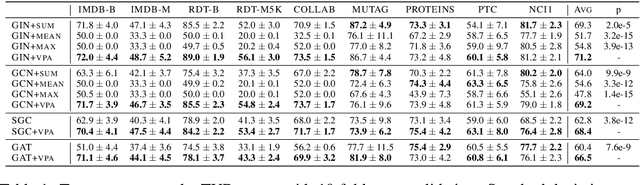
Graph neural networks (GNNs), and especially message-passing neural networks, excel in various domains such as physics, drug discovery, and molecular modeling. The expressivity of GNNs with respect to their ability to discriminate non-isomorphic graphs critically depends on the functions employed for message aggregation and graph-level readout. By applying signal propagation theory, we propose a variance-preserving aggregation function (VPA) that maintains expressivity, but yields improved forward and backward dynamics. Experiments demonstrate that VPA leads to increased predictive performance for popular GNN architectures as well as improved learning dynamics. Our results could pave the way towards normalizer-free or self-normalizing GNNs.