 Add to Chrome
 Add to Firefox
 Add to Edge
From Kellgren-Lawrence to Calcium Pyrophosphate Crystal Deposition: A Soft-Labelling Framework for Knee Osteoarthritis Assessmen
May 27, 2026
Background and objective. Conventional Deep Learning (DL) approaches for Knee Osteoarthritis (KOA) grading rely on one-hot labels, which fail to capture both the ordinal uncertainty of Kellgren--Lawrence (KL) and Calcium Pyrophosphate Deposition Disease (CPPD) severity scores and the asymmetric relationship between the two scales observed in clinical practice. Methods. We retrospectively collected 2172 knee X-ray images, including 968 radiographs jointly annotated for KL and CPPD severity. An ordinal DL framework based on soft-labelling was developed for both tasks, replacing one-hot targets with unimodal probability distributions centred on the annotated grade. Four formulations were investigated: binomial, beta, triangular, and exponential. Results. All soft-labelling strategies consistently outperformed the nominal baseline. For CPPD grading, the triangular formulation achieved the highest Quadratic Weighted Kappa (QWK) and the lowest Mean Absolute Error (MAE) (QWK = 0.796; MAE = 0.438), while the beta formulation yielded the most balanced class-wise performance considering Average MAE (AMAE) and Maximum MAE (MMAE) across classes (AMAE = 0.458; MMAE = 0.573). For KL grading, the beta-based approach provided the best overall performance, achieving the highest QWK together with the lowest MAE and class-wise errors (QWK = 0.777; MAE = 0.529; AMAE = 0.523; MMAE = 0.775). Statistical analysis demonstrated significant improvements over conventional one-hot supervision (p < 0.001).

dlordinal: a Python package for deep ordinal classification
Jul 24, 2024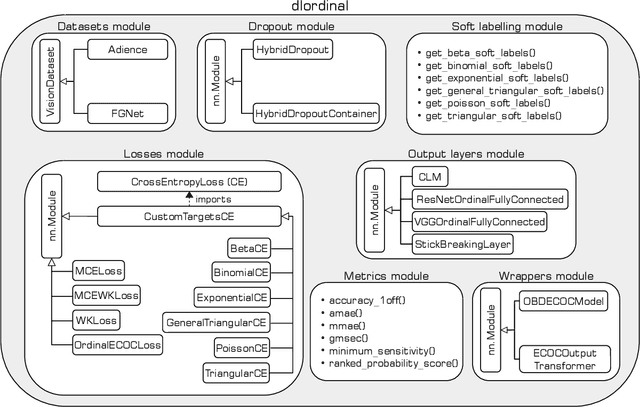
dlordinal is a new Python library that unifies many recent deep ordinal classification methodologies available in the literature. Developed using PyTorch as underlying framework, it implements the top performing state-of-the-art deep learning techniques for ordinal classification problems. Ordinal approaches are designed to leverage the ordering information present in the target variable. Specifically, it includes loss functions, various output layers, dropout techniques, soft labelling methodologies, and other classification strategies, all of which are appropriately designed to incorporate the ordinal information. Furthermore, as the performance metrics to assess novel proposals in ordinal classification depend on the distance between target and predicted classes in the ordinal scale, suitable ordinal evaluation metrics are also included. dlordinal is distributed under the BSD-3-Clause license and is available at https://github.com/ayrna/dlordinal.