 Add to Chrome
 Add to Firefox
 Add to Edge
AI-Assisted Scientific Assessment: A Case Study on Climate Change
Feb 10, 2026
The emerging paradigm of AI co-scientists focuses on tasks characterized by repeatable verification, where agents explore search spaces in 'guess and check' loops. This paradigm does not extend to problems where repeated evaluation is impossible and ground truth is established by the consensus synthesis of theory and existing evidence. We evaluate a Gemini-based AI environment designed to support collaborative scientific assessment, integrated into a standard scientific workflow. In collaboration with a diverse group of 13 scientists working in the field of climate science, we tested the system on a complex topic: the stability of the Atlantic Meridional Overturning Circulation (AMOC). Our results show that AI can accelerate the scientific workflow. The group produced a comprehensive synthesis of 79 papers through 104 revision cycles in just over 46 person-hours. AI contribution was significant: most AI-generated content was retained in the report. AI also helped maintain logical consistency and presentation quality. However, expert additions were crucial to ensure its acceptability: less than half of the report was produced by AI. Furthermore, substantial oversight was required to expand and elevate the content to rigorous scientific standards.

Robust detection and attribution of climate change under interventions
Dec 09, 2022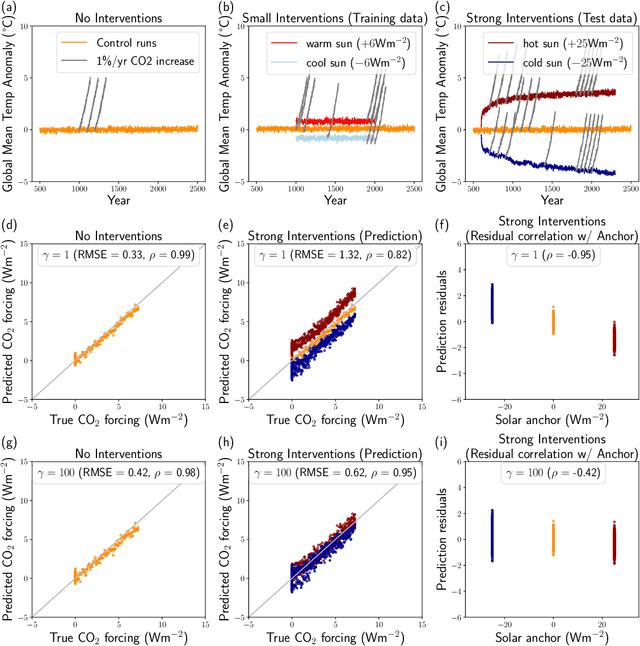
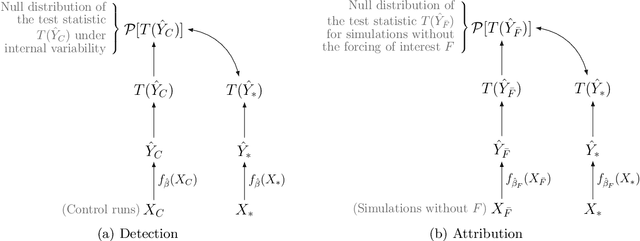
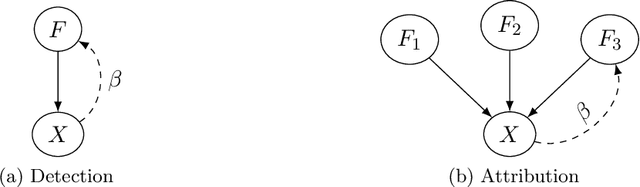
Fingerprints are key tools in climate change detection and attribution (D&A) that are used to determine whether changes in observations are different from internal climate variability (detection), and whether observed changes can be assigned to specific external drivers (attribution). We propose a direct D&A approach based on supervised learning to extract fingerprints that lead to robust predictions under relevant interventions on exogenous variables, i.e., climate drivers other than the target. We employ anchor regression, a distributionally-robust statistical learning method inspired by causal inference that extrapolates well to perturbed data under the interventions considered. The residuals from the prediction achieve either uncorrelatedness or mean independence with the exogenous variables, thus guaranteeing robustness. We define D&A as a unified hypothesis testing framework that relies on the same statistical model but uses different targets and test statistics. In the experiments, we first show that the CO2 forcing can be robustly predicted from temperature spatial patterns under strong interventions on the solar forcing. Second, we illustrate attribution to the greenhouse gases and aerosols while protecting against interventions on the aerosols and CO2 forcing, respectively. Our study shows that incorporating robustness constraints against relevant interventions may significantly benefit detection and attribution of climate change.