 Add to Chrome
 Add to Firefox
 Add to Edge
Leading-Silence Augmentation and Multi-Stage Synthetic Supervision for the Second MLC-SLM Challenge
Aug 14, 2026
The second Multilingual Conversational Speech Language Model (MLC-SLM) Challenge evaluates two tasks over complete, unsegmented multilingual conversations: speaker diarization and recognition (Task 1) and conversational speech understanding (Task 2). Neither task provides oracle utterance boundaries or speaker labels at evaluation, and Task 2 provides no question-answer training set. For Task 1, we fine-tune VibeVoice-ASR-7B with random leading-silence cropping, consistent timestamp correction, and an exponential moving average (EMA) training strategy. For Task 2, we construct synthetic question-answer pairs through multimodal candidate generation, silent-audio filtering, and distribution-matched augmentation, and fine-tune Qwen3-Omni-30B-A3B-Instruct for tagged direct answering. On the Task 1 evaluation set, cropping reduces tcpMER from 18.30% to 17.27%, and EMA further reduces it to 16.73%. On the Task 2 evaluation set, jointly applying distribution-matched augmentation and tagged direct answering raises accuracy from 83.0% to 86.0%.

Summary of DCASE 2026 Task 5: Audio-Dependent Question Answering
Jul 21, 2026DCASE~2026 Task~5 introduces Audio-Dependent Question Answering (ADQA), which tests whether large audio-language models answer from the audio rather than from textual priors. An Audio-Dependency Filtering (ADF) pipeline combines silent-audio probing, per-option perplexity, a large language model (LLM) commonsense check, and human review to remove items solvable from text alone. The 3000 items that pass form the ADQA-Bench evaluation set, spanning music, speech, and environmental audio. The inaugural edition draws 14 teams and 36 submissions across two tracks defined by total parameter count (up to 100B and under 10B). A Chung-Ang University ensemble of MOSS-Audio-8B-Thinking and Qwen3-Omni-30B reaches the top overall accuracy at \pct{58.33}, and a MOSS-only configuration from the same team leads the sub-10B track at \pct{57.30}. Across the 30 submissions with a comparable development score, evaluation accuracy falls by 11.91 percentage points (pp) on average (median 10.91\,pp) on the hidden evaluation split, which is designed to be harder than the development split. The most common building blocks are: the MOSS-Audio-8B-Thinking backbone (13 of 36 submissions), Low-Rank Adaptation (LoRA) fine-tuning on AudioMCQ-StrongAC, and preference or reinforcement-learning objectives -- Group Relative Policy Optimization (GRPO) in five teams, Group reward-Decoupled Normalization Policy Optimization (GDPO) in two. At test time, prompt engineering is near-universal, and majority or choice-permutation voting is common. Every system misses the same set of 233 evaluation items.
Natural Yet Challenging to Detect: Robust In-the-Wild TTS through EMA and Dual-Scoring Prompt Selection -- Submission for WildSpoof 2026 TTS Track
May 22, 2026In this technical report, we describe our submission for the WildSpoof Challenge TTS Track: Text-to-Speech with In-the-Wild Data. We introduce F5-TTS-DPS, a model built upon the F5-TTS architecture. Our approach integrates Exponential Moving Average (EMA) into supervised fine-tuning to stabilize training and improve generalization. To enhance synthesis fidelity, we leverage large language models (LLMs) and large audio language models (LALMs) for dual-scoring prompt selection, filtering reference audio and text prompts to ensure quality while addressing alignment issues in noisy datasets. Experimental evaluation demonstrates that F5-TTS-DPS achieves strong performance with UTMOS of 3.20 and speaker similarity of 0.51 on the development set. More importantly, our model achieves the best a-DCF scores of 0.1582, 0.5233, and 0.2562 across three advanced SASV systems among all submissions, indicating our synthesized speech is the most difficult to detect and exhibits the highest degree of naturalness and authenticity. Combined with competitive WER performance, these results validate the effectiveness of our approach in generating natural-sounding speech with strong spoofing capabilities.
EnvSSLAM-FFN: Lightweight Layer-Fused System for ESDD 2026 Challenge
Dec 23, 2025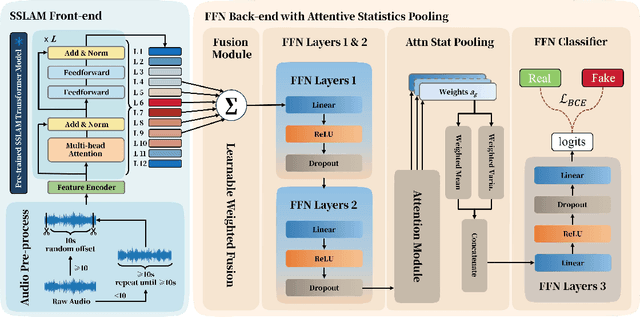
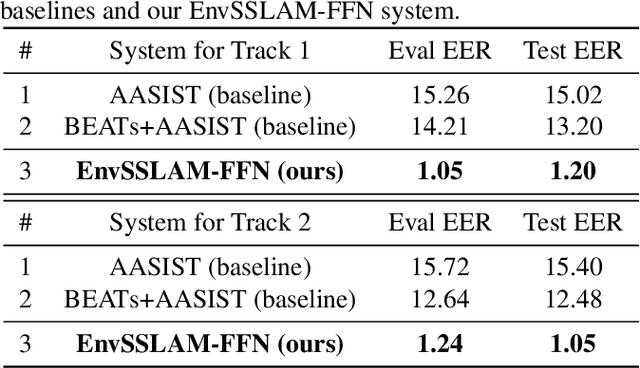
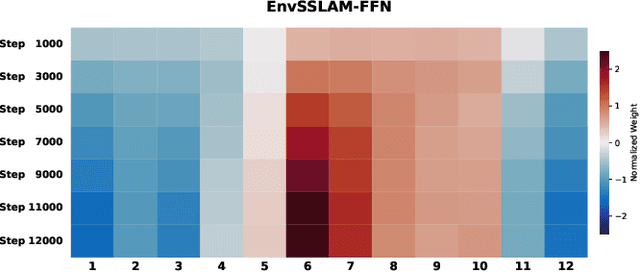
Recent advances in generative audio models have enabled high-fidelity environmental sound synthesis, raising serious concerns for audio security. The ESDD 2026 Challenge therefore addresses environmental sound deepfake detection under unseen generators (Track 1) and black-box low-resource detection (Track 2) conditions. We propose EnvSSLAM-FFN, which integrates a frozen SSLAM self-supervised encoder with a lightweight FFN back-end. To effectively capture spoofing artifacts under severe data imbalance, we fuse intermediate SSLAM representations from layers 4-9 and adopt a class-weighted training objective. Experimental results show that the proposed system consistently outperforms the official baselines on both tracks, achieving Test Equal Error Rates (EERs) of 1.20% and 1.05%, respectively.