 Add to Chrome
 Add to Firefox
 Add to Edge
TensorHub: Scalable and Elastic Weight Transfer for LLM RL Training
Apr 10, 2026
Modern LLM reinforcement learning (RL) workloads require a highly efficient weight transfer system to scale training across heterogeneous computational resources. However, existing weight transfer approaches either fail to provide flexibility for dynamically scaling clusters or incur fundamental data movement overhead, resulting in poor performance. We introduce Reference-Oriented Storage (ROS), a new storage abstraction for RL weight transfer that exploits the highly replicated model weights in place. ROS presents the illusion that certain versions of the model weights are stored and can be fetched on demand. Underneath, ROS does not physically store any copies of the weights; instead, it tracks the workers that hold these weights on GPUs for inference. Upon request, ROS directly uses them to serve reads. We build TensorHub, a production-quality system that extends the ROS idea with topology-optimized transfer, strong consistency, and fault tolerance. Evaluation shows that TensorHub fully saturates RDMA bandwidth and adapts to three distinct rollout workloads with minimal engineering effort. Specifically, TensorHub reduces total GPU stall time by up to 6.7x for standalone rollouts, accelerates weight update for elastic rollout by 4.8x, and cuts cross-datacenter rollout stall time by 19x. TensorHub has been deployed in production to support cutting-edge RL training.

Learning How To Learn Within An LSM-based Key-Value Store
May 28, 2020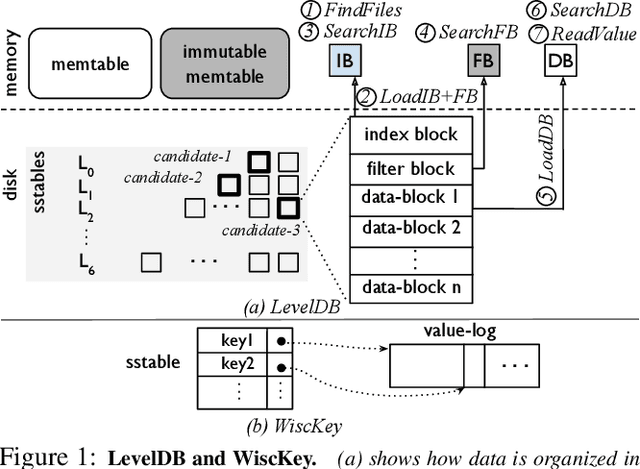
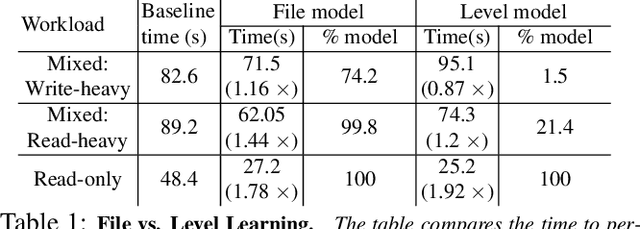
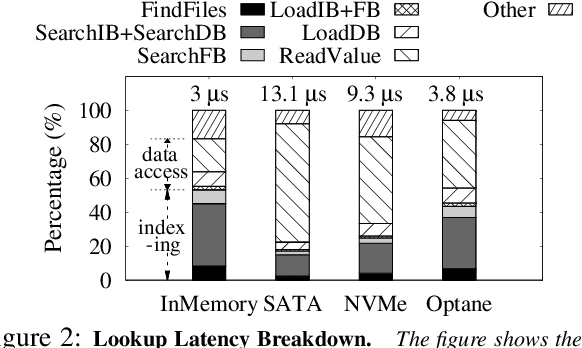
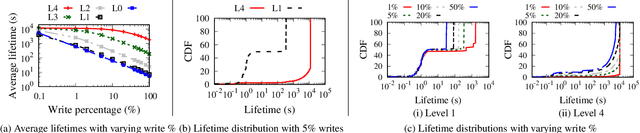
We introduce BOURBON, a log-structured merge (LSM) tree that utilizes machine learning to provide fast lookups. We base the design and implementation of BOURBON on empirically grounded principles that we derive through careful analysis of LSM design. BOURBON employs greedy piecewise linear regression to learn key distributions, enabling fast lookup with minimal computation, and applies a cost-benefit strategy to decide when learning will be worthwhile. Through a series of experiments on both synthetic and real-world datasets, we show that BOURBON improves lookup performance by 1.23x-1.78x as compared to state-of-the-art production LSMs.