 Add to Chrome
 Add to Firefox
 Add to Edge
Spatiotemporal Tube-Based Safety-Certificate for Autonomous Navigation of Articulated Vehicles
Aug 14, 2026
Articulated vehicles are the workhorses of freight transportation, and their autonomous navigation is challenging. Their physical characteristics and motion constraints pose significant challenges in manoeuvring these vehicles on narrow routes. This paper presents a spatiotemporal tube-based approach to plan autonomous navigation of vehicles like tractor semi-trailers, truck/ tractor trailers, towing Automated Guided Vehicles (AGVs), and road trains. This planning approach provides a certified path plan for the truck or tractor, ensuring that the towed series of trailers always remains within the road corridor, limited by permissible corrections. The planning leverages the kinematics of the linked elements along with sway constraints to arrive at a safe tube for the actuated prime mover. We modify the spatiotemporal tube using permissible corrections to provide a route safety certificate to the vehicle for the given route. The proposed planning method is verified on a truck-trailer navigation simulation for a complex route.

Input-Constrained Spatiotemporal Tubes for Safe Navigation of Unknown Euler-Lagrange Systems in Dynamic Environments
Jul 09, 2026Safe navigation in dynamic environments is challenging when system dynamics are unknown and actuator inputs are limited. Existing methods either rely on accurate models, require online optimization, or do not explicitly account for input constraints. This paper presents a real-time control framework for unknown Euler-Lagrange systems that guarantees finite-time reach-avoid-stay (FT-RAS) specifications while respecting actuator limits. We extend the spatiotemporal tube (STT) framework by incorporating input constraints into the controller design and derive offline-verifiable feasibility conditions that relate the available control authority to the tube design and uncertainty bounds. The resulting framework is approximation-free and computationally efficient, making it suitable for real-time implementation. The proposed approach is validated through simulations on a mobile robot, a quadrotor, and a spacecraft, together with hardware experiments on a mobile robot, demonstrating safe navigation while satisfying actuator constraints.
Learning Spatiotemporal Tubes for Full Class of Signal Temporal Logic Tasks for Control of Unknown Systems under Input Constraints
Jul 08, 2026This paper presents a Spatiotemporal Tube (STT)-based control framework for general unknown nonlinear Euler-Lagrange (EL) systems subject to input constraints, with the objective of satisfying Signal Temporal Logic (STL) specifications, where confinement of the system trajectory within the STT guarantees the satisfaction of the corresponding STL task. For both single and multi-agent scenarios, the STT corresponding to each agent is modeled as a time-varying ball, whose center and radius are jointly parameterized using a physics-informed neural network (PINN). The robustness metric associated with the STL specification corresponding to the agents is incorporated into the training process as a loss function, enabling the learned tube to encode task-level temporal requirements. For a multi-agent scenario, we introduce an additional robustness metric corresponding to the global task, which, when satisfied, ensures the tubes do not collide with each other. To ensure that the system trajectory remains within the learned STT and thereby satisfies the local and global STL specifications, we propose a control strategy that explicitly accounts for input constraints. In particular, a closed-form control law is developed to keep the trajectory inside the tube while regulating the motion of the tube by enforcing bounds on its evolution depending on the input constraints of the system. The proposed approach has been validated over several case studies.
Learning from Demonstration via Spatiotemporal Tubes for Unknown Euler-Lagrange Systems
Jul 01, 2026We present STT-LfD, a unified Learning from Demonstration (LfD) framework that integrates motion learning with control for unknown Euler-Lagrange systems. Unlike traditional decoupled approaches that track a fixed reference, the proposed method treats demonstrations as a data-driven safety specification. Using heteroscedastic Gaussian Processes, STT-LfD learns Spatiotemporal Tubes (STTs) as an intent envelope that capture time-varying precision requirements of a task. A closed-form feedback controller then enforces these learned constraints while respecting actuator limits, without requiring explicit system identification. The approach preserves the temporal structure of demonstrations, remains computationally efficient, and avoids explicit system identification. Hardware experiments on a mobile robot and a 7-DOF manipulator show that it outperforms baselines in robustness to disturbances and computational speed.
Spatiotemporal Tubes for Probabilistic Temporal Reach-Avoid-Stay Task in Uncertain Dynamic Environment
Dec 25, 2025In this work, we extend the Spatiotemporal Tube (STT) framework to address Probabilistic Temporal Reach-Avoid-Stay (PrT-RAS) tasks in dynamic environments with uncertain obstacles. We develop a real-time tube synthesis procedure that explicitly accounts for time-varying uncertain obstacles and provides formal probabilistic safety guarantees. The STT is formulated as a time-varying ball in the state space whose center and radius evolve online based on uncertain sensory information. We derive a closed-form, approximation-free control law that confines the system trajectory within the tube, ensuring both probabilistic safety and task satisfaction. Our method offers a formal guarantee for probabilistic avoidance and finite-time task completion. The resulting controller is model-free, approximation-free, and optimization-free, enabling efficient real-time execution while guaranteeing convergence to the target. The effectiveness and scalability of the framework are demonstrated through simulation studies and hardware experiments on mobile robots, a UAV, and a 7-DOF manipulator navigating in cluttered and uncertain environments.
Learning Spatiotemporal Tubes for Temporal Reach-Avoid-Stay Tasks using Physics-Informed Neural Networks
Dec 09, 2025This paper presents a Spatiotemporal Tube (STT)-based control framework for general control-affine MIMO nonlinear pure-feedback systems with unknown dynamics to satisfy prescribed time reach-avoid-stay tasks under external disturbances. The STT is defined as a time-varying ball, whose center and radius are jointly approximated by a Physics-Informed Neural Network (PINN). The constraints governing the STT are first formulated as loss functions of the PINN, and a training algorithm is proposed to minimize the overall violation. The PINN being trained on certain collocation points, we propose a Lipschitz-based validity condition to formally verify that the learned PINN satisfies the conditions over the continuous time horizon. Building on the learned STT representation, an approximation-free closed-form controller is defined to guarantee satisfaction of the T-RAS specification. Finally, the effectiveness and scalability of the framework are validated through two case studies involving a mobile robot and an aerial vehicle navigating through cluttered environments.
Approximation-free Control of Unknown Euler-Lagrangian Systems under Input Constraints
Jul 02, 2025In this paper, we present a novel funnel-based tracking control algorithm for robotic systems with unknown dynamics and prescribed input constraints. The Euler-Lagrange formulation, a common modeling approach for robotic systems, has been adopted in this study to address the trade-off between performance and actuator safety. We establish feasibility conditions that ensure tracking errors evolve within predefined funnel bounds while maintaining bounded control efforts, a crucial consideration for robots with limited actuation capabilities. We propose two approximation-free control strategies for scenarios where these conditions are violated: one actively corrects the error, and the other stops further deviation. Finally, we demonstrate the robust performance and safety of the approach through simulations and experimental validations. This work represents a significant advancement in funnel-based control, enhancing its applicability to real-world robotics systems with input constraints.
Control Barrier Functions for Prescribed-time Reach-Avoid-Stay Tasks using Spatiotemporal Tubes
Mar 11, 2025Prescribed-time reach-avoid-stay (PT-RAS) specifications are crucial in applications requiring precise timing, state constraints, and safety guarantees. While control carrier functions (CBFs) have emerged as a promising approach, providing formal guarantees of safety, constructing CBFs that satisfy PT-RAS specifications remains challenging. In this paper, we present a novel approach using a spatiotemporal tubes (STTs) framework to construct CBFs for PT-RAS tasks. The STT framework allows for the systematic design of CBFs that dynamically manage both spatial and temporal constraints, ensuring the system remains within a safe operational envelope while achieving the desired temporal objectives. The proposed method is validated with two case studies: temporal motion planning of an omnidirectional robot and temporal waypoint navigation of a drone with obstacles, using higher-order CBFs.
Spatiotemporal Tubes for Temporal Reach-Avoid-Stay Tasks in Unknown Systems
Nov 21, 2024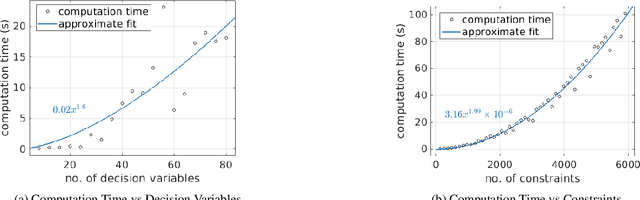
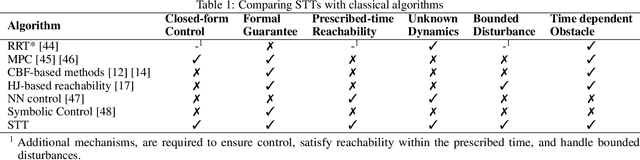
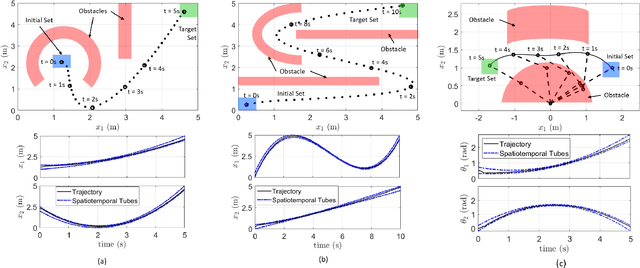
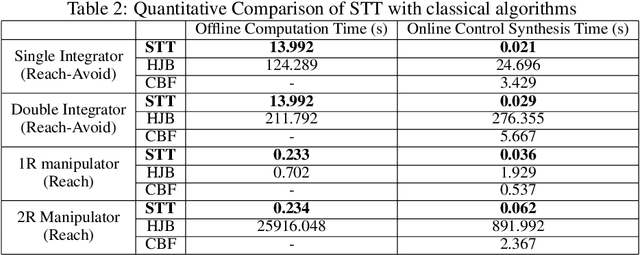
The paper considers the controller synthesis problem for general MIMO systems with unknown dynamics, aiming to fulfill the temporal reach-avoid-stay task, where the unsafe regions are time-dependent, and the target must be reached within a specified time frame. The primary aim of the paper is to construct the spatiotemporal tube (STT) using a sampling-based approach and thereby devise a closed-form approximation-free control strategy to ensure that system trajectory reaches the target set while avoiding time-dependent unsafe sets. The proposed scheme utilizes a novel method involving STTs to provide controllers that guarantee both system safety and reachability. In our sampling-based framework, we translate the requirements of STTs into a Robust optimization program (ROP). To address the infeasibility of ROP caused by infinite constraints, we utilize the sampling-based Scenario optimization program (SOP). Subsequently, we solve the SOP to generate the tube and closed-form controller for an unknown system, ensuring the temporal reach-avoid-stay specification. Finally, the effectiveness of the proposed approach is demonstrated through three case studies: an omnidirectional robot, a SCARA manipulator, and a magnetic levitation system.
RRT* Based Optimal Trajectory Generation with Linear Temporal Logic Specifications under Kinodynamic Constraints
Nov 09, 2024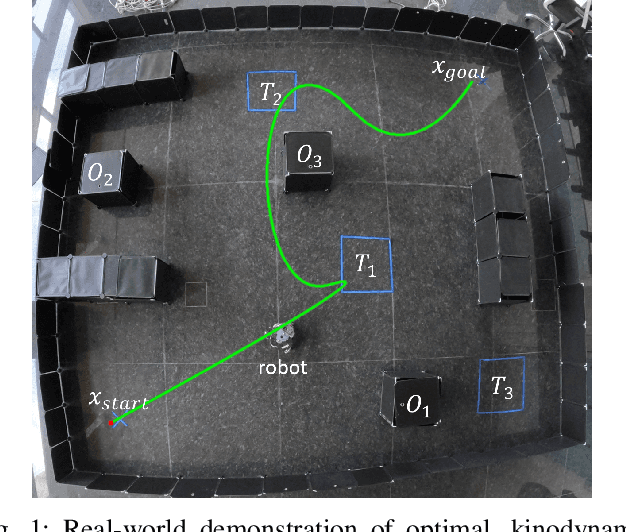
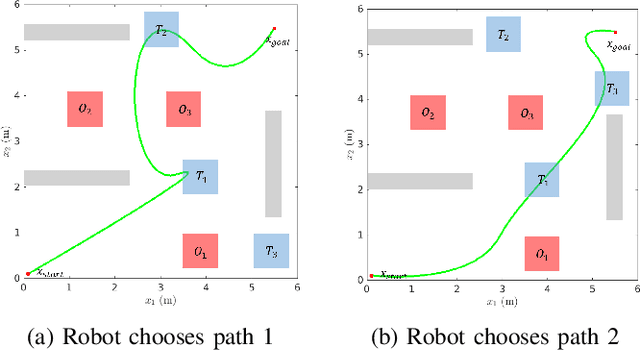
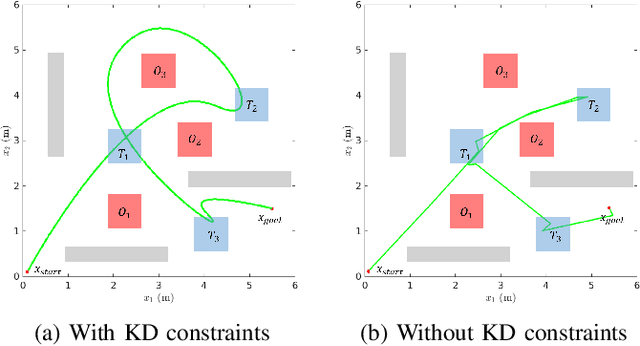
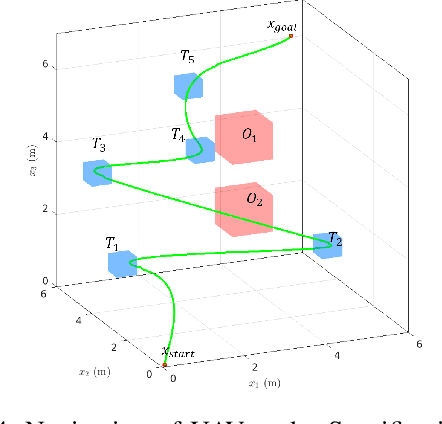
In this paper, we present a novel RRT*-based strategy for generating kinodynamically feasible paths that satisfy temporal logic specifications. Our approach integrates a robustness metric for Linear Temporal Logics (LTL) with the system's motion constraints, ensuring that the resulting trajectories are both optimal and executable. We introduce a cost function that recursively computes the robustness of temporal logic specifications while penalizing time and control effort, striking a balance between path feasibility and logical correctness. We validate our approach with simulations and real-world experiments in complex environments, demonstrating its effectiveness in producing robust and practical motion plans. This work represents a significant step towards expanding the applicability of motion planning algorithms to more complex, real-world scenarios.