 Add to Chrome
 Add to Firefox
 Add to Edge
Learning Spatiotemporal Tubes for Full Class of Signal Temporal Logic Tasks for Control of Unknown Systems under Input Constraints
Jul 08, 2026
This paper presents a Spatiotemporal Tube (STT)-based control framework for general unknown nonlinear Euler-Lagrange (EL) systems subject to input constraints, with the objective of satisfying Signal Temporal Logic (STL) specifications, where confinement of the system trajectory within the STT guarantees the satisfaction of the corresponding STL task. For both single and multi-agent scenarios, the STT corresponding to each agent is modeled as a time-varying ball, whose center and radius are jointly parameterized using a physics-informed neural network (PINN). The robustness metric associated with the STL specification corresponding to the agents is incorporated into the training process as a loss function, enabling the learned tube to encode task-level temporal requirements. For a multi-agent scenario, we introduce an additional robustness metric corresponding to the global task, which, when satisfied, ensures the tubes do not collide with each other. To ensure that the system trajectory remains within the learned STT and thereby satisfies the local and global STL specifications, we propose a control strategy that explicitly accounts for input constraints. In particular, a closed-form control law is developed to keep the trajectory inside the tube while regulating the motion of the tube by enforcing bounds on its evolution depending on the input constraints of the system. The proposed approach has been validated over several case studies.

Learning Spatiotemporal Tubes for Temporal Reach-Avoid-Stay Tasks using Physics-Informed Neural Networks
Dec 09, 2025This paper presents a Spatiotemporal Tube (STT)-based control framework for general control-affine MIMO nonlinear pure-feedback systems with unknown dynamics to satisfy prescribed time reach-avoid-stay tasks under external disturbances. The STT is defined as a time-varying ball, whose center and radius are jointly approximated by a Physics-Informed Neural Network (PINN). The constraints governing the STT are first formulated as loss functions of the PINN, and a training algorithm is proposed to minimize the overall violation. The PINN being trained on certain collocation points, we propose a Lipschitz-based validity condition to formally verify that the learned PINN satisfies the conditions over the continuous time horizon. Building on the learned STT representation, an approximation-free closed-form controller is defined to guarantee satisfaction of the T-RAS specification. Finally, the effectiveness and scalability of the framework are validated through two case studies involving a mobile robot and an aerial vehicle navigating through cluttered environments.
Spatiotemporal Tubes for Temporal Reach-Avoid-Stay Tasks in Unknown Systems
Nov 21, 2024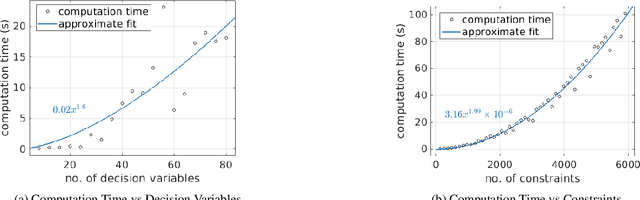
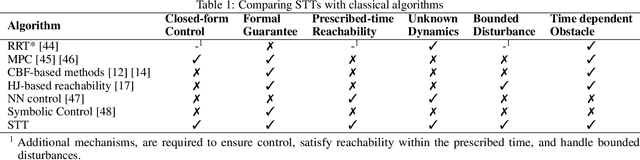
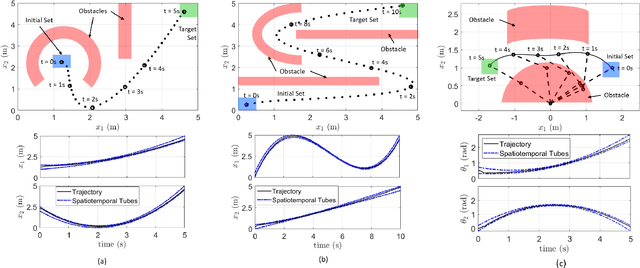
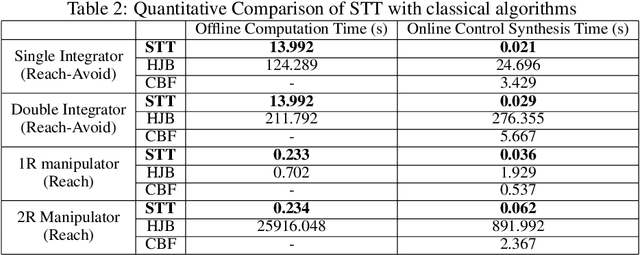
The paper considers the controller synthesis problem for general MIMO systems with unknown dynamics, aiming to fulfill the temporal reach-avoid-stay task, where the unsafe regions are time-dependent, and the target must be reached within a specified time frame. The primary aim of the paper is to construct the spatiotemporal tube (STT) using a sampling-based approach and thereby devise a closed-form approximation-free control strategy to ensure that system trajectory reaches the target set while avoiding time-dependent unsafe sets. The proposed scheme utilizes a novel method involving STTs to provide controllers that guarantee both system safety and reachability. In our sampling-based framework, we translate the requirements of STTs into a Robust optimization program (ROP). To address the infeasibility of ROP caused by infinite constraints, we utilize the sampling-based Scenario optimization program (SOP). Subsequently, we solve the SOP to generate the tube and closed-form controller for an unknown system, ensuring the temporal reach-avoid-stay specification. Finally, the effectiveness of the proposed approach is demonstrated through three case studies: an omnidirectional robot, a SCARA manipulator, and a magnetic levitation system.