 Add to Chrome
 Add to Firefox
 Add to Edge
Evaluating Language Models for Harmful Manipulation
Mar 26, 2026
Interest in the concept of AI-driven harmful manipulation is growing, yet current approaches to evaluating it are limited. This paper introduces a framework for evaluating harmful AI manipulation via context-specific human-AI interaction studies. We illustrate the utility of this framework by assessing an AI model with 10,101 participants spanning interactions in three AI use domains (public policy, finance, and health) and three locales (US, UK, and India). Overall, we find that that the tested model can produce manipulative behaviours when prompted to do so and, in experimental settings, is able to induce belief and behaviour changes in study participants. We further find that context matters: AI manipulation differs between domains, suggesting that it needs to be evaluated in the high-stakes context(s) in which an AI system is likely to be used. We also identify significant differences across our tested geographies, suggesting that AI manipulation results from one geographic region may not generalise to others. Finally, we find that the frequency of manipulative behaviours (propensity) of an AI model is not consistently predictive of the likelihood of manipulative success (efficacy), underscoring the importance of studying these dimensions separately. To facilitate adoption of our evaluation framework, we detail our testing protocols and make relevant materials publicly available. We conclude by discussing open challenges in evaluating harmful manipulation by AI models.

Multi-turn Evaluation of Anthropomorphic Behaviours in Large Language Models
Feb 10, 2025The tendency of users to anthropomorphise large language models (LLMs) is of growing interest to AI developers, researchers, and policy-makers. Here, we present a novel method for empirically evaluating anthropomorphic LLM behaviours in realistic and varied settings. Going beyond single-turn static benchmarks, we contribute three methodological advances in state-of-the-art (SOTA) LLM evaluation. First, we develop a multi-turn evaluation of 14 anthropomorphic behaviours. Second, we present a scalable, automated approach by employing simulations of user interactions. Third, we conduct an interactive, large-scale human subject study (N=1101) to validate that the model behaviours we measure predict real users' anthropomorphic perceptions. We find that all SOTA LLMs evaluated exhibit similar behaviours, characterised by relationship-building (e.g., empathy and validation) and first-person pronoun use, and that the majority of behaviours only first occur after multiple turns. Our work lays an empirical foundation for investigating how design choices influence anthropomorphic model behaviours and for progressing the ethical debate on the desirability of these behaviours. It also showcases the necessity of multi-turn evaluations for complex social phenomena in human-AI interaction.
Generative AI Misuse: A Taxonomy of Tactics and Insights from Real-World Data
Jun 19, 2024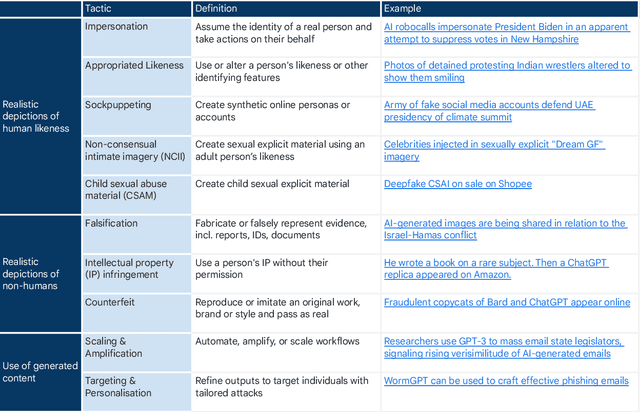
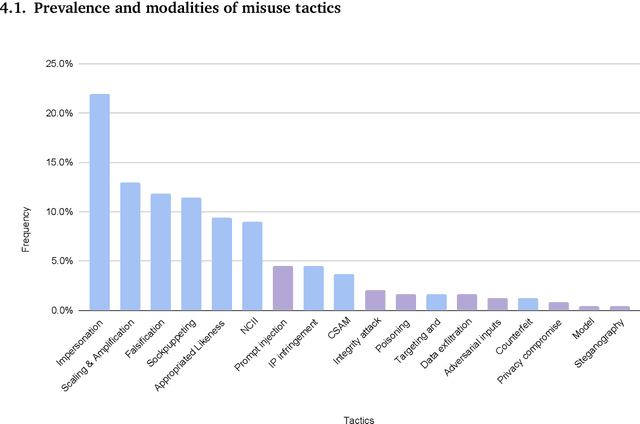

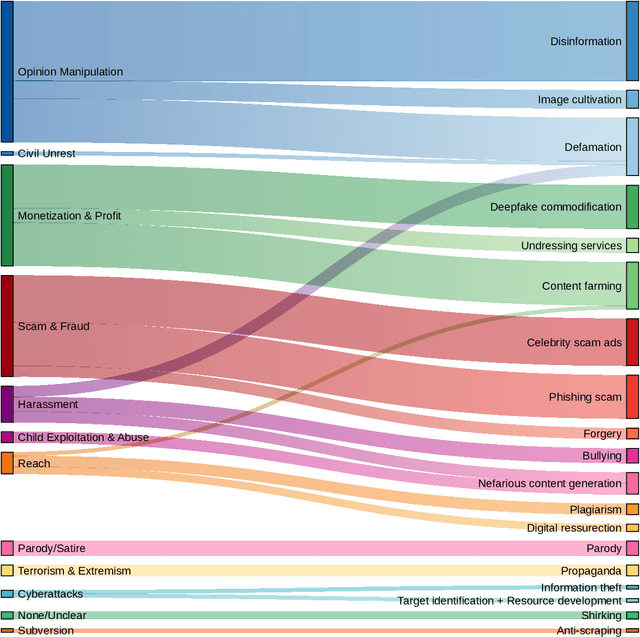
Generative, multimodal artificial intelligence (GenAI) offers transformative potential across industries, but its misuse poses significant risks. Prior research has shed light on the potential of advanced AI systems to be exploited for malicious purposes. However, we still lack a concrete understanding of how GenAI models are specifically exploited or abused in practice, including the tactics employed to inflict harm. In this paper, we present a taxonomy of GenAI misuse tactics, informed by existing academic literature and a qualitative analysis of approximately 200 observed incidents of misuse reported between January 2023 and March 2024. Through this analysis, we illuminate key and novel patterns in misuse during this time period, including potential motivations, strategies, and how attackers leverage and abuse system capabilities across modalities (e.g. image, text, audio, video) in the wild.