 Add to Chrome
 Add to Firefox
 Add to Edge
1000 Rallies: An Event-Camera Dataset and Real-Time Learned Ball-State Estimation for Robotic Table Tennis
Jun 24, 2026
Robotic table tennis has emerged as a compelling benchmark for real-time robotic perception due to its fast ball dynamics and stringent timing requirements. Accurate, high-frequency, and low-latency ball state estimation is critical for reliable trajectory prediction and timely control. Traditional frame-based cameras face an inherent trade-off: low frame rates leave temporal blind spots that miss fast-moving objects and high frame rates raise data and computational cost. Event cameras instead offer microsecond temporal resolution and, under sufficient illumination, remain largely free of motion blur even at high ball speeds. However, the community lacks large-scale datasets to develop and benchmark event-based perception in realistic sports scenarios. We address this gap by introducing the first large-scale event-camera dataset for table tennis, comprising over 1000 rallies from a diverse group of players ranging from amateurs to elite-level athletes. Each recording captures the event stream alongside 14 synchronized high-speed frame-based cameras at 200 FPS, which we use to produce 1 kHz pseudo ground-truth labels for ball position, velocity, and spin. Building on this dataset, we train a convolutional neural network robust to background player motion that jointly estimates the ball's position and velocity in the image-plane from events. Treating the predicted velocity as an additional measurement in the Kalman filter reduces bounce-point prediction error by 36% relative to a position-only baseline. Finally, we close the perception-action loop by integrating the event-based system with a Stäubli robotic arm, enabling the first real-time human-robot table tennis rallies driven by event-based perception.

Visual Pattern Recognition with on On-chip Learning: towards a Fully Neuromorphic Approach
Aug 08, 2020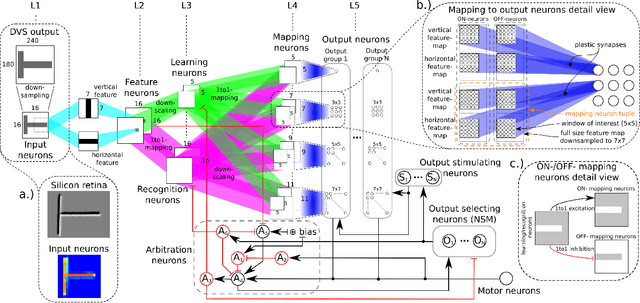
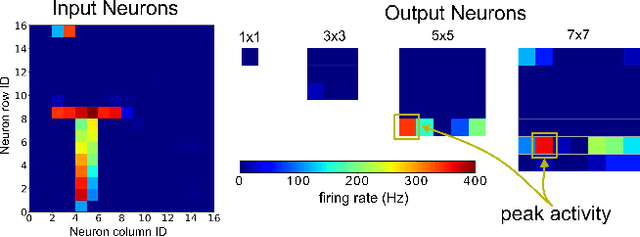
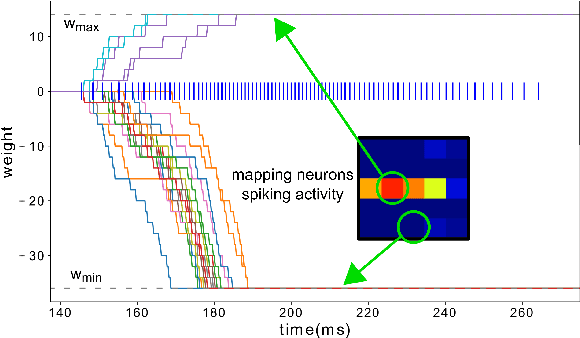
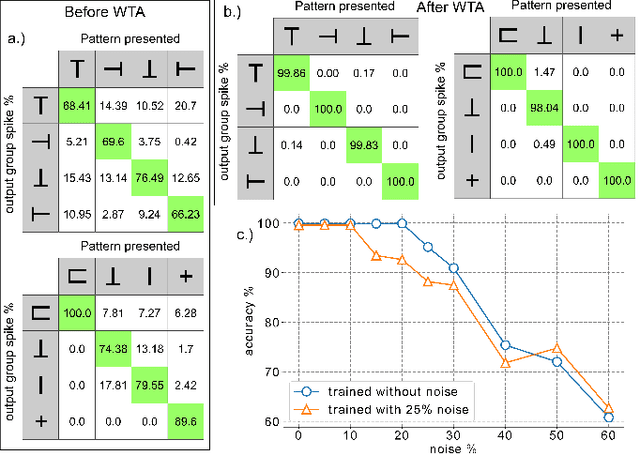
We present a spiking neural network (SNN) for visual pattern recognition with on-chip learning on neuromorphichardware. We show how this network can learn simple visual patterns composed of horizontal and vertical bars sensed by a Dynamic Vision Sensor, using a local spike-based plasticity rule. During recognition, the network classifies the pattern's identity while at the same time estimating its location and scale. We build on previous work that used learning with neuromorphic hardware in the loop and demonstrate that the proposed network can properly operate with on-chip learning, demonstrating a complete neuromorphic pattern learning and recognition setup. Our results show that the network is robust against noise on the input (no accuracy drop when adding 130% noise) and against up to 20% noise in the neuron parameters.
Adaptive motor control and learning in a spiking neural network realised on a mixed-signal neuromorphic processor
Oct 25, 2018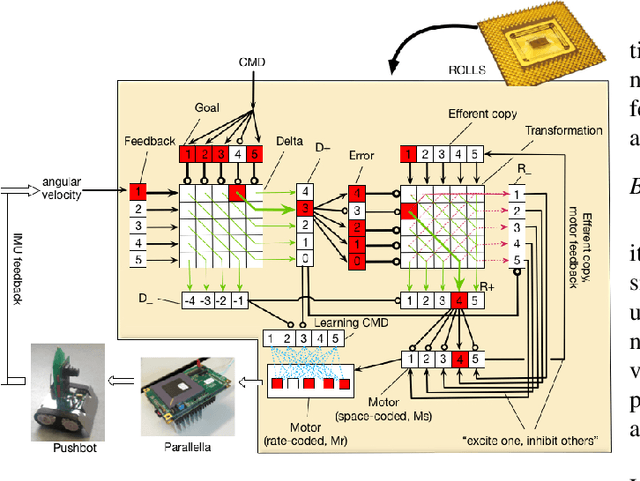
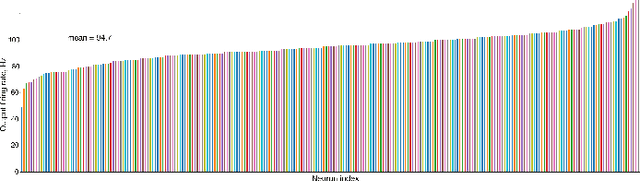
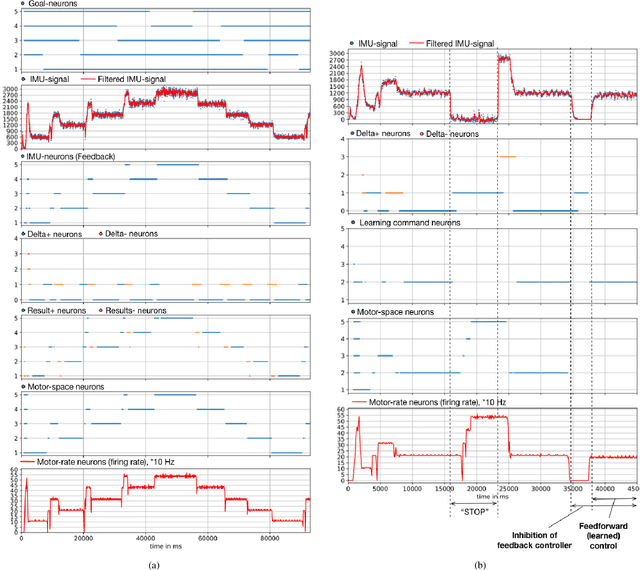
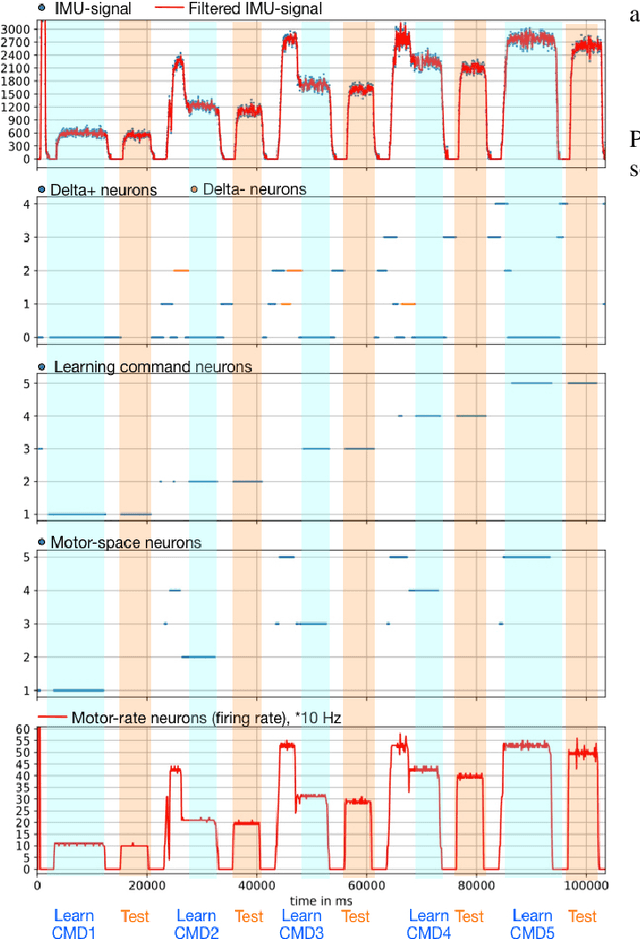
Neuromorphic computing is a new paradigm for design of both the computing hardware and algorithms inspired by biological neural networks. The event-based nature and the inherent parallelism make neuromorphic computing a promising paradigm for building efficient neural network based architectures for control of fast and agile robots. In this paper, we present a spiking neural network architecture that uses sensory feedback to control rotational velocity of a robotic vehicle. When the velocity reaches the target value, the mapping from the target velocity of the vehicle to the correct motor command, both represented in the spiking neural network on the neuromorphic device, is autonomously stored on the device using on-chip plastic synaptic weights. We validate the controller using a wheel motor of a miniature mobile vehicle and inertia measurement unit as the sensory feedback and demonstrate online learning of a simple 'inverse model' in a two-layer spiking neural network on the neuromorphic chip. The prototype neuromorphic device that features 256 spiking neurons allows us to realise a simple proof of concept architecture for the purely neuromorphic motor control and learning. The architecture can be easily scaled-up if a larger neuromorphic device is available.