 Add to Chrome
 Add to Firefox
 Add to Edge
1000 Rallies: An Event-Camera Dataset and Real-Time Learned Ball-State Estimation for Robotic Table Tennis
Jun 24, 2026
Robotic table tennis has emerged as a compelling benchmark for real-time robotic perception due to its fast ball dynamics and stringent timing requirements. Accurate, high-frequency, and low-latency ball state estimation is critical for reliable trajectory prediction and timely control. Traditional frame-based cameras face an inherent trade-off: low frame rates leave temporal blind spots that miss fast-moving objects and high frame rates raise data and computational cost. Event cameras instead offer microsecond temporal resolution and, under sufficient illumination, remain largely free of motion blur even at high ball speeds. However, the community lacks large-scale datasets to develop and benchmark event-based perception in realistic sports scenarios. We address this gap by introducing the first large-scale event-camera dataset for table tennis, comprising over 1000 rallies from a diverse group of players ranging from amateurs to elite-level athletes. Each recording captures the event stream alongside 14 synchronized high-speed frame-based cameras at 200 FPS, which we use to produce 1 kHz pseudo ground-truth labels for ball position, velocity, and spin. Building on this dataset, we train a convolutional neural network robust to background player motion that jointly estimates the ball's position and velocity in the image-plane from events. Treating the predicted velocity as an additional measurement in the Kalman filter reduces bounce-point prediction error by 36% relative to a position-only baseline. Finally, we close the perception-action loop by integrating the event-based system with a Stäubli robotic arm, enabling the first real-time human-robot table tennis rallies driven by event-based perception.

Bridging the sim2real gap in the table tennis robot with a transformer-based ball states predictor
Jun 09, 2026Robotic table tennis is a representative benchmark for high-speed, closed-loop robotic control in dynamic environments, where accurate and fast prediction of ball states is critical for reliable planning and control. Physics-based approaches rely heavily on accurate parameter identification and precise initial state, while learning-based methods often struggle to capture long-range temporal dependencies and are typically trained on limited or simulated data. We propose a transformer-based framework for table tennis ball state prediction that leverages attention mechanisms to model long-range temporal correlations directly from historical observations, without relying on explicit flight or bounce models. To support robust learning and generalization, we collected a large-scale real-world dataset from players of varying skill levels and diverse ball cannon configurations. The combination of a high-capacity transformer architecture and extensive real-world data enables accurate long-horizon forecasting. Building on this capability, we introduce a plug-and-play sim-to-real transfer strategy, Swap Predictor at Deployment (SPAD), which replaces the physics-based simulator used during training with the proposed real-world-trained predictor at deployment, improving the sim-to-real transferability of the policy without requiring retraining. We demonstrate that this simple substitution effectively narrows the sim-to-real gap while preserving the efficiency and scalability of simulation-based training.
Graph-based Spatial-temporal Feature Learning for Neuromorphic Vision Sensing
Nov 11, 2019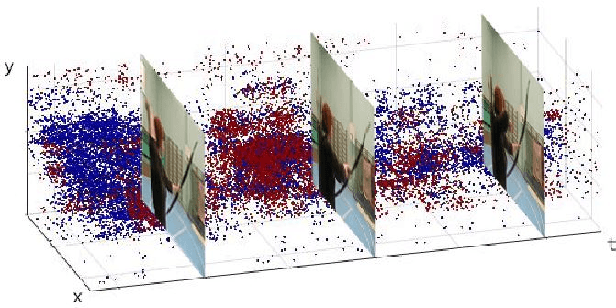

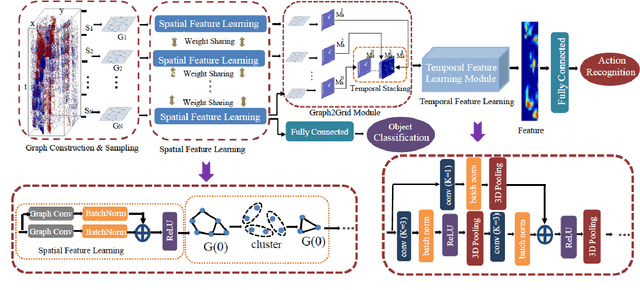

Neuromorphic vision sensing (NVS)\ devices represent visual information as sequences of asynchronous discrete events (a.k.a., "spikes") in response to changes in scene reflectance. Unlike conventional active pixel sensing (APS), NVS allows for significantly higher event sampling rates at substantially increased energy efficiency and robustness to illumination changes. However, feature representation for NVS is far behind its APS-based counterparts, resulting in lower performance in high-level computer vision tasks. To fully utilize its sparse and asynchronous nature, we propose a compact graph representation for NVS, which allows for end-to-end learning with graph convolution neural networks. We couple this with a novel end-to-end feature learning framework that accommodates both appearance-based and motion-based tasks. The core of our framework comprises a spatial feature learning module, which utilizes residual-graph convolutional neural networks (RG-CNN), for end-to-end learning of appearance-based features directly from graphs. We extend this with our proposed Graph2Grid block and temporal feature learning module for efficiently modelling temporal dependencies over multiple graphs and a long temporal extent. We show how our framework can be configured for object classification, action recognition and action similarity labeling. Importantly, our approach preserves the spatial and temporal coherence of spike events, while requiring less computation and memory. The experimental validation shows that our proposed framework outperforms all recent methods on standard datasets. Finally, to address the absence of large real-world NVS datasets for complex recognition tasks, we introduce, evaluate and make available the American Sign Language letters (ASL-DVS), as well as human action dataset (UCF101-DVS, HMDB51-DVS and ASLAN-DVS).
Graph-Based Object Classification for Neuromorphic Vision Sensing
Aug 19, 2019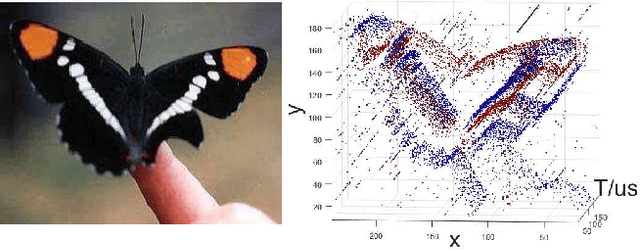


Neuromorphic vision sensing (NVS)\ devices represent visual information as sequences of asynchronous discrete events (a.k.a., ``spikes'') in response to changes in scene reflectance. Unlike conventional active pixel sensing (APS), NVS allows for significantly higher event sampling rates at substantially increased energy efficiency and robustness to illumination changes. However, object classification with NVS streams cannot leverage on state-of-the-art convolutional neural networks (CNNs), since NVS does not produce frame representations. To circumvent this mismatch between sensing and processing with CNNs, we propose a compact graph representation for NVS. We couple this with novel residual graph CNN architectures and show that, when trained on spatio-temporal NVS data for object classification, such residual graph CNNs preserve the spatial and temporal coherence of spike events, while requiring less computation and memory. Finally, to address the absence of large real-world NVS datasets for complex recognition tasks, we present and make available a 100k dataset of NVS recordings of the American sign language letters, acquired with an iniLabs DAVIS240c device under real-world conditions.