 Add to Chrome
 Add to Firefox
 Add to Edge
Understanding the Sociocultural Dimensions of Mental Health Discourse in Arabic-Language X Communities
Jun 06, 2026
Computational mental health research has predominantly centered on English-speaking populations, leaving Arabic-language discourse comparatively under-examined. We present an exploratory computational study of 8,147 tweets from 607 users classified by a GPT-4.1 personal-disclosure pipeline as likely lived-experience authors in three condition-specific Arabic-language X (formerly Twitter) Communities. We focus on discourse related to borderline personality disorder (BPD), bipolar disorder, and ADHD, and characterize community-associated linguistic patterns using a multi-domain cultural keyword framework. The results suggest that in this corpus, Bipolar tweets contain more religious and medical vocabulary, BPD tweets contain more relational, identity, and emotional-distress vocabulary, and ADHD tweets more often focus on practical symptoms and medication management. We treat these patterns as hypothesis-generating rather than confirmatory because the corpus is imbalanced across conditions, some subcorpora are temporally concentrated, and the keyword framework is an initial operationalization rather than a validated measurement instrument. The paper contributes a reusable LLM-assisted personal-disclosure pipeline and an exploratory cultural keyword framework for Arabic mental health discourse.

DWTSumm: Discrete Wavelet Transform for Document Summarization
Apr 22, 2026Summarizing long, domain-specific documents with large language models (LLMs) remains challenging due to context limitations, information loss, and hallucinations, particularly in clinical and legal settings. We propose a Discrete Wavelet Transform (DWT)-based multi-resolution framework that treats text as a semantic signal and decomposes it into global (approximation) and local (detail) components. Applied to sentence- or word-level embeddings, DWT yields compact representations that preserve overall structure and critical domain-specific details, which are used directly as summaries or to guide LLM generation. Experiments on clinical and legal benchmarks demonstrate comparable ROUGE-L scores. Compared to a GPT-4o baseline, the DWT based summarization consistently improve semantic similarity and grounding, achieving gains of over 2% in BERTScore, more than 4\% in Semantic Fidelity, factual consistency in legal tasks, and large METEOR improvements indicative of preserved domain-specific semantics. Across multiple embedding models, Fidelity reaches up to 97%, suggesting that DWT acts as a semantic denoising mechanism that reduces hallucinations and strengthens factual grounding. Overall, DWT provides a lightweight, generalizable method for reliable long-document and domain-specific summarization with LLMs.
MemInsight: Autonomous Memory Augmentation for LLM Agents
Mar 27, 2025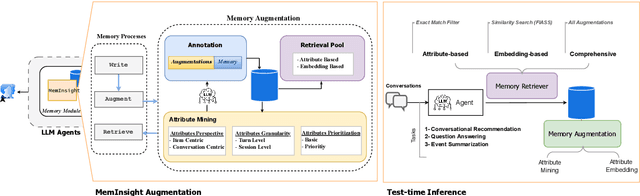
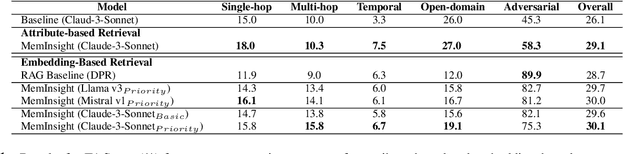
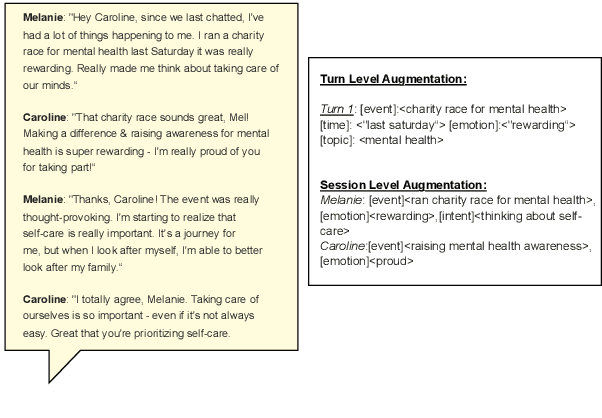

Large language model (LLM) agents have evolved to intelligently process information, make decisions, and interact with users or tools. A key capability is the integration of long-term memory capabilities, enabling these agents to draw upon historical interactions and knowledge. However, the growing memory size and need for semantic structuring pose significant challenges. In this work, we propose an autonomous memory augmentation approach, MemInsight, to enhance semantic data representation and retrieval mechanisms. By leveraging autonomous augmentation to historical interactions, LLM agents are shown to deliver more accurate and contextualized responses. We empirically validate the efficacy of our proposed approach in three task scenarios; conversational recommendation, question answering and event summarization. On the LLM-REDIAL dataset, MemInsight boosts persuasiveness of recommendations by up to 14%. Moreover, it outperforms a RAG baseline by 34% in recall for LoCoMo retrieval. Our empirical results show the potential of MemInsight to enhance the contextual performance of LLM agents across multiple tasks.