 Add to Chrome
 Add to Firefox
 Add to Edge
ReDON: Recurrent Diffractive Optical Neural Processor with Reconfigurable Self-Modulated Nonlinearity
Mar 02, 2026
Diffractive optical neural networks (DONNs) have demonstrated unparalleled energy efficiency and parallelism by processing information directly in the optical domain. However, their computational expressivity is constrained by static, passive diffractive phase masks that lack efficient nonlinear responses and reprogrammability. To address these limitations, we introduce the Recurrent Diffractive Optical Neural Processor (ReDON), a novel architecture featuring reconfigurable, recurrent self-modulated nonlinearity. This mechanism enables dynamic, input-dependent optical transmission through in-situ electro-optic self-modulation, providing a highly efficient and reprogrammable approach to optical computation. Inspired by the gated linear unit (GLU) used in large language models, ReDON senses a fraction of the propagating optical field and modulates its phase or intensity via a lightweight parametric function, enabling effective nonlinearity with minimal inference overhead. As a non-von Neumann architecture in which the primary weighting elements (metasurfaces) remain fixed, ReDON substantially extends the nonlinear representational capacity and task adaptability of conventional DONNs through recurrent optical hardware reuse and dynamically tunable nonlinearity. We systematically investigate various self-modulation configurations to characterize the trade-offs between hardware efficiency and computational expressivity. On image recognition and segmentation benchmarks, ReDON improves test accuracy and mean intersection-over-union (mIoU) by up to 20% compared with prior DONNs employing either optical or digital nonlinearities at comparable model complexity and negligible additional power consumption. This work establishes a new paradigm for reconfigurable nonlinear optical computing, uniting recurrence and self-modulation within non-von Neumann analog processors.

An inversely designed mode-multiplexed photonic integrated vector dot-product core
Jan 18, 2024


Photonic computing has the potential of harnessing the full degrees of freedom (DOFs) of the light field, including wavelength, spatial mode, spatial location, phase quadrature, and polarization, to achieve higher level of computation parallelization and scalability than digital electronic processors. While multiplexing using wavelength and other DOFs can be readily integrated on silicon photonics platforms with compact footprints, conventional mode-division multiplexed (MDM) photonic designs occupy areas exceeding tens to hundreds of microns for a few spatial modes, significantly limiting their scalability. Here we utilize inverse design to demonstrate an ultracompact photonic computing core that calculates vector dot-products based on MDM coherent mixing within a nominal footprint of 5 um x 3 um. Our dot-product core integrates the functionalities of 2 mode multiplexers and 1 multi-mode coherent mixers, all within the footprint, and could be applied to various computation and computer vision tasks, with high computing throughput density. We experimentally demonstrate computing examples on the fabricated core, including complex number multiplication and motion estimation using optical flow.
Integrated Photonic Encoder for Terapixel Image Processing
Jun 07, 2023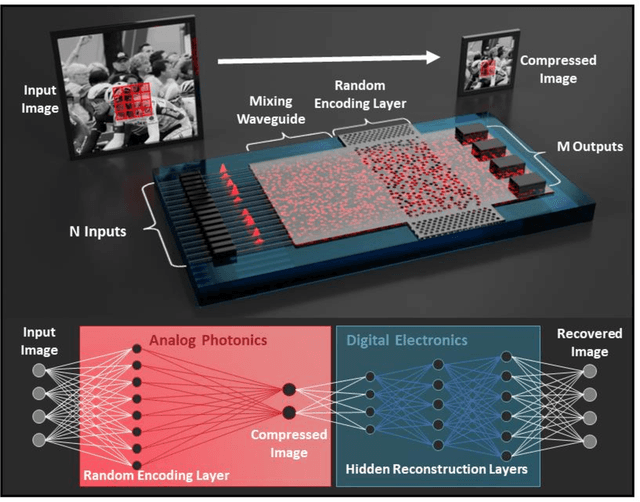
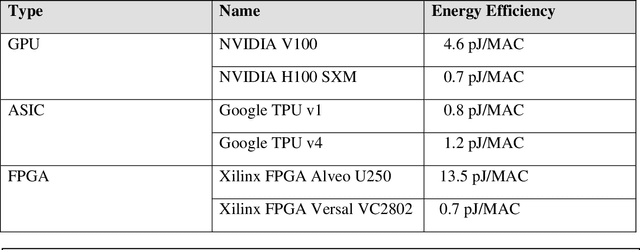
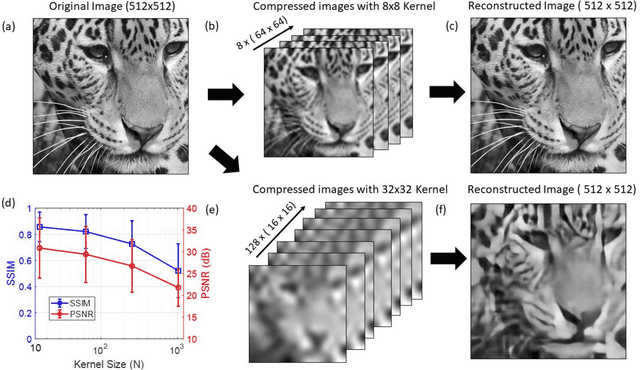
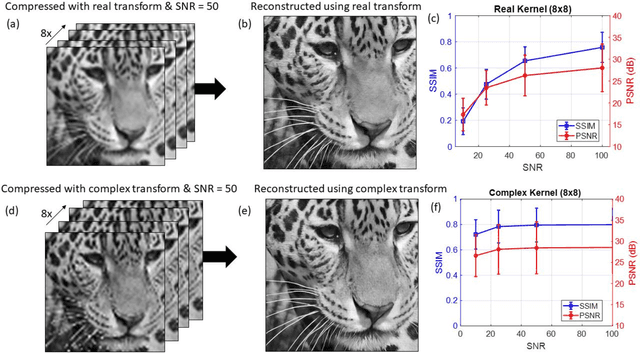
Modern lens designs are capable of resolving >10 gigapixels, while advances in camera frame-rate and hyperspectral imaging have made Terapixel/s data acquisition a real possibility. The main bottlenecks preventing such high data-rate systems are power consumption and data storage. In this work, we show that analog photonic encoders could address this challenge, enabling high-speed image compression using orders-of-magnitude lower power than digital electronics. Our approach relies on a silicon-photonics front-end to compress raw image data, foregoing energy-intensive image conditioning and reducing data storage requirements. The compression scheme uses a passive disordered photonic structure to perform kernel-type random projections of the raw image data with minimal power consumption and low latency. A back-end neural network can then reconstruct the original images with structural similarity exceeding 90%. This scheme has the potential to process Terapixel/s data streams using less than 100 fJ/pixel, providing a path to ultra-high-resolution data and image acquisition systems.