 Add to Chrome
 Add to Firefox
 Add to Edge
Closing the Calibration Gap in Semantic Caching
Jun 18, 2026
Semantic caching cuts LLM inference costs by serving a cached response to semantically similar queries. Standard practice evaluates these systems using PR-AUC, a metric that only measures how well scores rank and ignores whether they are usable at a fixed threshold. We show this mismatch leads to systematically poor deployment choices, as models with the highest PR-AUC are often the worst in operation. We introduce Precision-Cache Hit Ratio (P-CHR) AUC, a cache-aware metric that measures precision across cache utilization levels, and Calibration Retention Rate (CRR), which captures how much offline ranking quality survives at deployment. We decompose the operational gap between offline and deployed quality into a recoverable calibration component and an irreducible structural component fixed by the dataset's positive rate. Our experiments show that the calibration gap is governed by the training objective rather than data scale, and post-hoc calibration only partially closes it. Ultimately, model selection for semantic caching is a calibration problem, not a ranking one, and measuring it is the first step to closing the gap.

Multilingual Word Embeddings for Low-Resource Languages using Anchors and a Chain of Related Languages
Nov 21, 2023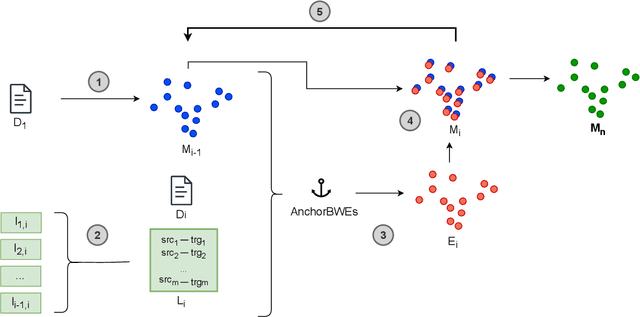

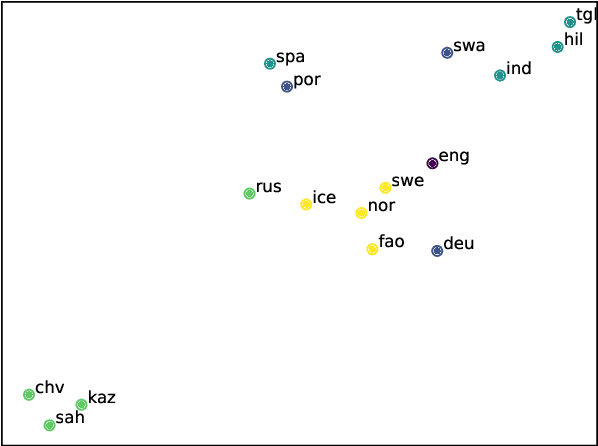

Very low-resource languages, having only a few million tokens worth of data, are not well-supported by multilingual NLP approaches due to poor quality cross-lingual word representations. Recent work showed that good cross-lingual performance can be achieved if a source language is related to the low-resource target language. However, not all language pairs are related. In this paper, we propose to build multilingual word embeddings (MWEs) via a novel language chain-based approach, that incorporates intermediate related languages to bridge the gap between the distant source and target. We build MWEs one language at a time by starting from the resource rich source and sequentially adding each language in the chain till we reach the target. We extend a semi-joint bilingual approach to multiple languages in order to eliminate the main weakness of previous works, i.e., independently trained monolingual embeddings, by anchoring the target language around the multilingual space. We evaluate our method on bilingual lexicon induction for 4 language families, involving 4 very low-resource (<5M tokens) and 4 moderately low-resource (<50M) target languages, showing improved performance in both categories. Additionally, our analysis reveals the importance of good quality embeddings for intermediate languages as well as the importance of leveraging anchor points from all languages in the multilingual space.