 Add to Chrome
 Add to Firefox
 Add to Edge
Closing the Calibration Gap in Semantic Caching
Jun 18, 2026
Semantic caching cuts LLM inference costs by serving a cached response to semantically similar queries. Standard practice evaluates these systems using PR-AUC, a metric that only measures how well scores rank and ignores whether they are usable at a fixed threshold. We show this mismatch leads to systematically poor deployment choices, as models with the highest PR-AUC are often the worst in operation. We introduce Precision-Cache Hit Ratio (P-CHR) AUC, a cache-aware metric that measures precision across cache utilization levels, and Calibration Retention Rate (CRR), which captures how much offline ranking quality survives at deployment. We decompose the operational gap between offline and deployed quality into a recoverable calibration component and an irreducible structural component fixed by the dataset's positive rate. Our experiments show that the calibration gap is governed by the training objective rather than data scale, and post-hoc calibration only partially closes it. Ultimately, model selection for semantic caching is a calibration problem, not a ranking one, and measuring it is the first step to closing the gap.

Advancing Semantic Caching for LLMs with Domain-Specific Embeddings and Synthetic Data
Apr 03, 2025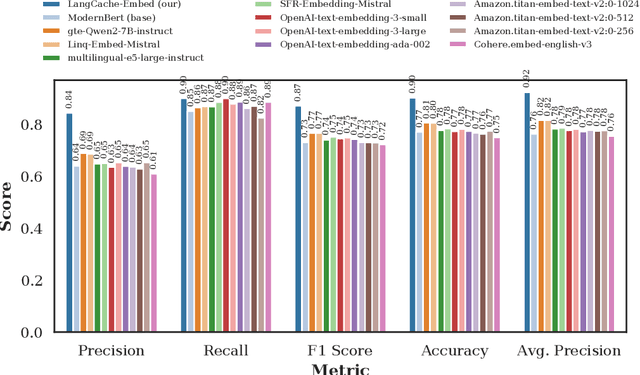
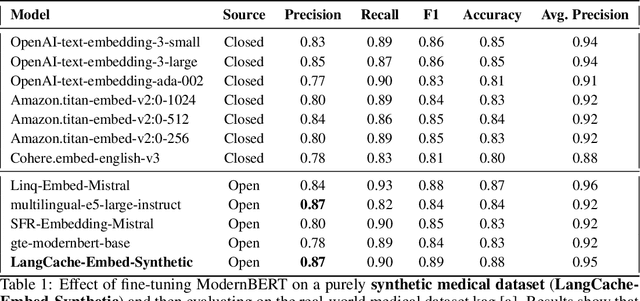
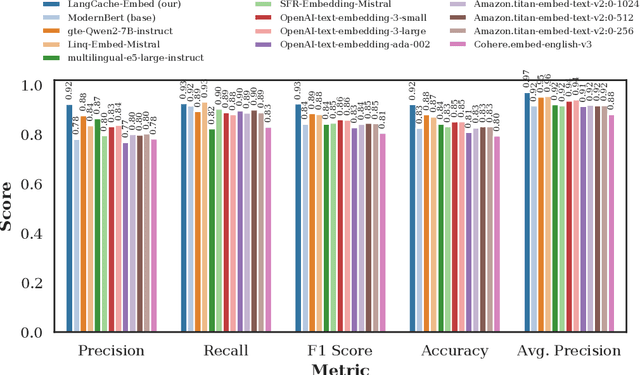
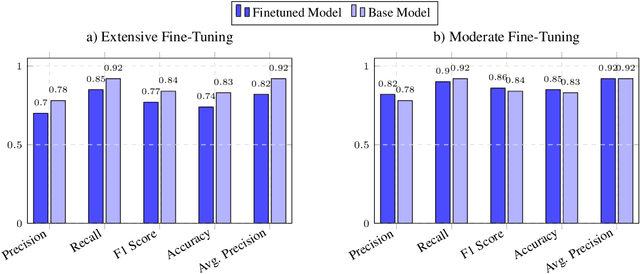
This report investigates enhancing semantic caching effectiveness by employing specialized, fine-tuned embedding models. Semantic caching relies on embedding similarity rather than exact key matching, presenting unique challenges in balancing precision, query latency, and computational efficiency. We propose leveraging smaller, domain-specific embedding models, fine-tuned with targeted real-world and synthetically generated datasets. Our empirical evaluations demonstrate that compact embedding models fine-tuned for just one epoch on specialized datasets significantly surpass both state-of-the-art open-source and proprietary alternatives in precision and recall. Moreover, we introduce a novel synthetic data generation pipeline for the semantic cache that mitigates the challenge of limited domain-specific annotated data, further boosting embedding performance. Our approach effectively balances computational overhead and accuracy, establishing a viable and efficient strategy for practical semantic caching implementations.