 Add to Chrome
 Add to Firefox
 Add to Edge
Closing the Calibration Gap in Semantic Caching
Jun 18, 2026
Semantic caching cuts LLM inference costs by serving a cached response to semantically similar queries. Standard practice evaluates these systems using PR-AUC, a metric that only measures how well scores rank and ignores whether they are usable at a fixed threshold. We show this mismatch leads to systematically poor deployment choices, as models with the highest PR-AUC are often the worst in operation. We introduce Precision-Cache Hit Ratio (P-CHR) AUC, a cache-aware metric that measures precision across cache utilization levels, and Calibration Retention Rate (CRR), which captures how much offline ranking quality survives at deployment. We decompose the operational gap between offline and deployed quality into a recoverable calibration component and an irreducible structural component fixed by the dataset's positive rate. Our experiments show that the calibration gap is governed by the training objective rather than data scale, and post-hoc calibration only partially closes it. Ultimately, model selection for semantic caching is a calibration problem, not a ranking one, and measuring it is the first step to closing the gap.

KGHaluBench: A Knowledge Graph-Based Hallucination Benchmark for Evaluating the Breadth and Depth of LLM Knowledge
Feb 23, 2026Large Language Models (LLMs) possess a remarkable capacity to generate persuasive and intelligible language. However, coherence does not equate to truthfulness, as the responses often contain subtle hallucinations. Existing benchmarks are limited by static and narrow questions, leading to limited coverage and misleading evaluations. We present KGHaluBench, a Knowledge Graph-based hallucination benchmark that assesses LLMs across the breadth and depth of their knowledge, providing a fairer and more comprehensive insight into LLM truthfulness. Our framework utilises the KG to dynamically construct challenging, multifaceted questions, whose difficulty is then statistically estimated to address popularity bias. Our automated verification pipeline detects abstentions and verifies the LLM's response at both conceptual and correctness levels to identify different types of hallucinations. We evaluate 25 frontier models, using novel accuracy and hallucination metrics. The results provide a more interpretable insight into the knowledge factors that cause hallucinations across different model sizes. KGHaluBench is publicly available to support future developments in hallucination mitigation.
Advancing Semantic Caching for LLMs with Domain-Specific Embeddings and Synthetic Data
Apr 03, 2025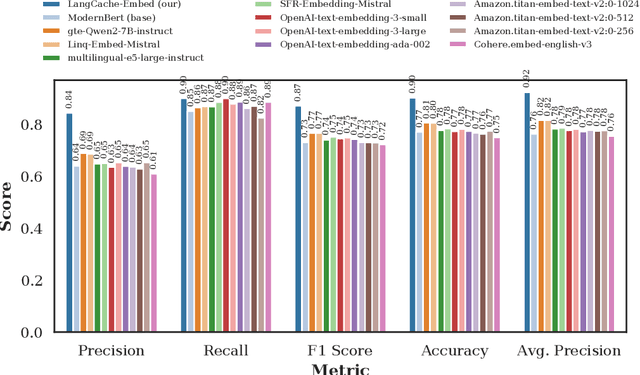
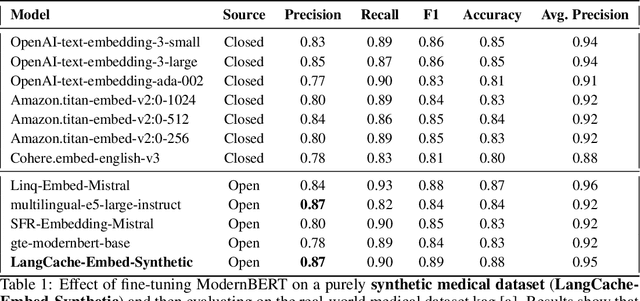
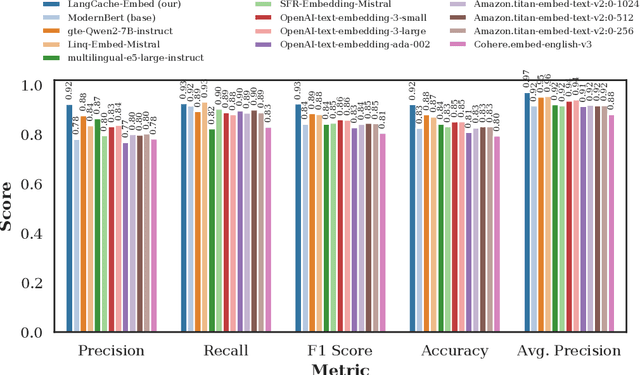
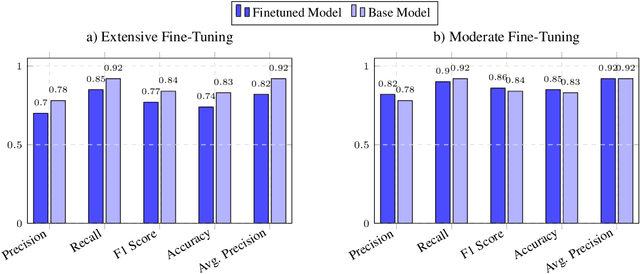
This report investigates enhancing semantic caching effectiveness by employing specialized, fine-tuned embedding models. Semantic caching relies on embedding similarity rather than exact key matching, presenting unique challenges in balancing precision, query latency, and computational efficiency. We propose leveraging smaller, domain-specific embedding models, fine-tuned with targeted real-world and synthetically generated datasets. Our empirical evaluations demonstrate that compact embedding models fine-tuned for just one epoch on specialized datasets significantly surpass both state-of-the-art open-source and proprietary alternatives in precision and recall. Moreover, we introduce a novel synthetic data generation pipeline for the semantic cache that mitigates the challenge of limited domain-specific annotated data, further boosting embedding performance. Our approach effectively balances computational overhead and accuracy, establishing a viable and efficient strategy for practical semantic caching implementations.
Ensemble based approach to quantifying uncertainty of LLM based classifications
Feb 12, 2025The output of Large Language Models (LLMs) are a function of the internal model's parameters and the input provided into the context window. The hypothesis presented here is that under a greedy sampling strategy the variance in the LLM's output is a function of the conceptual certainty embedded in the model's parametric knowledge, as well as the lexical variance in the input. Finetuning the model results in reducing the sensitivity of the model output to the lexical input variations. This is then applied to a classification problem and a probabilistic method is proposed for estimating the certainties of the predicted classes.
A Weakly-Supervised Attention-based Visualization Tool for Assessing Political Affiliation
Aug 05, 2019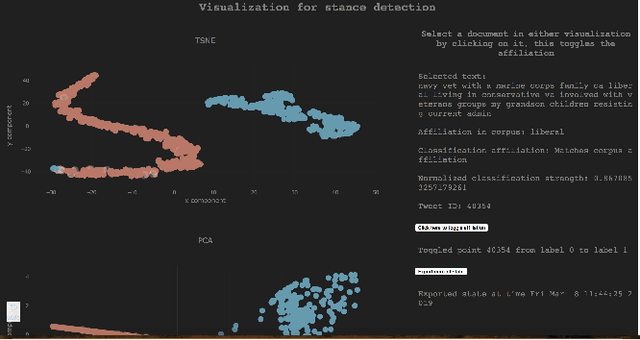
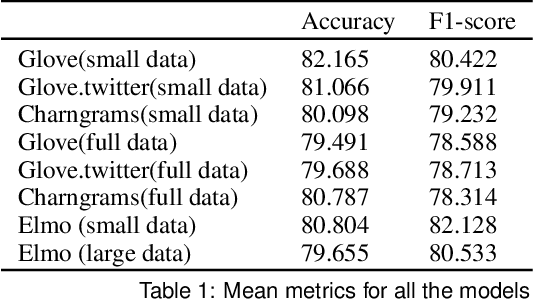
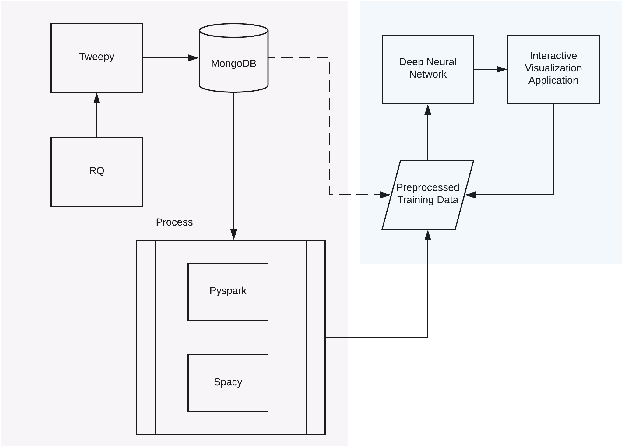
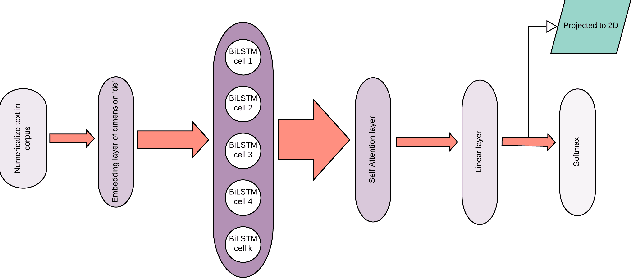
In this work, we seek to finetune a weakly-supervised expert-guided Deep Neural Network (DNN) for the purpose of determining political affiliations. In this context, stance detection is used for determining political affiliation or ideology which is framed in the form of relative proximities between entities in a low-dimensional space. An attention-based mechanism is used to provide model interpretability. A Deep Neural Network for Natural Language Understanding (NLU) using static and contextual embeddings is trained and evaluated. Various techniques to visualize the projections generated from the network are evaluated for visualization efficiency. An overview of the pipeline from data ingestion, processing and generation of visualization is given here. A web-based framework created to faciliate this interaction and exploration is presented here. Preliminary results of this study are summarized and future work is outlined.