 Add to Chrome
 Add to Firefox
 Add to Edge
Relative State Estimation using Event-Based Propeller Sensing
Apr 20, 2026
Autonomous swarms of multi-Unmanned Aerial Vehicle (UAV) system requires an accurate and fast relative state estimation. Although monocular frame-based camera methods perform well in ideal conditions, they are slow, suffer scale ambiguity, and often struggle in visually challenging conditions. The advent of event cameras addresses these challenging tasks by providing low latency, high dynamic range, and microsecond-level temporal resolution. This paper proposes a framework for relative state estimation for quadrotors using event-based propeller sensing. The propellers in the event stream are tracked by detection to extract the region-of-interests. The event streams in these regions are processed in temporal chunks to estimate per-propeller frequencies. These frequency measurements drive a kinematic state estimation module as a thrust input, while camera-derived position measurements provide the update step. Additionally, we use geometric primitives derived from event streams to estimate the orientation of the quadrotor by fitting an ellipse over a propeller and backprojecting it to recover body-frame tilt-axis. The existing event-based approaches for quadrotor state estimation use the propeller frequency in simulated flight sequences. Our approach estimates the propeller frequency under 3% error on a test dataset of five real-world outdoor flight sequences, providing a method for decentralized relative localization for multi-robot systems using event camera.

EEPPR: Event-based Estimation of Periodic Phenomena Rate using Correlation in 3D
Aug 19, 2024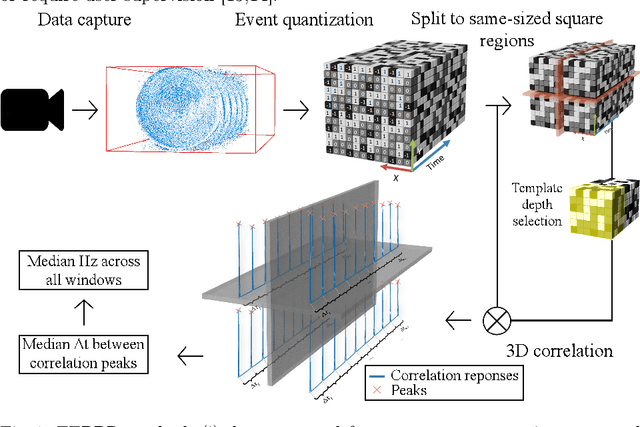

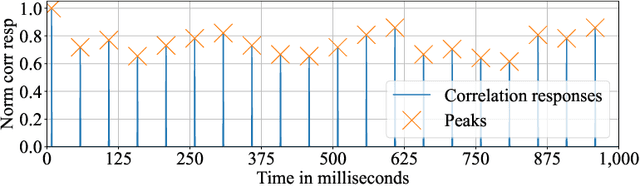
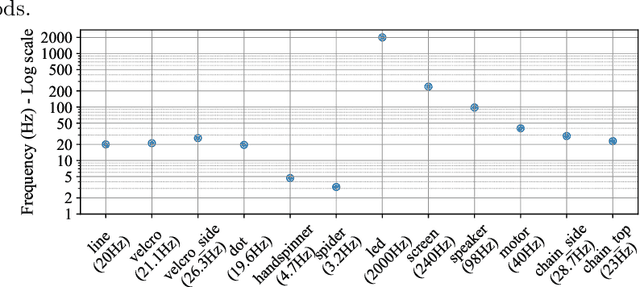
We present a novel method for measuring the period of phenomena like rotation, flicker and vibration, by an event camera, a device asynchronously reporting brightness changes at independently operating pixels with high temporal resolution. The approach assumes that for a periodic phenomenon, a highly similar set of events is generated within a spatio-temporal window at a time difference corresponding to its period. The sets of similar events are detected by a correlation in the spatio-temporal event stream space. The proposed method, EEPPR, is evaluated on a dataset of 12 sequences of periodic phenomena, i.e. flashing light and vibration, and periodic motion, e.g., rotation, ranging from 3.2 Hz to 2 kHz (equivalent to 192 - 120 000 RPM). EEPPR significantly outperforms published methods on this dataset, achieving the mean relative error of 0.1%. The dataset and codes are publicly available on GitHub.
EE3P3D: Event-based Estimation of Periodic Phenomena Frequency using 3D Correlation
Aug 13, 2024We present a novel method for measuring the frequency of periodic phenomena, e.g., rotation, flicker and vibration, by an event camera, a device asynchronously reporting brightness changes at independently operating pixels with high temporal resolution. The approach assumes that for a periodic phenomenon, a highly similar set of events is generated within a specific spatio-temporal window at a time difference corresponding to the phenomenon's period. The sets of similar events are detected by 3D spatio-temporal correlation in the event stream space. The proposed method, EE3P3D, is evaluated on a dataset of 12 sequences of periodic phenomena, i.e. flashing light and vibration, and periodic motion, e.g., rotation, ranging from 3.2 Hz to 2 kHz (equivalent to 192 - 120 000 RPM). EE3P3D significantly outperforms published methods on this dataset, achieving a mean relative error of 0.1%.
EE3P: Event-based Estimation of Periodic Phenomena Properties
Feb 22, 2024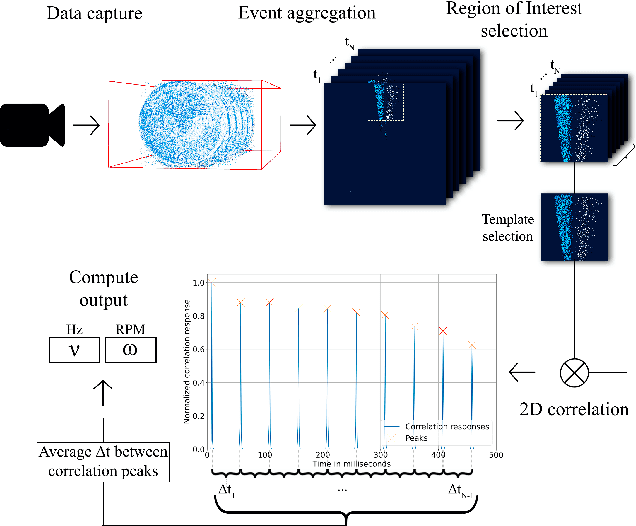
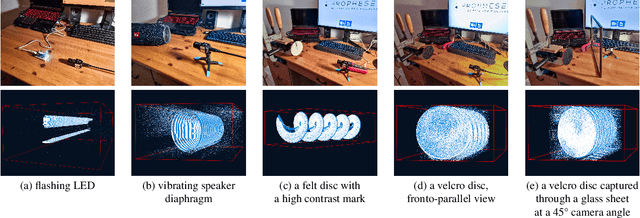
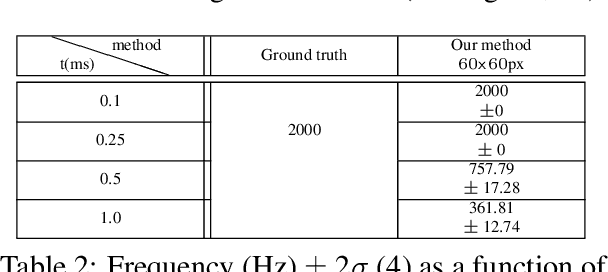
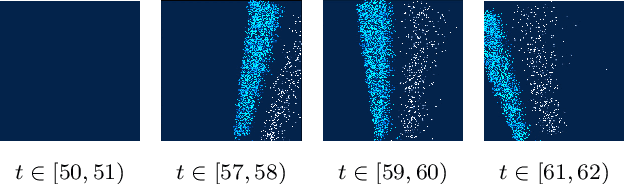
We introduce a novel method for measuring properties of periodic phenomena with an event camera, a device asynchronously reporting brightness changes at independently operating pixels. The approach assumes that for fast periodic phenomena, in any spatial window where it occurs, a very similar set of events is generated at the time difference corresponding to the frequency of the motion. To estimate the frequency, we compute correlations of spatio-temporal windows in the event space. The period is calculated from the time differences between the peaks of the correlation responses. The method is contactless, eliminating the need for markers, and does not need distinguishable landmarks. We evaluate the proposed method on three instances of periodic phenomena: (i) light flashes, (ii) vibration, and (iii) rotational speed. In all experiments, our method achieves a relative error lower than 0.04%, which is within the error margin of ground truth measurements.
* 9 pages, 55 figures, accepted and presented at CVWW24, published in Proceedings of the 27th Computer Vision Winter Workshop, 2024