 Add to Chrome
 Add to Firefox
 Add to Edge
Outcome Monitors: Recovery Affordances for Silent Tool Failures
Aug 19, 2026
When a tool call times out, the agent sees the failure and can route around it. A cached error page or negative price can instead arrive in the expected format and be consumed as fact. We introduce Outcome Monitors, which detect violations of outcome contracts mined from task-disjoint traces or derived from public schemas. On a violation, the monitor preserves the result and issues a nonbinding receipt naming the violated property and public recovery tools. In frozen, prespecified evaluations with injected failures, Outcome Monitors raise ToolMaze completion from 10.9% to 28.1% across four models in two provider families and replicate in a third. In tau-bench retail, completion improves by 14.0 and 12.0 points on two tiers. In separate ToolMaze controls, removing the recovery-tool list eliminates the measured gain and restoring it recovers the effect; diagnostic detail and timing produce no detectable differences. Gains concentrate where the fault blocks completion. On a suite transcribed from a published incident taxonomy, detection outside the mined vocabulary falls to 46%, though delivery continues and completion is unchanged. Recovery tools are the active receipt content in these controls; extending detection beyond the contract vocabulary remains open.

Fixed RAG Compression Collapses Measured Reader Scaling
Jun 20, 2026Retrieval-Augmented Generation (RAG) compression papers often evaluate a compressor on one to three readers and treat the compressed evidence layer as evaluation-neutral. We show this assumption is false: fixed compression can raise average accuracy while hiding reader upgrades and reversing model rankings. Across 20 readers and ten domain-method settings over four QA benchmarks and one summarization benchmark, compression gain decreases with reader baseline (nine of ten settings significant, p < 0.05). Generic summarization flips 31% of pairwise model rankings on LongMemEval-S, and a fixed HotpotQA compressor hides 80% of the raw upgrade from Qwen 7B to GPT-4.1-mini. Two opposing forces explain this paradox: compression rescues weak readers by removing noise they cannot filter, and harms strong readers by dropping details they would have used. The pattern appears across structured compilation, generic summarization, three trained compressor families, query-focused summarization, and an external audit of nine published compression papers. We release ragscale, a toolkit built on 177,000 row-level compression transitions, so any compression paper can audit reader scaling with three readers in one day.
Same Ranking, Different Winner: How Scoring Targets Shape LLM Memory Benchmarks
May 22, 2026Conversational-memory systems increasingly transform dialogue history into facts, summaries, timelines, and other source-linked descendants, so a single source turn can coexist with several derived memories in the same retrieval index. This raises an underspecified evaluation question: which stored form should receive retrieval credit? We show that this scoring-target choice is often left implicit and can materially change benchmark conclusions. We present TIAP, a fixed-output audit that rescores saved ranked outputs under three targets -- Raw, Source, and Canonical -- without rerunning retrieval. On LoCoMo and LongMemEval-S, switching only the credited target changes nDCG on 83.4--94.0 percent of shared queries, flips target orderings on Mem0 and MemoryOS transfer runs, and reverses parser-density recommendations. A 1,902-case semantic audit further shows that relaxed source-linked credit is fully justified only 29.2 percent of the time, despite high rubric reliability in a validation subset. These results reveal target noninvariance: conclusions about memory architectures can silently flip with a single benchmark-design choice. Conversational-memory papers should therefore define and report the scoring target explicitly.
LLM-as-Judge for Semantic Judging of Powerline Segmentation in UAV Inspection
Apr 07, 2026The deployment of lightweight segmentation models on drones for autonomous power line inspection presents a critical challenge: maintaining reliable performance under real-world conditions that differ from training data. Although compact architectures such as U-Net enable real-time onboard inference, their segmentation outputs can degrade unpredictably in adverse environments, raising safety concerns. In this work, we study the feasibility of using a large language model (LLM) as a semantic judge to assess the reliability of power line segmentation results produced by drone-mounted models. Rather than introducing a new inspection system, we formalize a watchdog scenario in which an offboard LLM evaluates segmentation overlays and examine whether such a judge can be trusted to behave consistently and perceptually coherently. To this end, we design two evaluation protocols that analyze the judge's repeatability and sensitivity. First, we assess repeatability by repeatedly querying the LLM with identical inputs and fixed prompts, measuring the stability of its quality scores and confidence estimates. Second, we evaluate perceptual sensitivity by introducing controlled visual corruptions (fog, rain, snow, shadow, and sunflare) and analyzing how the judge's outputs respond to progressive degradation in segmentation quality. Our results show that the LLM produces highly consistent categorical judgments under identical conditions while exhibiting appropriate declines in confidence as visual reliability deteriorates. Moreover, the judge remains responsive to perceptual cues such as missing or misidentified power lines, even under challenging conditions. These findings suggest that, when carefully constrained, an LLM can serve as a reliable semantic judge for monitoring segmentation quality in safety-critical aerial inspection tasks.
Adaptive Anchor Policies for Efficient 4D Gaussian Streaming
Mar 18, 2026Dynamic scene reconstruction with Gaussian Splatting has enabled efficient streaming for real-time rendering and free-viewpoint video. However, most pipelines rely on fixed anchor selection such as Farthest Point Sampling (FPS), typically using 8,192 anchors regardless of scene complexity, which over-allocates computation under strict budgets. We propose Efficient Gaussian Streaming (EGS), a plug-in, budget-aware anchor sampler that replaces FPS with a reinforcement-learned policy while keeping the Gaussian streaming reconstruction backbone unchanged. The policy jointly selects an anchor budget and a subset of informative anchors under discrete constraints, balancing reconstruction quality and runtime using spatial features of the Gaussian representation. We evaluate EGS in two settings: fast rendering, which prioritizes runtime efficiency, and high-quality refinement, which enables additional optimization. Experiments on dynamic multi-view datasets show consistent improvements in the quality--efficiency trade-off over FPS sampling. On unseen data, in fast rendering at 256 anchors ($32\times$ fewer than 8,192), EGS improves PSNR by $+0.52$--$0.61$\,dB while running $1.29$--$1.35\times$ faster than IGS@8192 (N3DV and MeetingRoom). In high-quality refinement, EGS remains competitive with the full-anchor baseline at substantially lower anchor budgets. \emph{Code and pretrained checkpoints will be released upon acceptance.} \keywords{4D Gaussian Splatting \and 4D Gaussian Streaming \and Reinforcement Learning}
CDUL: CLIP-Driven Unsupervised Learning for Multi-Label Image Classification
Jul 31, 2023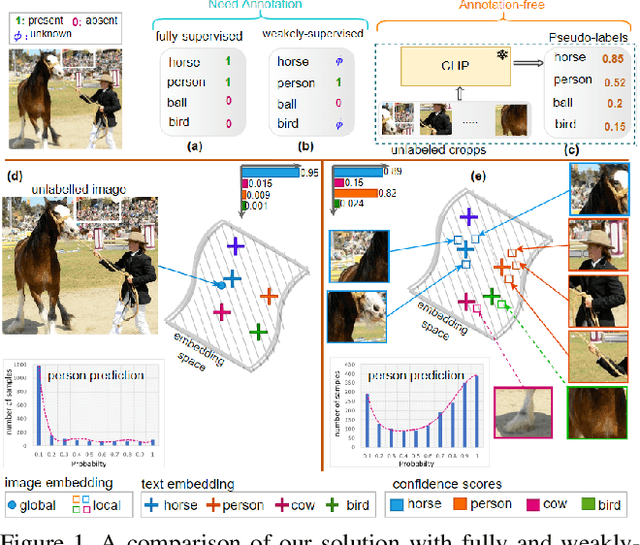
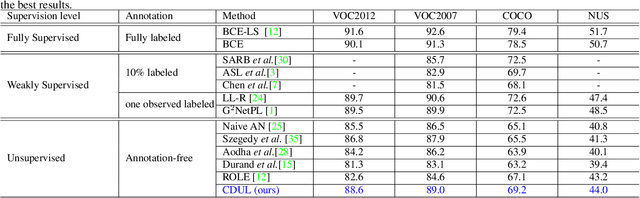


This paper presents a CLIP-based unsupervised learning method for annotation-free multi-label image classification, including three stages: initialization, training, and inference. At the initialization stage, we take full advantage of the powerful CLIP model and propose a novel approach to extend CLIP for multi-label predictions based on global-local image-text similarity aggregation. To be more specific, we split each image into snippets and leverage CLIP to generate the similarity vector for the whole image (global) as well as each snippet (local). Then a similarity aggregator is introduced to leverage the global and local similarity vectors. Using the aggregated similarity scores as the initial pseudo labels at the training stage, we propose an optimization framework to train the parameters of the classification network and refine pseudo labels for unobserved labels. During inference, only the classification network is used to predict the labels of the input image. Extensive experiments show that our method outperforms state-of-the-art unsupervised methods on MS-COCO, PASCAL VOC 2007, PASCAL VOC 2012, and NUS datasets and even achieves comparable results to weakly supervised classification methods.
Leveraging Inpainting for Single-Image Shadow Removal
Feb 10, 2023
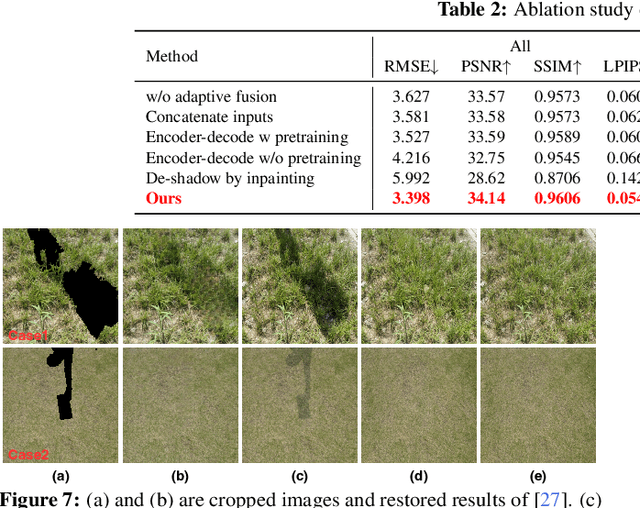
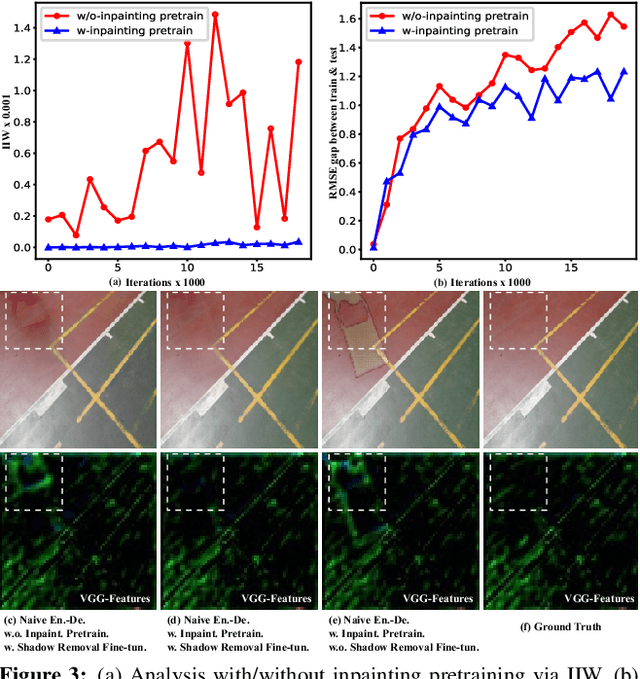
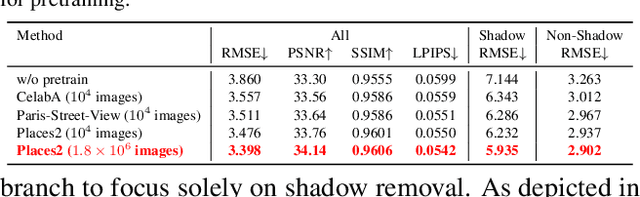
Fully-supervised shadow removal methods achieve top restoration qualities on public datasets but still generate some shadow remnants. One of the reasons is the lack of large-scale shadow & shadow-free image pairs. Unsupervised methods can alleviate the issue but their restoration qualities are much lower than those of fully-supervised methods. In this work, we find that pretraining shadow removal networks on the image inpainting dataset can reduce the shadow remnants significantly: a naive encoder-decoder network gets competitive restoration quality w.r.t. the state-of-the-art methods via only 10% shadow & shadow-free image pairs. We further analyze the difference between networks with/without inpainting pretraining and observe that: inpainting pretraining enhances networks' capability of filling missed semantic information; shadow removal fine-tuning makes the networks know how to fill details of the shadow regions. Inspired by the above observations, we formulate shadow removal as a shadow-guided inpainting task to take advantage of the shadow removal and image inpainting. Specifically, we build a shadow-informed dynamic filtering network with two branches: the image inpainting branch takes the shadow-masked image as input while the second branch takes the shadow image as input and is to estimate dynamic kernels and offsets for the first branch to provide missing semantic information and details. The extensive experiments show that our method empowered with inpainting outperforms all state-of-the-art methods.
Depth Monocular Estimation with Attention-based Encoder-Decoder Network from Single Image
Oct 24, 2022
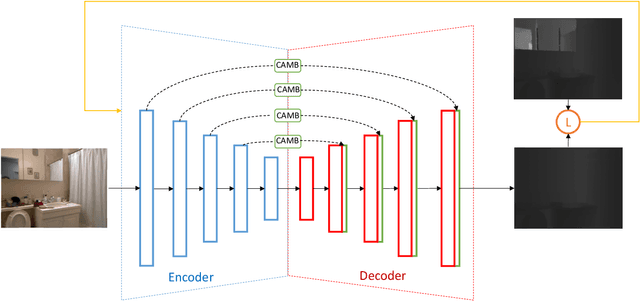
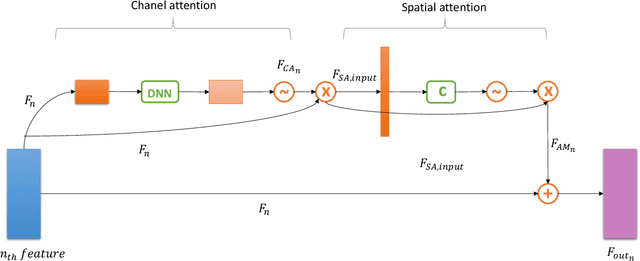
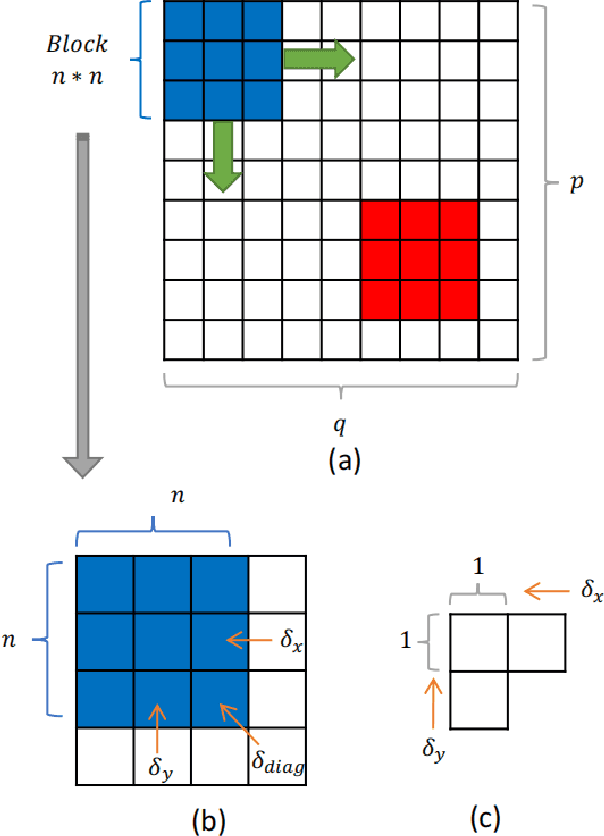
Depth information is the foundation of perception, essential for autonomous driving, robotics, and other source-constrained applications. Promptly obtaining accurate and efficient depth information allows for a rapid response in dynamic environments. Sensor-based methods using LIDAR and RADAR obtain high precision at the cost of high power consumption, price, and volume. While due to advances in deep learning, vision-based approaches have recently received much attention and can overcome these drawbacks. In this work, we explore an extreme scenario in vision-based settings: estimate a depth map from one monocular image severely plagued by grid artifacts and blurry edges. To address this scenario, We first design a convolutional attention mechanism block (CAMB) which consists of channel attention and spatial attention sequentially and insert these CAMBs into skip connections. As a result, our novel approach can find the focus of current image with minimal overhead and avoid losses of depth features. Next, by combining the depth value, the gradients of X axis, Y axis and diagonal directions, and the structural similarity index measure (SSIM), we propose our novel loss function. Moreover, we utilize pixel blocks to accelerate the computation of the loss function. Finally, we show, through comprehensive experiments on two large-scale image datasets, i.e. KITTI and NYU-V2, that our method outperforms several representative baselines.
An Effective Approach for Multi-label Classification with Missing Labels
Oct 24, 2022

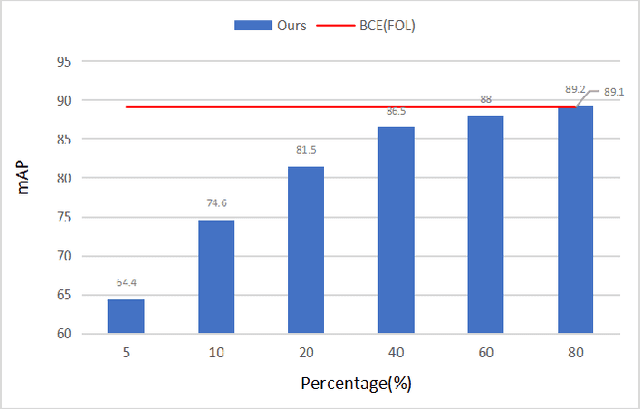

Compared with multi-class classification, multi-label classification that contains more than one class is more suitable in real life scenarios. Obtaining fully labeled high-quality datasets for multi-label classification problems, however, is extremely expensive, and sometimes even infeasible, with respect to annotation efforts, especially when the label spaces are too large. This motivates the research on partial-label classification, where only a limited number of labels are annotated and the others are missing. To address this problem, we first propose a pseudo-label based approach to reduce the cost of annotation without bringing additional complexity to the existing classification networks. Then we quantitatively study the impact of missing labels on the performance of classifier. Furthermore, by designing a novel loss function, we are able to relax the requirement that each instance must contain at least one positive label, which is commonly used in most existing approaches. Through comprehensive experiments on three large-scale multi-label image datasets, i.e. MS-COCO, NUS-WIDE, and Pascal VOC12, we show that our method can handle the imbalance between positive labels and negative labels, while still outperforming existing missing-label learning approaches in most cases, and in some cases even approaches with fully labeled datasets.
G2NetPL: Generic Game-Theoretic Network for Partial-Label Image Classification
Oct 20, 2022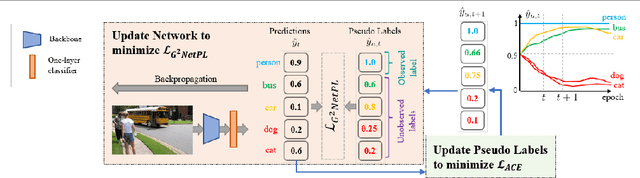
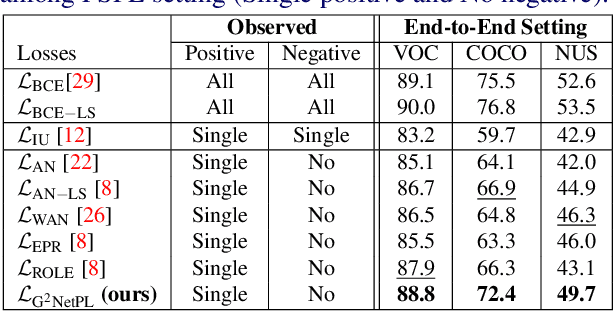
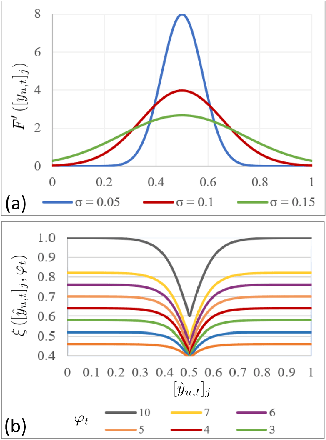
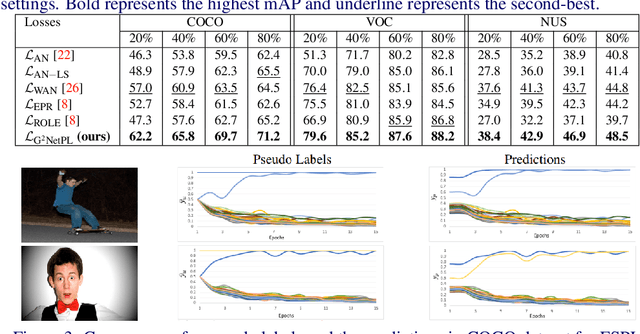
Multi-label image classification aims to predict all possible labels in an image. It is usually formulated as a partial-label learning problem, since it could be expensive in practice to annotate all the labels in every training image. Existing works on partial-label learning focus on the case where each training image is labeled with only a subset of its positive/negative labels. To effectively address partial-label classification, this paper proposes an end-to-end Generic Game-theoretic Network (G2NetPL) for partial-label learning, which can be applied to most partial-label settings, including a very challenging, but annotation-efficient case where only a subset of the training images are labeled, each with only one positive label, while the rest of the training images remain unlabeled. In G2NetPL, each unobserved label is associated with a soft pseudo label, which, together with the network, formulates a two-player non-zero-sum non-cooperative game. The objective of the network is to minimize the loss function with given pseudo labels, while the pseudo labels will seek convergence to 1 (positive) or 0 (negative) with a penalty of deviating from the predicted labels determined by the network. In addition, we introduce a confidence-aware scheduler into the loss of the network to adaptively perform easy-to-hard learning for different labels. Extensive experiments demonstrate that our proposed G2NetPL outperforms many state-of-the-art multi-label classification methods under various partial-label settings on three different datasets.