 Add to Chrome
 Add to Firefox
 Add to Edge
Video-ToC: Video Tree-of-Cue Reasoning
Apr 22, 2026
Existing Video Large Language Models (Video LLMs) struggle with complex video understanding, exhibiting limited reasoning capabilities and potential hallucinations. In particular, these methods tend to perform reasoning solely relying on the pretrained inherent reasoning rationales whilst lacking perception-aware adaptation to the input video content. To address this, we propose \textbf{Video-ToC}, a novel video reasoning framework that enhances video understanding through tree-of-cue reasoning. Specifically, our approach introduces three key innovations: (1) A tree-guided visual cue localization mechanism, which endows the model with enhanced fine-grained perceptual capabilities through structured reasoning patterns; (2) A reasoning-demand reward mechanism, which dynamically adjusts the reward value for reinforcement learning (RL) based on the estimation of reasoning demands, enabling on-demand incentives for more effective reasoning strategies; and (3) An automated annotation pipeline that constructs the Video-ToC-SFT-1k and Video-ToC-RL-2k datasets for supervised fine-tuning (SFT) and RL training, respectively. Extensive evaluations on six video understanding benchmarks and a video hallucination benchmark demonstrate the superiority of Video-ToC over baselines and recent methods. Code is available at https://github.com/qizhongtan/Video-ToC.

D$^2$ST-Adapter: Disentangled-and-Deformable Spatio-Temporal Adapter for Few-shot Action Recognition
Dec 03, 2023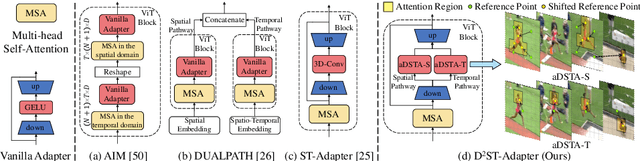
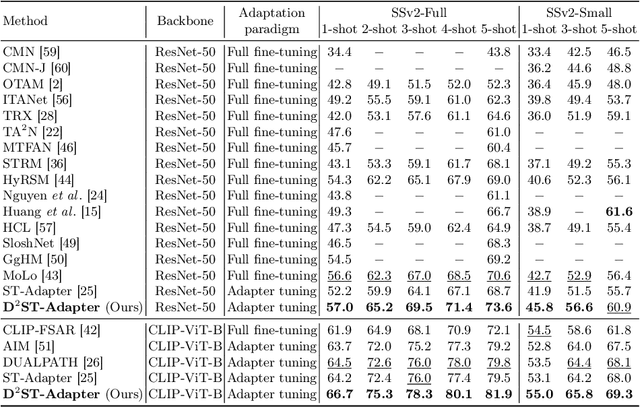
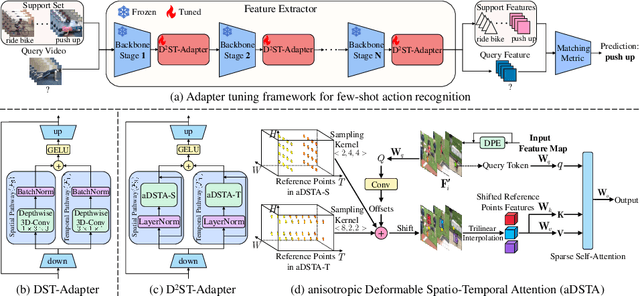
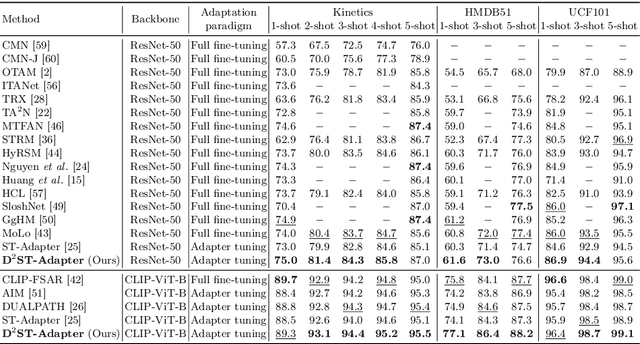
Adapting large pre-trained image models to few-shot action recognition has proven to be an effective and efficient strategy for learning robust feature extractors, which is essential for few-shot learning. Typical fine-tuning based adaptation paradigm is prone to overfitting in the few-shot learning scenarios and offers little modeling flexibility for learning temporal features in video data. In this work we present the Disentangled-and-Deformable Spatio-Temporal Adapter (D$^2$ST-Adapter), a novel adapter tuning framework for few-shot action recognition, which is designed in a dual-pathway architecture to encode spatial and temporal features in a disentangled manner. Furthermore, we devise the Deformable Spatio-Temporal Attention module as the core component of D$^2$ST-Adapter, which can be tailored to model both spatial and temporal features in corresponding pathways, allowing our D$^2$ST-Adapter to encode features in a global view in 3D spatio-temporal space while maintaining a lightweight design. Extensive experiments with instantiations of our method on both pre-trained ResNet and ViT demonstrate the superiority of our method over state-of-the-art methods for few-shot action recognition. Our method is particularly well-suited to challenging scenarios where temporal dynamics are critical for action recognition.