 Add to Chrome
 Add to Firefox
 Add to Edge
Massive Editing for Large Language Models Based on Dynamic Weight Generation
Dec 17, 2025
Knowledge Editing (KE) is a field that studies how to modify some knowledge in Large Language Models (LLMs) at a low cost (compared to pre-training). Currently, performing large-scale edits on LLMs while ensuring the Reliability, Generality, and Locality metrics of the edits remain a challenge. This paper proposes a Massive editing approach for LLMs based on dynamic weight Generation (MeG). Our MeG involves attaching a dynamic weight neuron to specific layers of the LLMs and using a diffusion model to conditionally generate the weights of this neuron based on the input query required for the knowledge. This allows the use of adding a single dynamic weight neuron to achieve the goal of large-scale knowledge editing. Experiments show that our MeG can significantly improve the performance of large-scale KE in terms of Reliability, Generality, and Locality metrics compared to existing knowledge editing methods, particularly with a high percentage point increase in the absolute value index for the Locality metric, demonstrating the advantages of our proposed method.

Towards Top-Down Reasoning: An Explainable Multi-Agent Approach for Visual Question Answering
Nov 29, 2023
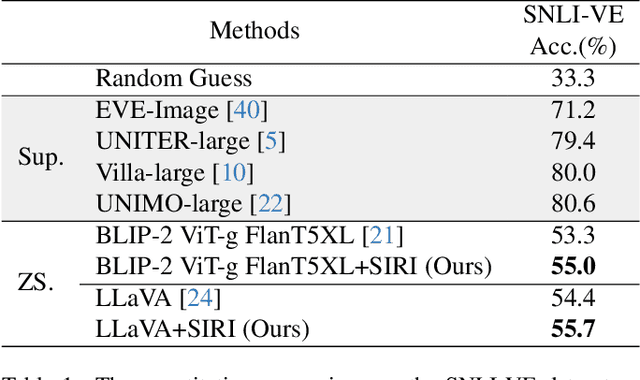
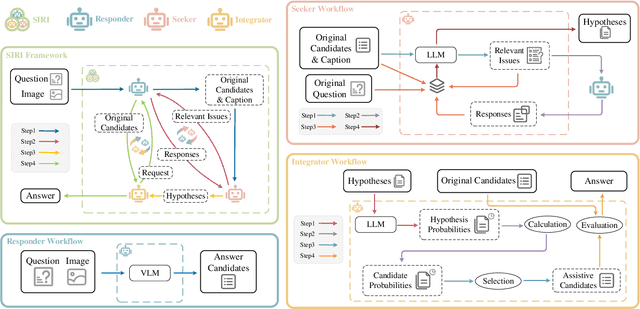
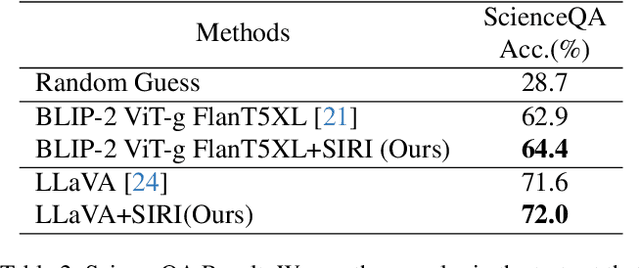
Recently, Vision Language Models (VLMs) have gained significant attention, exhibiting notable advancements across various tasks by leveraging extensive image-text paired data. However, prevailing VLMs often treat Visual Question Answering (VQA) as perception tasks, employing black-box models that overlook explicit modeling of relationships between different questions within the same visual scene. Moreover, the existing VQA methods that rely on Knowledge Bases (KBs) might frequently encounter biases from limited data and face challenges in relevant information indexing. Attempt to overcome these limitations, this paper introduces an explainable multi-agent collaboration framework by tapping into knowledge embedded in Large Language Models (LLMs) trained on extensive corpora. Inspired by human cognition, our framework uncovers latent information within the given question by employing three agents, i.e., Seeker, Responder, and Integrator, to perform a top-down reasoning process. The Seeker agent generates relevant issues related to the original question. The Responder agent, based on VLM, handles simple VQA tasks and provides candidate answers. The Integrator agent combines information from the Seeker agent and the Responder agent to produce the final VQA answer. Through the above collaboration mechanism, our framework explicitly constructs a multi-view knowledge base for a specific image scene, reasoning answers in a top-down processing manner. We extensively evaluate our method on diverse VQA datasets and VLMs, demonstrating its broad applicability and interpretability with comprehensive experimental results.