 Add to Chrome
 Add to Firefox
 Add to Edge
LayerTracer: A Joint Task-Particle and Vulnerable-Layer Analysis framework for Arbitrary Large Language Model Architectures
Apr 22, 2026
Currently, Large Language Models (LLMs) feature a diversified architectural landscape, including traditional Transformer, GateDeltaNet, and Mamba. However, the evolutionary laws of hierarchical representations, task knowledge formation positions, and network robustness bottleneck mechanisms in various LLM architectures remain unclear, posing core challenges for hybrid architecture design and model optimization. This paper proposes LayerTracer, an architecture-agnostic end-to-end analysis framework compatible with any LLM architecture. By extracting hidden states layer-by-layer and mapping them to vocabulary probability distributions, it achieves joint analysis of task particle localization and layer vulnerability quantification. We define the task particle as the key layer where the target token probability first rises significantly, representing the model's task execution starting point, and the vulnerable layer is defined as the layer with the maximum Jensen-Shannon (JS) divergence between output distributions before and after mask perturbation, reflecting its sensitivity to disturbances. Experiments on models of different parameter scales show that task particles mainly appear in the deep layers of the model regardless of parameter size, while larger-parameter models exhibit stronger hierarchical robustness. LayerTracer provides a scientific basis for layer division, module ratio, and gating switching of hybrid architectures, effectively optimizing model performance. It accurately locates task-effective layers and stability bottlenecks, offering universal support for LLM structure design and interpretability research.

Towards Open-World Mobile Manipulation in Homes: Lessons from the Neurips 2023 HomeRobot Open Vocabulary Mobile Manipulation Challenge
Jul 09, 2024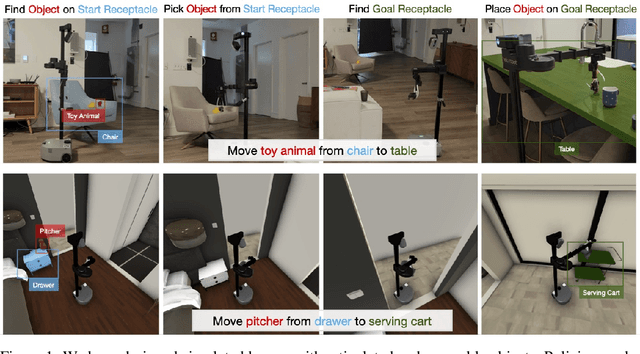


In order to develop robots that can effectively serve as versatile and capable home assistants, it is crucial for them to reliably perceive and interact with a wide variety of objects across diverse environments. To this end, we proposed Open Vocabulary Mobile Manipulation as a key benchmark task for robotics: finding any object in a novel environment and placing it on any receptacle surface within that environment. We organized a NeurIPS 2023 competition featuring both simulation and real-world components to evaluate solutions to this task. Our baselines on the most challenging version of this task, using real perception in simulation, achieved only an 0.8% success rate; by the end of the competition, the best participants achieved an 10.8\% success rate, a 13x improvement. We observed that the most successful teams employed a variety of methods, yet two common threads emerged among the best solutions: enhancing error detection and recovery, and improving the integration of perception with decision-making processes. In this paper, we detail the results and methodologies used, both in simulation and real-world settings. We discuss the lessons learned and their implications for future research. Additionally, we compare performance in real and simulated environments, emphasizing the necessity for robust generalization to novel settings.