 Add to Chrome
 Add to Firefox
 Add to Edge
Vectra: A New Metric, Dataset, and Model for Visual Quality Assessment in E-Commerce In-Image Machine Translation
Jan 31, 2026
In-Image Machine Translation (IIMT) powers cross-border e-commerce product listings; existing research focuses on machine translation evaluation, while visual rendering quality is critical for user engagement. When facing context-dense product imagery and multimodal defects, current reference-based methods (e.g., SSIM, FID) lack explainability, while model-as-judge approaches lack domain-grounded, fine-grained reward signals. To bridge this gap, we introduce Vectra, to the best of our knowledge, the first reference-free, MLLM-driven visual quality assessment framework for e-commerce IIMT. Vectra comprises three components: (1) Vectra Score, a multidimensional quality metric system that decomposes visual quality into 14 interpretable dimensions, with spatially-aware Defect Area Ratio (DAR) quantification to reduce annotation ambiguity; (2) Vectra Dataset, constructed from 1.1M real-world product images via diversity-aware sampling, comprising a 2K benchmark for system evaluation, 30K reasoning-based annotations for instruction tuning, and 3.5K expert-labeled preferences for alignment and evaluation; and (3) Vectra Model, a 4B-parameter MLLM that generates both quantitative scores and diagnostic reasoning. Experiments demonstrate that Vectra achieves state-of-the-art correlation with human rankings, and our model outperforms leading MLLMs, including GPT-5 and Gemini-3, in scoring performance. The dataset and model will be released upon acceptance.

Auto-Augmentation Contrastive Learning for Wearable-based Human Activity Recognition
Jan 30, 2026For low-semantic sensor signals from human activity recognition (HAR), contrastive learning (CL) is essential to implement novel applications or generic models without manual annotation, which is a high-performance self-supervised learning (SSL) method. However, CL relies heavily on data augmentation for pairwise comparisons. Especially for low semantic data in the HAR area, conducting good performance augmentation strategies in pretext tasks still rely on manual attempts lacking generalizability and flexibility. To reduce the augmentation burden, we propose an end-to-end auto-augmentation contrastive learning (AutoCL) method for wearable-based HAR. AutoCL is based on a Siamese network architecture that shares the parameters of the backbone and with a generator embedded to learn auto-augmentation. AutoCL trains the generator based on the representation in the latent space to overcome the disturbances caused by noise and redundant information in raw sensor data. The architecture empirical study indicates the effectiveness of this design. Furthermore, we propose a stop-gradient design and correlation reduction strategy in AutoCL to enhance encoder representation learning. Extensive experiments based on four wide-used HAR datasets demonstrate that the proposed AutoCL method significantly improves recognition accuracy compared with other SOTA methods.
Methodological Explainability Evaluation of an Interpretable Deep Learning Model for Post-Hepatectomy Liver Failure Prediction Incorporating Counterfactual Explanations and Layerwise Relevance Propagation: A Prospective In Silico Trial
Aug 07, 2024
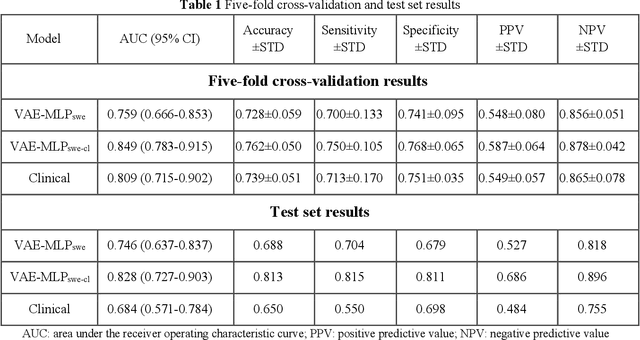


Artificial intelligence (AI)-based decision support systems have demonstrated value in predicting post-hepatectomy liver failure (PHLF) in hepatocellular carcinoma (HCC). However, they often lack transparency, and the impact of model explanations on clinicians' decisions has not been thoroughly evaluated. Building on prior research, we developed a variational autoencoder-multilayer perceptron (VAE-MLP) model for preoperative PHLF prediction. This model integrated counterfactuals and layerwise relevance propagation (LRP) to provide insights into its decision-making mechanism. Additionally, we proposed a methodological framework for evaluating the explainability of AI systems. This framework includes qualitative and quantitative assessments of explanations against recognized biomarkers, usability evaluations, and an in silico clinical trial. Our evaluations demonstrated that the model's explanation correlated with established biomarkers and exhibited high usability at both the case and system levels. Furthermore, results from the three-track in silico clinical trial showed that clinicians' prediction accuracy and confidence increased when AI explanations were provided.