 Add to Chrome
 Add to Firefox
 Add to Edge
Network-Aware Bilinear Tokenization for Brain Functional Connectivity Representation Learning
May 13, 2026
Masked autoencoders (MAEs) have recently shown promise for self-supervised representation learning of resting-state brain functional connectivity (FC). However, a fundamental question remains unresolved: how should FC matrices be tokenized to align with the intrinsic modular organization of large-scale brain networks? Existing approaches typically adopt region-centric or graph-based schemes that treat FC as structurally homogeneous elements and overlook the large-scale network brain organization. We introduce NERVE (Network-Aware Representations of Brain Functional Connectivity via Bilinear Tokenization), a self-supervised learning framework that redefines FC tokenization by partitioning FC matrices into patches of intra- and inter-network connectivity blocks. Unlike image-based MAE, where fixed-size patches share a common tokenizer, FC patches defined by network pairs are heterogeneous in size and correspond to distinct functional roles. To resolve this problem, NERVE embeds FC patches through a novel structured bilinear factorization. This formulation preserves network identity and reduces parameter complexity from quadratic to linear scaling in the number of networks. We evaluate NERVE across three large-scale developmental cohorts (ABCD, PNC, and CCNP) for behavior and psychopathology prediction. Compared to structurally agnostic MAE variants and graph-based self-supervised baselines, the proposed network-aware formulation yields more stable and transferable representations, particularly in cross-cohort evaluation. Ablation studies confirm that the proposed bilinear network embedding and anatomically grounded parcellation are critical for performance. These findings highlight the importance of incorporating domain-specific structural priors into self-supervised learning for functional connectomics.

SUGAR: Spherical Ultrafast Graph Attention Framework for Cortical Surface Registration
Jul 02, 2023
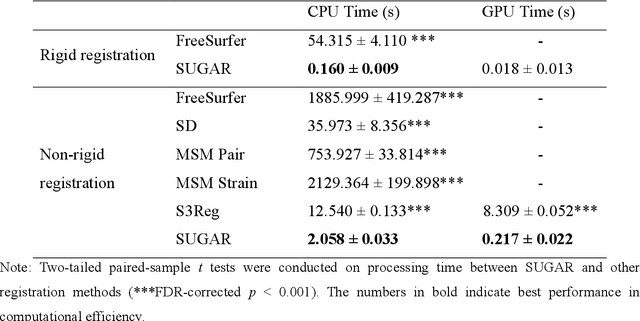

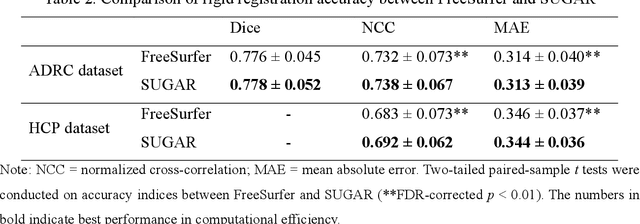
Cortical surface registration plays a crucial role in aligning cortical functional and anatomical features across individuals. However, conventional registration algorithms are computationally inefficient. Recently, learning-based registration algorithms have emerged as a promising solution, significantly improving processing efficiency. Nonetheless, there remains a gap in the development of a learning-based method that exceeds the state-of-the-art conventional methods simultaneously in computational efficiency, registration accuracy, and distortion control, despite the theoretically greater representational capabilities of deep learning approaches. To address the challenge, we present SUGAR, a unified unsupervised deep-learning framework for both rigid and non-rigid registration. SUGAR incorporates a U-Net-based spherical graph attention network and leverages the Euler angle representation for deformation. In addition to the similarity loss, we introduce fold and multiple distortion losses, to preserve topology and minimize various types of distortions. Furthermore, we propose a data augmentation strategy specifically tailored for spherical surface registration, enhancing the registration performance. Through extensive evaluation involving over 10,000 scans from 7 diverse datasets, we showed that our framework exhibits comparable or superior registration performance in accuracy, distortion, and test-retest reliability compared to conventional and learning-based methods. Additionally, SUGAR achieves remarkable sub-second processing times, offering a notable speed-up of approximately 12,000 times in registering 9,000 subjects from the UK Biobank dataset in just 32 minutes. This combination of high registration performance and accelerated processing time may greatly benefit large-scale neuroimaging studies.