 Add to Chrome
 Add to Firefox
 Add to Edge
Beyond Average Performance: Dynamic Instance Clustering and Specialized Algorithm Design in LLM-Assisted Evolutionary Search
Aug 04, 2026
Large Language Model-assisted Evolutionary Search (LES) has emerged as a powerful paradigm for automated algorithm design. However, existing LES methods primarily optimize for average performance, inherently directing search effort toward instances that contribute most to this metric while leaving others poorly served, resulting in weak tail robustness and limited real-world reliability. To address this limitation, we propose Dynamic Instance Clustering and Specialized Algorithm Design (DyCA), an LES framework with a feature-free, structure-aware mechanism for constructing reliable algorithm portfolios under heterogeneous instance distributions. DyCA treats instance clustering as a co-evolving component within the search process, reusing accumulated evaluation data as feature-free signals to progressively partition instances with similar algorithmic response patterns. The uncovered clusters decompose the mixed objective into a set of structure-aware sub-objectives, thereby enabling finer-grained and more adaptive guidance for specialized algorithm design. Experimental results across four algorithm design tasks with heterogeneous instances demonstrate that DyCA outperforms state-of-the-art LES baselines, improving tail robustness by an average of 15.2\% and overall performance by 7.1\% while maintaining competitive head performance.

Discovering Interpretable Programmatic Policies via Multimodal LLM-assisted Evolutionary Search
Aug 07, 2025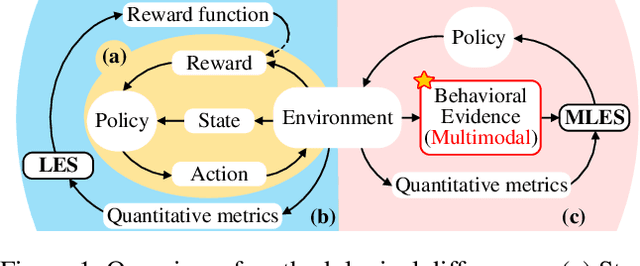
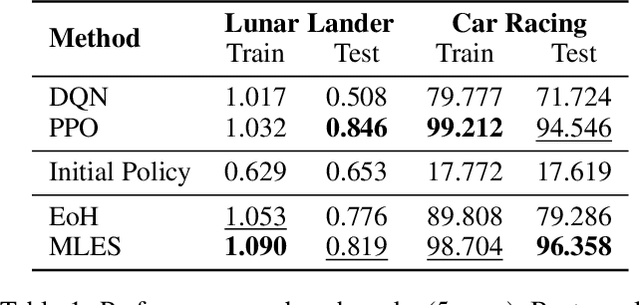
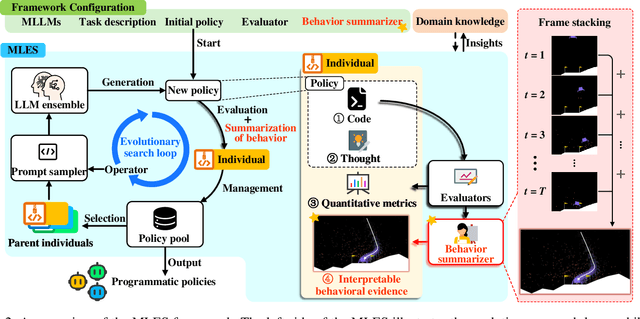
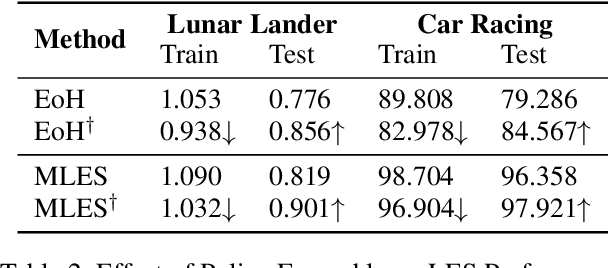
Interpretability and high performance are essential goals in designing control policies, particularly for safety-critical tasks. Deep reinforcement learning has greatly enhanced performance, yet its inherent lack of interpretability often undermines trust and hinders real-world deployment. This work addresses these dual challenges by introducing a novel approach for programmatic policy discovery, called Multimodal Large Language Model-assisted Evolutionary Search (MLES). MLES utilizes multimodal large language models as policy generators, combining them with evolutionary mechanisms for automatic policy optimization. It integrates visual feedback-driven behavior analysis within the policy generation process to identify failure patterns and facilitate targeted improvements, enhancing the efficiency of policy discovery and producing adaptable, human-aligned policies. Experimental results show that MLES achieves policy discovery capabilities and efficiency comparable to Proximal Policy Optimization (PPO) across two control tasks, while offering transparent control logic and traceable design processes. This paradigm overcomes the limitations of predefined domain-specific languages, facilitates knowledge transfer and reuse, and is scalable across various control tasks. MLES shows promise as a leading approach for the next generation of interpretable control policy discovery.