 Add to Chrome
 Add to Firefox
 Add to Edge
MultiUAV-Plat: An LLM-Oriented Platform, Benchmark and Framework for Multi-UAV Collaborative Task Planning
Jun 30, 2026
Large language models (LLMs) provide a promising interface for high-level robotic task planning, but their use in multi-UAV collaboration remains difficult to evaluate systematically. Existing UAV simulators mainly emphasize dynamics, perception, or low-level control, while existing LLM-agent benchmarks rarely capture aerial-robotics constraints such as partial observability, spatial coverage, UAV assignment, and multi-vehicle coordination. To bridge this gap, we present MultiUAV-Plat, a lightweight, easy-to-use, LLM-agent-oriented simulation platform for multi-UAV collaborative task planning. The platform exposes concise RESTful APIs, agent-facing observations, role-based information access, hidden validation logic, and optional 2D/3D visualization, allowing agents to solve missions through realistic tool interaction rather than privileged simulator access. Built on this platform, the MultiUAV-Plat Benchmark contains 75 mission sessions, 1500 natural-language tasks, and 9396 validation checks across target assignment, area search, and area assignment and patrol scenarios. We further propose Agent4Drone, a task-specific LLM agent framework that structures multi-UAV behavior into memory, observation, task understanding, planning, execution, and verification. In a full paired benchmark comparison, Agent4Drone achieves a 57.9% task pass rate, a 74.6% average task check pass rate, and a 72.0% global check pass rate, substantially outperforming a ReAct baseline at 30.6%, 47.9%, and 43.1%, respectively. Agent4Drone also reduces the total failed task rate from 32.4% to 12.9%. These results demonstrate that MultiUAV-Plat and MultiUAV-Plat Benchmark provide a reproducible foundation for studying LLM-driven multi-UAV autonomy under realistic information and execution constraints.

Improving Image Clustering through Sample Ranking and Its Application to remote--sensing images
Sep 26, 2022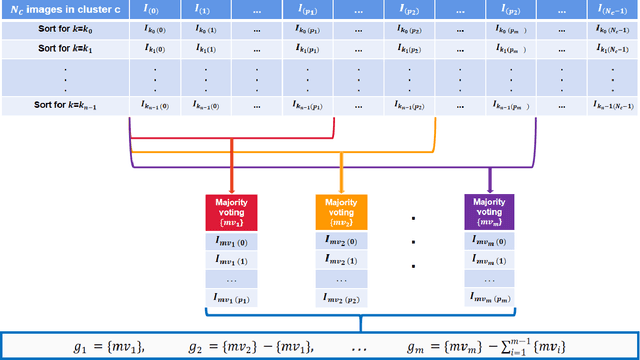

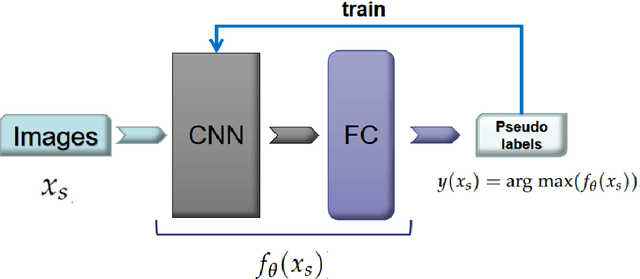
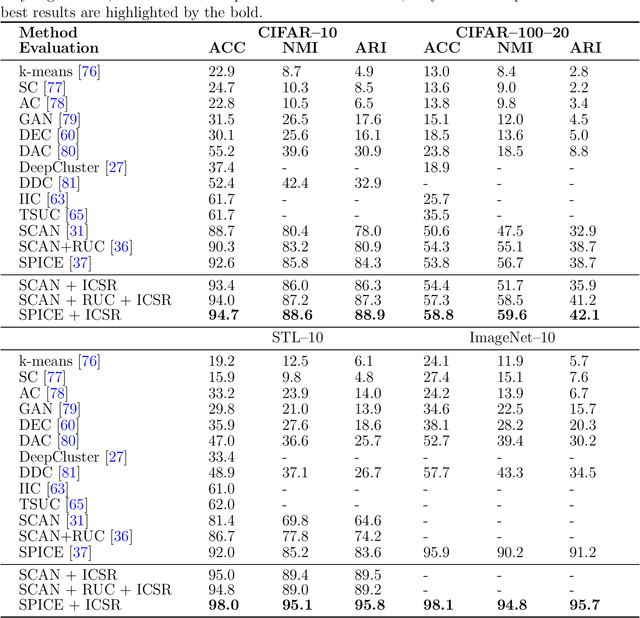
Image clustering is a very useful technique that is widely applied to various areas, including remote sensing. Recently, visual representations by self-supervised learning have greatly improved the performance of image clustering. To further improve the well-trained clustering models, this paper proposes a novel method by first ranking samples within each cluster based on the confidence in their belonging to the current cluster and then using the ranking to formulate a weighted cross-entropy loss to train the model. For ranking the samples, we developed a method for computing the likelihood of samples belonging to the current clusters based on whether they are situated in densely populated neighborhoods, while for training the model, we give a strategy for weighting the ranked samples. We present extensive experimental results that demonstrate that the new technique can be used to improve the State-of-the-Art image clustering models, achieving accuracy performance gains ranging from $2.1\%$ to $15.9\%$. Performing our method on a variety of datasets from remote sensing, we show that our method can be effectively applied to remote--sensing images.
* 39
On Designing Good Representation Learning Models
Aug 06, 2021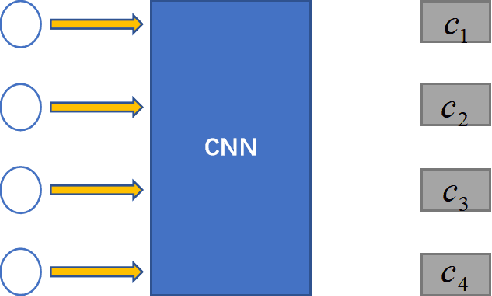
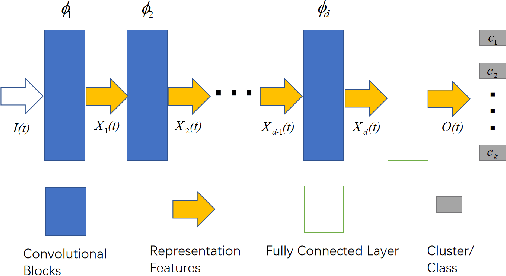
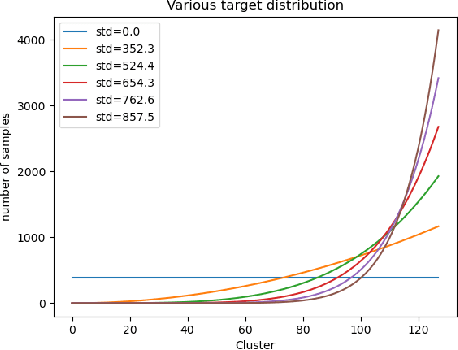
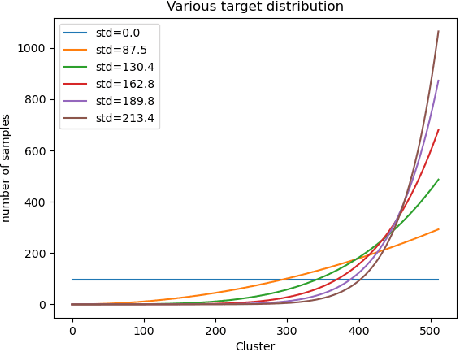
The goal of representation learning is different from the ultimate objective of machine learning such as decision making, it is therefore very difficult to establish clear and direct objectives for training representation learning models. It has been argued that a good representation should disentangle the underlying variation factors, yet how to translate this into training objectives remains unknown. This paper presents an attempt to establish direct training criterions and design principles for developing good representation learning models. We propose that a good representation learning model should be maximally expressive, i.e., capable of distinguishing the maximum number of input configurations. We formally define expressiveness and introduce the maximum expressiveness (MEXS) theorem of a general learning model. We propose to train a model by maximizing its expressiveness while at the same time incorporating general priors such as model smoothness. We present a conscience competitive learning algorithm which encourages the model to reach its MEXS whilst at the same time adheres to model smoothness prior. We also introduce a label consistent training (LCT) technique to boost model smoothness by encouraging it to assign consistent labels to similar samples. We present extensive experimental results to show that our method can indeed design representation learning models capable of developing representations that are as good as or better than state of the art. We also show that our technique is computationally efficient, robust against different parameter settings and can work effectively on a variety of datasets. Code available at https://github.com/qlilx/odgrlm.git