 Add to Chrome
 Add to Firefox
 Add to Edge
Dual-Loop Control in DCVerse: Advancing Reliable Deployment of AI in Data Centers via Digital Twins
Apr 08, 2026
The growing scale and complexity of modern data centers present major challenges in balancing energy efficiency with outage risk. Although Deep Reinforcement Learning (DRL) shows strong potential for intelligent control, its deployment in mission-critical systems is limited by data scarcity and the lack of real-time pre-evaluation mechanisms. This paper introduces the Dual-Loop Control Framework (DLCF), a digital twin-based architecture designed to overcome these challenges. The framework comprises three core entities: the physical system, a digital twin, and a policy reservoir of diverse DRL agents. These components interact through a dual-loop mechanism involving real-time data acquisition, data assimilation, DRL policy training, pre-evaluation, and expert verification. Theoretical analysis shows how DLCF can improve sample efficiency, generalization, safety, and optimality. Leveraging DLCF, we implemented the DCVerse platform and validated it through case studies on a real-world data center cooling system. The evaluation shows that our approach achieves up to 4.09% energy savings over conventional control strategies without violating SLA requirements. Additionally, the framework improves policy interpretability and supports more trustworthy DRL deployment. This work provides a foundation for reliable AI-based control in data centers and points toward future extensions for holistic, system-wide optimization.

Toward Physics-Informed Machine Learning for Data Center Operations: A Tropical Case Study
May 26, 2025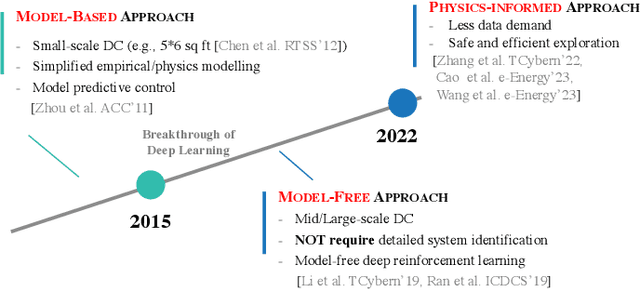
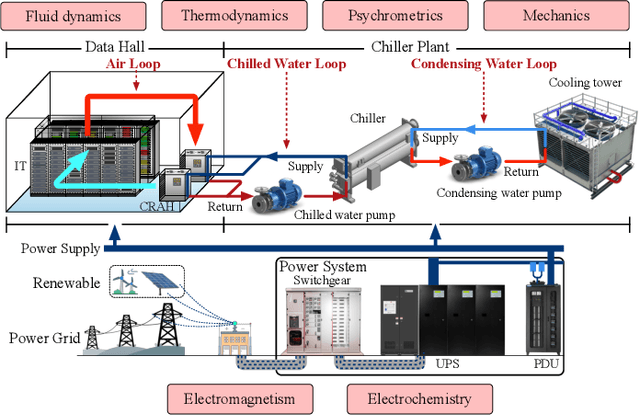
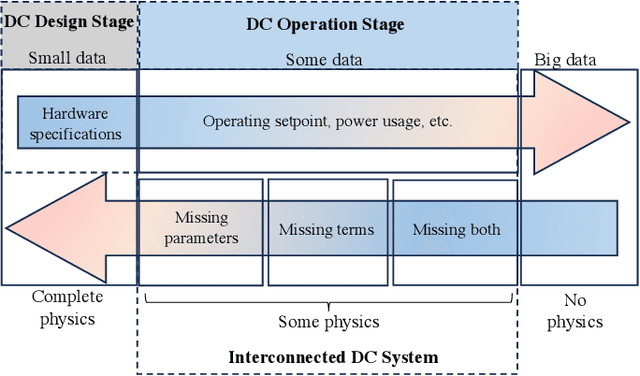
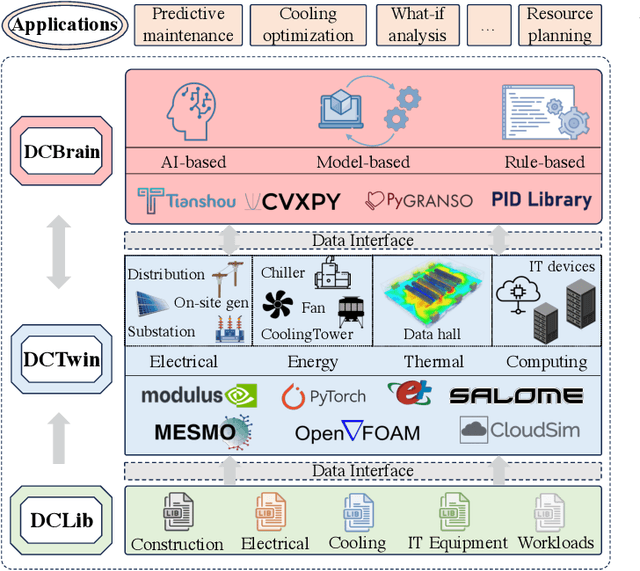
Data centers are the backbone of computing capacity. Operating data centers in the tropical regions faces unique challenges due to consistently high ambient temperature and elevated relative humidity throughout the year. These conditions result in increased cooling costs to maintain the reliability of the computing systems. While existing machine learning-based approaches have demonstrated potential to elevate operations to a more proactive and intelligent level, their deployment remains dubious due to concerns about model extrapolation capabilities and associated system safety issues. To address these concerns, this article proposes incorporating the physical characteristics of data centers into traditional data-driven machine learning solutions. We begin by introducing the data center system, including the relevant multiphysics processes and the data-physics availability. Next, we outline the associated modeling and optimization problems and propose an integrated, physics-informed machine learning system to address them. Using the proposed system, we present relevant applications across varying levels of operational intelligence. A case study on an industry-grade tropical data center is provided to demonstrate the effectiveness of our approach. Finally, we discuss key challenges and highlight potential future directions.