 Add to Chrome
 Add to Firefox
 Add to Edge
Dual-Loop Control in DCVerse: Advancing Reliable Deployment of AI in Data Centers via Digital Twins
Apr 08, 2026
The growing scale and complexity of modern data centers present major challenges in balancing energy efficiency with outage risk. Although Deep Reinforcement Learning (DRL) shows strong potential for intelligent control, its deployment in mission-critical systems is limited by data scarcity and the lack of real-time pre-evaluation mechanisms. This paper introduces the Dual-Loop Control Framework (DLCF), a digital twin-based architecture designed to overcome these challenges. The framework comprises three core entities: the physical system, a digital twin, and a policy reservoir of diverse DRL agents. These components interact through a dual-loop mechanism involving real-time data acquisition, data assimilation, DRL policy training, pre-evaluation, and expert verification. Theoretical analysis shows how DLCF can improve sample efficiency, generalization, safety, and optimality. Leveraging DLCF, we implemented the DCVerse platform and validated it through case studies on a real-world data center cooling system. The evaluation shows that our approach achieves up to 4.09% energy savings over conventional control strategies without violating SLA requirements. Additionally, the framework improves policy interpretability and supports more trustworthy DRL deployment. This work provides a foundation for reliable AI-based control in data centers and points toward future extensions for holistic, system-wide optimization.

Fusion Intelligence for Digital Twinning AI Data Centers: A Synergistic GenAI-PhyAI Approach
May 26, 2025The explosion in artificial intelligence (AI) applications is pushing the development of AI-dedicated data centers (AIDCs), creating management challenges that traditional methods and standalone AI solutions struggle to address. While digital twins are beneficial for AI-based design validation and operational optimization, current AI methods for their creation face limitations. Specifically, physical AI (PhyAI) aims to capture the underlying physical laws, which demands extensive, case-specific customization, and generative AI (GenAI) can produce inaccurate or hallucinated results. We propose Fusion Intelligence, a novel framework synergizing GenAI's automation with PhyAI's domain grounding. In this dual-agent collaboration, GenAI interprets natural language prompts to generate tokenized AIDC digital twins. Subsequently, PhyAI optimizes these generated twins by enforcing physical constraints and assimilating real-time data. Case studies demonstrate the advantages of our framework in automating the creation and validation of AIDC digital twins. These twins deliver predictive analytics to support power usage effectiveness (PUE) optimization in the design stage. With operational data collected, the digital twin accuracy is further improved compared with pure physics-based models developed by human experts. Fusion Intelligence offers a promising pathway to accelerate digital transformation. It enables more reliable and efficient AI-driven digital transformation for a broad range of mission-critical infrastructures.
Transforming Future Data Center Operations and Management via Physical AI
Apr 07, 2025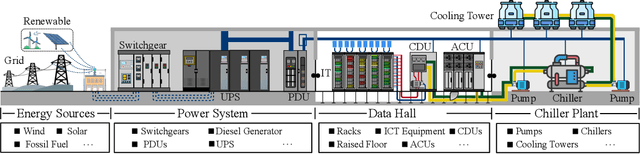
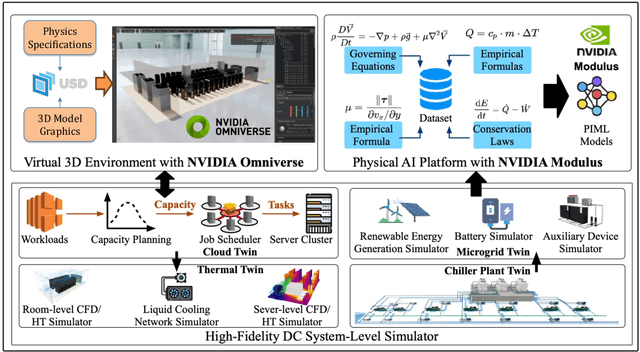
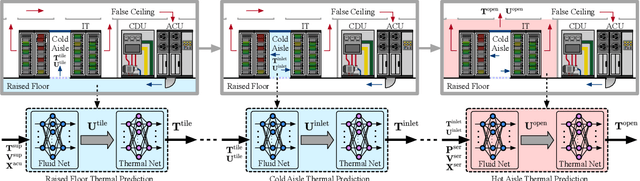
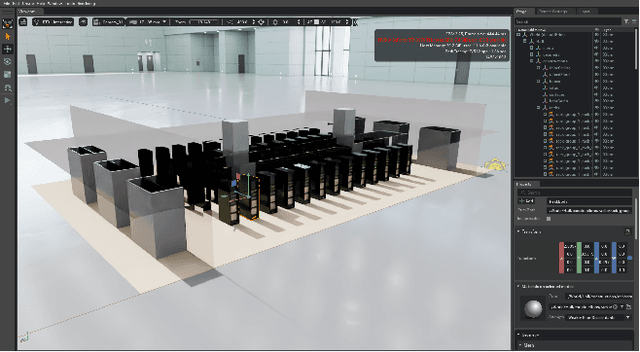
Data centers (DCs) as mission-critical infrastructures are pivotal in powering the growth of artificial intelligence (AI) and the digital economy. The evolution from Internet DC to AI DC has introduced new challenges in operating and managing data centers for improved business resilience and reduced total cost of ownership. As a result, new paradigms, beyond the traditional approaches based on best practices, must be in order for future data centers. In this research, we propose and develop a novel Physical AI (PhyAI) framework for advancing DC operations and management. Our system leverages the emerging capabilities of state-of-the-art industrial products and our in-house research and development. Specifically, it presents three core modules, namely: 1) an industry-grade in-house simulation engine to simulate DC operations in a highly accurate manner, 2) an AI engine built upon NVIDIA PhysicsNemo for the training and evaluation of physics-informed machine learning (PIML) models, and 3) a digital twin platform built upon NVIDIA Omniverse for our proposed 5-tier digital twin framework. This system presents a scalable and adaptable solution to digitalize, optimize, and automate future data center operations and management, by enabling real-time digital twins for future data centers. To illustrate its effectiveness, we present a compelling case study on building a surrogate model for predicting the thermal and airflow profiles of a large-scale DC in a real-time manner. Our results demonstrate its superior performance over traditional time-consuming Computational Fluid Dynamics/Heat Transfer (CFD/HT) simulation, with a median absolute temperature prediction error of 0.18 {\deg}C. This emerging approach would open doors to several potential research directions for advancing Physical AI in future DC operations.