 Add to Chrome
 Add to Firefox
 Add to Edge
M3D-Stereo: A Multiple-Medium and Multiple-Degradation Dataset for Stereo Image Restoration
Apr 14, 2026
Image restoration under adverse conditions, such as underwater, haze or fog, and low-light environments, remains a highly challenging problem due to complex physical degradations and severe information loss. Existing datasets are predominantly limited to a single degradation type or heavily rely on synthetic data without stereo consistency, inherently restricting their applicability in real-world scenarios. To address this, we introduce M3D-Stereo, a stereo dataset with 7904 high-resolution image pairs for image restoration research acquired in multiple media with multiple controlled degradation levels. It encompasses four degradation scenarios: underwater scatter, haze/fog, underwater low-light, and haze low-light. Each scenario forms a subset, and is divided into six levels of progressive degradation, allowing fine-grained evaluations of restoration methods with increasing severity of degradation. Collected via a laboratory setup, the dataset provides aligned stereo image pairs along with their pixel-wise consistent clear ground truths. Two restoration tasks, single-level and mixed-level degradation, were performed to verify its validity. M3D-Stereo establishes a better controlled and more realistic benchmark to evaluate image restoration and stereo matching methods in complex degradation environments. It is made public under LGPLv3 license.

ProPL: Universal Semi-Supervised Ultrasound Image Segmentation via Prompt-Guided Pseudo-Labeling
Nov 19, 2025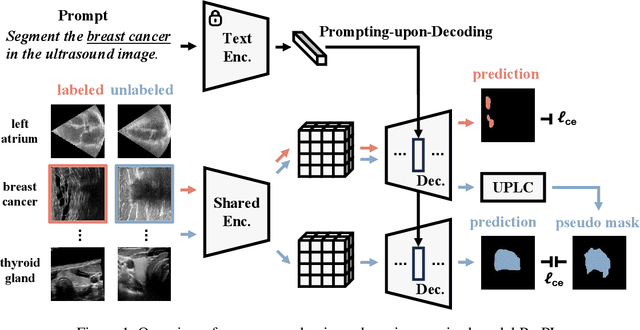
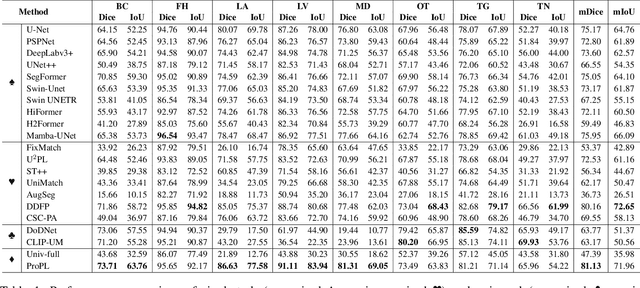
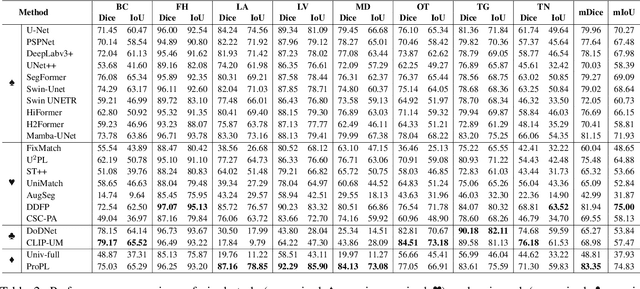
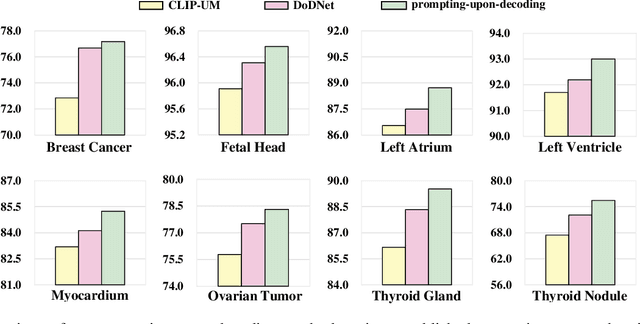
Existing approaches for the problem of ultrasound image segmentation, whether supervised or semi-supervised, are typically specialized for specific anatomical structures or tasks, limiting their practical utility in clinical settings. In this paper, we pioneer the task of universal semi-supervised ultrasound image segmentation and propose ProPL, a framework that can handle multiple organs and segmentation tasks while leveraging both labeled and unlabeled data. At its core, ProPL employs a shared vision encoder coupled with prompt-guided dual decoders, enabling flexible task adaptation through a prompting-upon-decoding mechanism and reliable self-training via an uncertainty-driven pseudo-label calibration (UPLC) module. To facilitate research in this direction, we introduce a comprehensive ultrasound dataset spanning 5 organs and 8 segmentation tasks. Extensive experiments demonstrate that ProPL outperforms state-of-the-art methods across various metrics, establishing a new benchmark for universal ultrasound image segmentation.